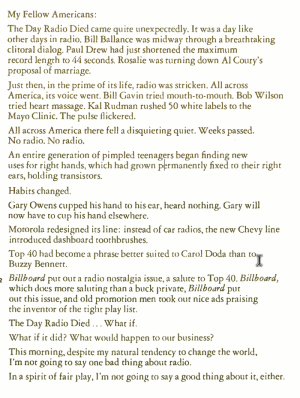
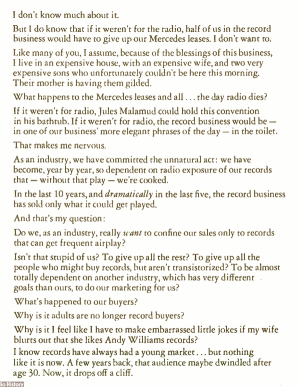
This is the first two pages of a speech by Stan Cornyn of RCA from the NARM convention in 1975.
You can see the full speech at
MID CENTURY RADIO COLLECTION: Unique or short-run publications. It's worth reading both for the ideas and the marvelous use of our English language. And it comments on music's then dependency on radio, the record industry's focus only on young buyers and a lot more.
View attachment 11835
View attachment 11836
A select quote from Cornyn is
"When it comes to racing into any new technology, the record business finishes just ahead of the Amish." Maybe that, today, can be applied to the radio business.
Though I am sure we are meant to take these words rhetorically, I would point out that by the mid 1960s the so-called "adult" audience was sated. They had all the records they wanted, and really much more than they could have ever dreamed they might have. Though it might have been only 20, 40, or 60 LPs. They had grown up with network radio and kept listening long after the networks had ceased to entertain on radio. After say 1963 most of the record buying, including of MOR artists, was done by young people. Oh listeners in their 50s and 50s might occasionally add something they found striking or important to their collections, but surveys show that only half of all adults were still buying recordings in 1966 while 82 percent of teenagers were actively engaged in that pursuit.
Because of that fact MOR artists still active were mostly hustled by recording companies into making youth-oriented tunes hoping the young generation still buying would accept them and acquire them. Which they did not always feel comfortable with. And doubfful that youthful buyers were going for Andy Williams or Frankie Laine or Doris Day doing White Rabbit or Born To Be Wild.
Another factor was that a recording company had to lay out a lot of money for musicians and arrangers to make the kind of full orchestral sessions MOR artists were accustomed to. Much greater savings in going with a small guitar band or a few studio instrumentalists or by purchasing masters already produced and recorded by others.
George Melachrino died in 1965, Hugo Winterhalter in 1973. Mantovani and Hugo Montenegro retired from recording in 1975, Percy Faith died in early '76. Andy Williams was active to about 1980. Other artists still selling in the 70s such as Ferrante and Teicher, Paul Mauriat, Roger Williams sold as well to mostly younger buyers. The over 30s never embraced Mauriat at all or Montenegro's later style both of which which they considered "rock".
So I would say quite natural that the record companies had long since set down the older generation by 1975 since they had stopped buying. There was still product that older listeners might have been interested in being made in England and Europe to the mid 1980s which for the most part American buyers did not have access to. I can remember a number of good things available on Peters International by the later 70s and Bainbridge reissued some of Bob Shad's 1960 - 63 Time Records catalogue in the early 80s. They had few takers.
The generations which had grown up with radio in the 20s and 1930s stayed with it, gravitating to Beautiful Music stations on FM in the 1970s when MOR outlets became less and less music-oriented to the point that personality hosts no longer chose their own music, leaving that up to young aides who tended to program current Top 40 hits.
Then a funny thing happened. In the 1980s the younger agency time buyers less and less wanted the older audience. That same audience who had bought them all manner of records when they were growing up (and kids records were 10 percent of the market, sometimes more, in the 1950s and into the 60s) which went far to establishing them as regular record buyers in life!
How many Beautiful Music stations gave up the ghost in the 1980s and early 90s while they still had double digit rating shares? Granted that audience was already shrinking due to attrition and the lack of an active recording industry producing new product to support it. Which had ceased to exist because of lack of demand, as already mentioned, and because few younger music arrangers possessed the skills of the older writers most of whom had been trained in network radio. You may recall that from 1973 through the early 80s Beautiful Music syndicators such as Schulke and Bonneville commissioned their own music to obtain suitable new product or gathered together with notable stations, as you did with IBMA, for the same end. The more successful of this custom music was by arrangers who had been working before 1960, as younger men, with the exception of the brilliant Nick Ingman, had no or too little experience in setting pop music for orchestral forces.
The obvious point I am making is that the mature audience stopped buying in quantity by the mid 60s so the recording industry eventually set them aside. Without the backing of new commercial recorded product the MOR radio formats appealing to older people dried up and radio set the older audience aside as undesirable. After the death of the Beautiful Music radio in the early 1990s its audience learned to do without radio for the remaining 20, 30, 40 years of their lives. Yes after 2000 it had a revival on non-commercial internet outlets but most of its former adherents lacked the necessary technological skills to access them.
Including some of us who were still not yet 30 in 1975 when Mr. Cornyn's address was delivered. Many of us who grew up with terrestrial radio in the 1950s loving it and being excited by it have now lived half our lives without it. We have our CDs and vinyl records most or which we acquired many years ago. You may recall after the materials shortages brought about by the oil embargos of 1973 and after resulted in record companies withdrawing and deleting their catalogs how used record shops sprang up almost like magic for about 25 years. From which we were able to buy scores of 10 and 25 cent LPs of the 50s and 60s for a while. When what we cherished had not yet been isolated and marginalized as "beautiful music" or "easy listening' or "nostalgia" but was just popular or classical music.
Thank you.