
RabbitEars.Info
RabbitEars, where you can learn all about local, over-the-air TV channels.
 www.rabbitears.info
IIRC, some LG TVs have ATSC 3.0 tuners.
Kirk Bayne

www.rabbitears.info
So do some Samsung's, if you're willing to pay 3K for something that has to be connected to the Internet to work.RabbitEars.Info
RabbitEars, where you can learn all about local, over-the-air TV channels.
IIRC, some LG TVs have ATSC 3.0 tuners.
Kirk Bayne
Maybe before the pandemic we would have seen some 4K. I doubt they will go through the trouble at this point.I got the HD HomeRun 4K in their KickStarter, so I am able to watch the local ATSC 3.0 channels in Phoenix. No 4K streams...yet, but the picture and sound quality is better than their ATSC 1.0 counterparts. Maybe there will be some 4K test runs for the Olympics?
I think that's the whole idea. Get them used to using 5G internet for most things, and then wean them off of broadcast entirely.So do some Samsung's, if you're willing to pay 3K for something that has to be connected to the Internet to work.
5G is still a joke. I got a 5G phone a few months ago, and it's still not ready for prime time (T-Mobile in Mesa AZ). I called T-Mobile to complain, and the guy who took my call admitted that it's not fully operational yet.I think that's the whole idea. Get them used to using 5G internet for most things, and then wean them off of broadcast entirely.
Plus, the internet part is to bombard you with custom advertising.
So does this mean we have to get new TV's or will we still be able to watch on our older tvs
$200? Not yet. Not until I see proof that 3.0 > 1.0. That means no dropouts at 25 miles from the transmitter, and it works in a moving car. Until then, meh.^^^Amazon.com: SiliconDust HDHomeRun Flex 4K ATSC 3.0 NextGen TV: 2/4 Tuners HDFX-4K: Computers & Accessories
Amazon.com: SiliconDust HDHomeRun Flex 4K ATSC 3.0 NextGen TV: 2/4 Tuners HDFX-4K: Computers & Accessorieswww.amazon.com
Receive and watch free to air ATSC 3.0 and ATSC 1.0 TV
Kirk Bayne
I'll consider getting a 3.0 converter box when the price becomes more reasonable. Like most electronic items they will start out at a higher price and go down with time as there gets to be more demand.$200? Not yet. Not until I see proof that 3.0 > 1.0. That means no dropouts at 25 miles from the transmitter, and it works in a moving car. Until then, meh.
No, there are no plans to do away with ATSC 1.0. Sinclair and a handful of other groups have been pushing ASTC 3.0, mainly for the enhanced, targeted advertising capability.So does this mean we have to get new TV's or will we still be able to watch on our older tvs
I'm sure the day will come for 1.0 to go away, but I don't see it coming for close to a decade. It took 15 years for analog to be shut down after the first ATSC 1.0 tests began.No, there are no plans to do away with ATSC 1.0. Sinclair and a handful of other groups have been pushing ASTC 3.0, mainly for the enhanced, targeted advertising capability.
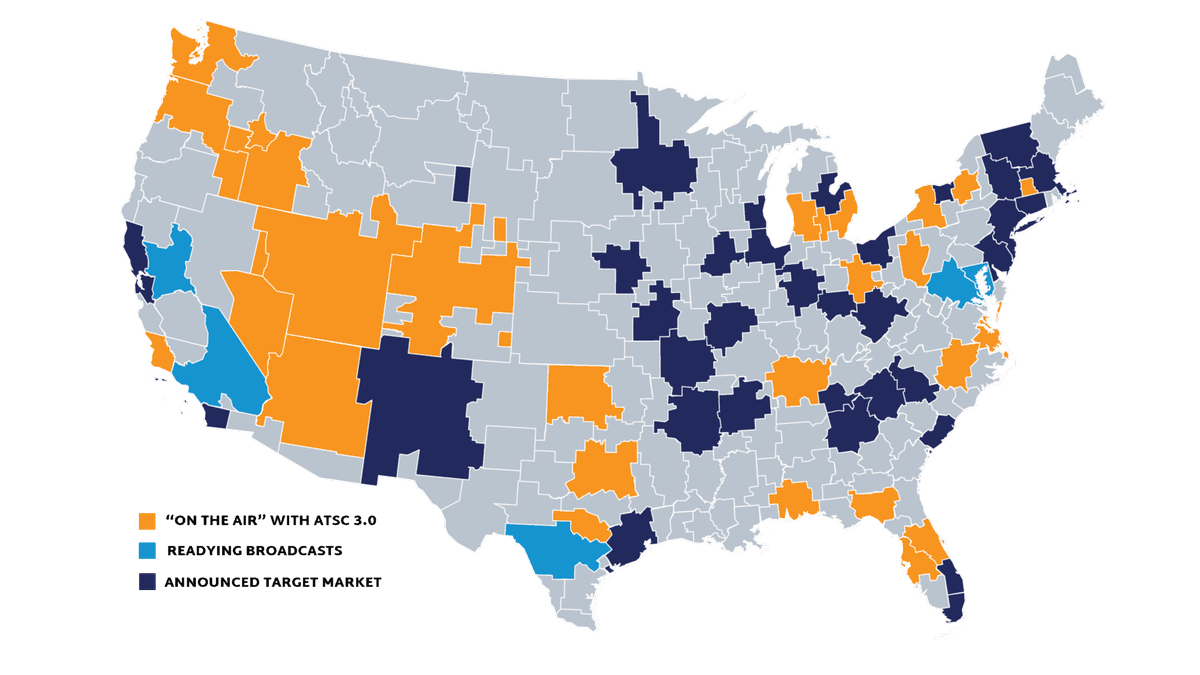
The requirement to be connected to the Internet is more than just the targeted advertising component. Program schedules for the stations carried within the ATSC 3.0 streams are via the Internet. Also, if UHD or 4K programming is available, that stream is obtained via the Internet connection, along with any firmware/software updates to the receiver.Points of clarification:
- There is no requirement that an ATSC 3.0 receiver be hooked up to the internet. A tuner can pick up the signal over the air, just as it does currently. However, broadcasters will never tell you that. They want you to connect through the internet because that gives them the ability to do location-based, targeted advertising. As a trade-off for that access, some stations plan to offer OTT features that are only accessible to TV sets connected to the internet.
Unless ATSC 3.0 is eventually sold to the government as a way to multiplex an entire market signals into one carrier. In that case, all the extra spectrum would be freed-up for auction by the FCC to cell/wireless data carriers. If that happens, expect renewed attention from the government, and the potential replay of something like 2009.
- Stations are required to simulcast an ATSC 1.0 signal for no less than five years after commencing ATSC 3.0 broadcasts, so there will be no phase-out of ATSC 1.0 for some time.
True, but consumer electronic device manufacturers are finding little interest from consumers in ATSC 3.0, and the benefits of paying the premium therein. Unless the government forces a change, it's a tough sell.
- A TV, DVR or any other device with only an ATSC 1.0 tuner will not be able to receive an ATSC 3.0 station, which is part of the reason for the five year simulcasting requirement: it gives time for TVs with ATSC 3.0 tuners to hit the market and for consumers to buy them.
That's been true from the beginning. Plus you have a push for more content being available on mobile devices. The smaller the screen, the less UHD, 4K, or 8K production has any tangible benefit other than a higher number. (marketing)
- Although ATSC 3.0 can handle 4K broadcasts, there is no requirement for broadcasters to send out a 4K signal. Word on the street (and this was the case long before we ever heard of COVID-19) is that broadcasters would probably broadcast nothing better than 1080p, opting instead for more subchannels. Truth be told, the average Joe probably can't tell the difference between 1080p and 4K. I mean, these are the people that think they're watching hi-def because they stretched out a 4:3 picture into 16:9.
That's mainly because ATSC 3.0 is a hybrid approach of COFDM modulation, where there's room for additional redundant packets being sent along with the primary packets.
- The biggest improvement that an OTA viewer is likely to see is greater signal reliability. An ATSC 1.0 signal is destroyed by multipath interference, while ATSC 3.0 is much more tolerant. That means that stations can use Distributed Transmission Systems (DTS), also known as Single-Frequency Networks (SFNs), to put transmitters in hard-to-reach areas without using up all of the available frequencies and without the interference issues that plague DTS setups in ATSC 1.0. Reception in hilly terrain should be more reliable as well.


