
With Greenland making international news (through no fault of its own), here's an interesting video from YouTuber Adam Martyn about the short history of television in the territory of fewer than 57,000 inhabitants:

-
Get involved.
We want your input!
Apply for Membership and join the conversations about everything related to broadcasting.
After we receive your registration, a moderator will review it. After your registration is approved, you will be permitted to post.
If you use a disposable or false email address, your registration will be rejected.
After your membership is approved, please take a minute to tell us a little bit about yourself.
https://www.radiodiscussions.com/forums/introduce-yourself.1088/
Thanks in advance and have fun!
RadioDiscussions Administrators
You are using an out of date browser. It may not display this or other websites correctly.
You should upgrade or use an alternative browser.
You should upgrade or use an alternative browser.
The History of Television in Greenland
- Thread starter TVWorldwide
- Start date
I imagine they receive Danish television and anything else off of the sats.
I imagine they receive Danish television and anything else off of the sats.
And before the advent of satellites (Intelsat and Eutelsat), Danish television was distributed to Greenland on tape. According to this page (and ignore that part about the not-yet-invented VHS, apparently a mistranslation), the practice began in 1966.
Apparently, parts of Greenland were able to receive Canadian television via that country's Anik satellites beginning in 1973.
Greenland has long had radio, and its public broadcaster has a network of several dozen FM stations across the island. There are a few private stations, plus a transmitter in Nuuk carrying Danish National Radio.
There are three AM stations in Greenland on 570, 650 and 720 kHz. The first two are 5kw and the latter 10kw. Much sought after DX targets.
The AM transmitters were actually shut down a number of years ago, but eventually reactivated as the fishing fleet, as well as some very isolated communities, could not receive any of the FM outlets.
Greenland’s public radio once had a shortwave outlet on 3999 kHz, now long gone. I remember listening for it; got a weak carrier but never any useable audio at my Texas location.
There are three AM stations in Greenland on 570, 650 and 720 kHz. The first two are 5kw and the latter 10kw. Much sought after DX targets.
The AM transmitters were actually shut down a number of years ago, but eventually reactivated as the fishing fleet, as well as some very isolated communities, could not receive any of the FM outlets.
Greenland’s public radio once had a shortwave outlet on 3999 kHz, now long gone. I remember listening for it; got a weak carrier but never any useable audio at my Texas location.
The U.S. base at Pituffik has an FM on 97.1 with 100 watts. Years ago it was a low power AM.Thule AFB had AFRTS Radio and I'm sure a TV outlet.
More on broadcasting in Greenland from the source:
| KNR
I tried for it in Massachusetts, too, as a young shortwave listener using a Zenith Transoceanic. No joy, just the occasional sound of hams chattering away at the top of the 75 meter band. I might have been able to catch it with an outdoor antenna, but I was only using the built-in telescopic whip. I remember the World Radio-TV Handbook's entry, which mentioned the station's interval (tuning) signal, a Greenlandic tune whose title translated as "The Whale Boat 'Sonja' Drags Whale." I wanted to log the station just to hear how that song sounded!Greenland’s public radio once had a shortwave outlet on 3999 kHz, now long gone. I remember listening for it; got a weak carrier but never any useable audio at my Texas location.
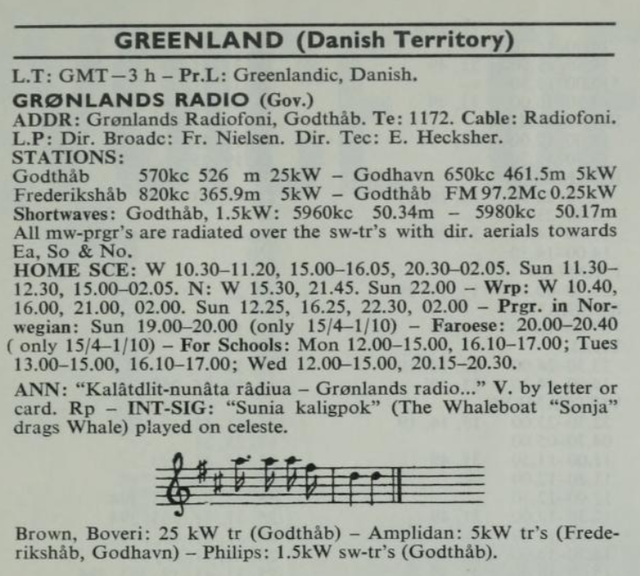
I remember the World Radio-TV Handbook's entry, which mentioned the station's interval (tuning) signal, a Greenlandic tune whose title translated as "The Whale Boat 'Sonja' Drags Whale." I wanted to log the station just to hear how that song sounded!
From the 1966 edition:
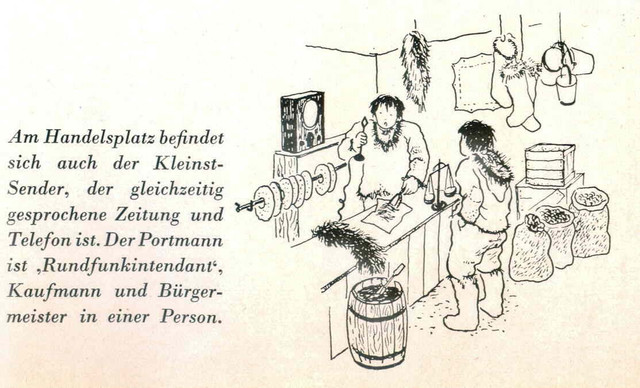
And here's a drawing from a 1936 German "radio atlas" of Greenlanders listening to the radio:
When did they move to 3999?
Thanks for posting that. I had completely forgotten about the 49 meter shortwave frequencies. I now recall trying for those, without any luck. I think the directional antennas were aimed away from most of North America.From the 1966 edition:
The shortwave operation must have started in 1965; the WRTH from that year shows them as a planned service.
The 1968 WRTH shows the 3999 outlet in addition to the 49 meter frequencies, and that is what was stuck in my brain. I think they had two transmitters that could change frequencies. Also looked at the 1974 WRTH which listed three additional frequencies in the 31 and 25 meter bands, apparently from a newer transmitter. I had forgotten about those as well.When did they move to 3999?
The 1981 WRTH only has 3999 kHz remaining on shortwave. IIRC the Greenland SW operation was gone by the 1990s.
The Interval Signals Online website has some vintage recordings of Greenland Radio. The website design doesn’t allow a direct link, but easy to navigate.I remember the World Radio-TV Handbook's entry, which mentioned the station's interval (tuning) signal, a Greenlandic tune whose title translated as "The Whale Boat 'Sonja' Drags Whale." I wanted to log the station just to hear how that song sounded!
Can't play any of those recordings on my Chromebook. The .m3u format is not supported. The file downloads and dumps itself in a folder, but can't be played. Any suggestions?The Interval Signals Online website has some vintage recordings of Greenland Radio. The website design doesn’t allow a direct link, but easy to navigate.
Not sure what to tell you. They play on my iPad in the Safari browser.Can't play any of those recordings on my Chromebook. The .m3u format is not supported. The file downloads and dumps itself in a folder, but can't be played. Any suggestions?

Try this:Can't play any of those recordings on my Chromebook. The .m3u format is not supported. The file downloads and dumps itself in a folder, but can't be played. Any suggestions?

VideoPlayer MPD/M3U8/IPTV/EPG - Chrome Web Store
Native video player for videos or livestreams in DASH (mpd), HLS (m3u8) format and M3U list with EPG support.
 chromewebstore.google.com
In 2019, Greenland's KNR had a very special guest weathercaster (beginning at the 4:30 mark):
I am curious how Greenland got the CBC networks via Anik. Were satellite earth stations installed with low-power transmitters to serve some of the southwestern communities? The spot beam for CBC North (East feed) must have hit those areas OK, maybe with some sparklies. I see Greenland is a PAL format area like most of Europe...yet CBC was in NTSC.
If you look at You Tube, there are quite a few examples of Greenland television. There is also an around-the-clock feed of Greenland radio. Let's remember that all of Greenland is only 56,000 people. The capital city, Nuuk, is 20,000. That's not a lot to staff and support a television station and a radio station.
I saw a morning show with several people around a table, three women, one man. They read from their notes about news items, then chatted among themselves. We saw video of young people skiing. Several men were working on a project in a truck garage.
Here's what I didn't realize. Most of the people were a mix of Danish and Native. Everyone spoke the native Inuit language, even the people who looked European with Danish names.
Could you imagine if your community of 20,000 to 50,000 people had its own TV and radio station?
I saw a morning show with several people around a table, three women, one man. They read from their notes about news items, then chatted among themselves. We saw video of young people skiing. Several men were working on a project in a truck garage.
Here's what I didn't realize. Most of the people were a mix of Danish and Native. Everyone spoke the native Inuit language, even the people who looked European with Danish names.
Could you imagine if your community of 20,000 to 50,000 people had its own TV and radio station?
Could you imagine if your community of 20,000 to 50,000 people had its own TV and radio station?
Surprising, tiny Monaco (with a population of 38,000) currently has two fully fledged services that provide local news to the municipality. The first time I saw this newscast--with a memorable set!--was in a hotel room in Guatemala via TV5MONDE:
Here's today's edition of the other:
And here's a 2020 compilation of news opens from European microstates:
And here's a historical compilation of TV news opens from the Faroe Islands, another Danish territory in the North Atlantic with a similar population size as Greenland:
Lidl often has farmed salmon fillets from the Faroe Islands.And here's a historical compilation of TV news opens from the Faroe Islands, another Danish territory in the North Atlantic with a similar population size as Greenland:
And here's a 2020 compilation of news opens from European microstates:
That's an interesting collection, I realized that up to now, I had no clear idea of what Maltese sounded like.
Not to nitpick, but I don't normally think of Malta and Luxembourg as "microstates". Granted, they are small both in area and population, but when I think of a "microstate", places come to mind such as Liechtenstein, Andorra, Monaco, or to use an extreme example, Vatican City State.
I would think of Malta and Luxembourg more as I would some of the Caribbean islands that are independent countries, Grenada, Barbados, St Kitts-Nevis, just to name a few.