
• Get involved.
    We want your input!
    Apply for Membership and join the conversations about everything related to broadcasting.

    After we receive your registration, a moderator will review it. After your registration is approved, you will be permitted to post.
    If you use a disposable or false email address, your registration will be rejected.

    After your membership is approved, please take a minute to tell us a little bit about yourself.
    https://www.radiodiscussions.com/forums/introduce-yourself.1088/

    Thanks in advance and have fun!
    RadioDiscussions Administrators

What is the furthest FM Station you can receive on seek?

Does it differ in other areas of the country as much as AM radio does? In New England terrain determines reception to a great extent. For example when driving from my home in Northbridge MA to a golf course in Sutton MA I ususally receive WHOM 94.9 on seek (from about 110-120 mi) but sometimes cannot receive a 98.9 on seek out of Webster MA about 10-15 mi away! That station is blocked by a good sized hill. I'm probably one of the very few that don't use my presets very much!
I read a post about the Salt Lake City FM's received in Wendover NV (120 + mi away). Is that the best it gets?
Are there any FM's that really get out on a consistent basis in your area on your car radio (not skip related)? I'd like to hear about em. Thanks, bob
 
I can often get WWTN, WSIX and WSM-FM from Nashville on seek even with a walkman. around 80 miles away. WBPT from Birmingham is also a strong one here at 105 or so miles away.
 
vibe said:
I read a post about the Salt Lake City FM's received in Wendover NV (120 + mi away). Is that the best it gets?
Are there any FM's that really get out on a consistent basis in your area on your car radio (not skip related)? I'd like to hear about em. Thanks, bob

No, many Salt Lake and Provo area FM stations get much further out than 120 miles. However, the mention of Wendover is because you drive 120 miles and most of the stations hang in there with strong, almost local-grade, signals for that distance. Further out, it all depends upon terrain. As there are few signal conflicts, the right terrain can provide Salt Lake stations fading in and out along I-70 between Green River and Emery, UT - about 200 miles from their TX sites. Same is true in higher terrain areas in southern UT, southern ID, eastern NV and southwestern WY. This is not counting the various translators.

FMs from Grand Junction, CO get out well over 100 miles, as do Denver and Colorado Springs FM stations - along the Front Range, at least. Those are bad in the mountains because of the placement of their transmitter sites. FM stations from Albuquerque are capable of being heard 200 miles away too - depending on your location. You've gotta have the terrain on your side....but you often do along some major highways, like I-25.
 
Nothing really impressive in Michigan. I can get Lansing, Fort Wayne and Grand Rapids stations on scan sometimes.

Probably the best station around here as far as distance goes is 90.1 WMBI out of Chicago. They're a 100kw station in the suburbs, but they're on a wide open frequency and I know Lake Michigan plays a part in it as well.

I don't know how much longer this will last. There's a CP for a new station on 90.1 just 7 miles away from my location.
 
Sooo since FM's can be received on seek for over 100 mi, why are some of the radio locator maps so seemingly inaccurate? Are the maps based on theoretical calculations inside a cubicle at MIT or based on "real life" scenarios, which probably would be quite difficult to measure? I can't fathom 200 mi FM coverage on the east coast.
 
radio-locator maps on the FM side are based upon technical data and calculations, not much else. they do NOT take into account mountain ranges or tlal hills that may be 20 miles away from the transmitter site
 
Can someone help explain this? While driving the same road) Central Turnpike in Sutton MA west of RT 146) for the last thre or four days, WHOM came in very strong on seek. Yesterday, it was available (and reasonably clear) but not on seek. I didn't notice any signal degradation on any others. It was drizzling but that shouldn't have affected it. Does the strength of an FM vary from day to day?
 
Sometimes, if a reciever can't get a clear stereo signal, it won't stop on the station. Atmopsheric conditions such as heavy rain, heavy fog or heavy clouds can affect things.

By the way, I'm north of you in Dover, NH... hell neighbor;)
 
Is it "hello neighbor" or "hell neighbor"? By the way HOM was much stronger this afternoon and evening. What was funny was that I was picking up AAF's new translator on 97.7 on seek, but not getting AAF from Boylston on 107.3 from 10-15 miles away. But thats a separate issue which I replied to on the Boston board.
Thanks for the clarifiaction.
 
LOL of course it was supposed to be hello.. but thats what I get when I type too fast
 
I know you meant hello. Your replys (and all others) to my previous posts, as a somewhat novice, are appreciated. Having said that this post began with a mention of WHOM 94.9 Mt. Washington. This evening they billed themselves as the "largest station in North America." or something very similar. Could it be because they broadcast into parts of Quebec, maybe New Brunswick? I'm sure other stations can make this assertion as well?
Any other contestents?
 
VIBE WROTE: I read a post about the Salt Lake City FM's received in Wendover NV (120 + mi away). Is that the best it gets?
Are there any FM's that really get out on a consistent basis in your area on your car radio (not skip related)? I'd like to hear about em. Thanks, bob
Here is a link to the contour of KSL-FM 102.7 in Salt Lake City. As you can see, they reach Wendover, NV. But I'm not sure if that contour is accurate because I know by experience that most of the SLC FMs (and AMs) stop on seek when in Wendover. If field tests were done, I wouldn't be surprised if the signal strenght in Wendover was between 50 and 60 dbu instead of the 40 dbu dipected by that map. In fact, I know that SLCs FMs reach the Northwest corner of the state, even though the map shows that area way outside the 40dbu contour. The FMs do well in the Salt Flats because their towers area located on 10,000 ft. peaks overlooking the 4200 ft. flats. The AMs do well due to the unbeatable ground conductivity. When looking at the FCC contour maps, they appear to look accurate in most locations, but tend to underestimate the Utah AMs and FMs. Traveling east of SLC is another story. Because of the mountains, the signals east of SLC are plauged by severe multipath problems.

http://www.radio-locator.com/cgi-bin/pat?call=KSL&service=FM&status=L&hours=U
 
Most of the big Dallas fms do well between 100-150 miles till adjacent bleedover takes them I often start hearing them over the noise floor sometimes as far as sw ark under normal conditions
 
vibe said:
I know you meant hello. Your replys (and all others) to my previous posts, as a somewhat novice, are appreciated. Having said that this post began with a mention of WHOM 94.9 Mt. Washington. This evening they billed themselves as the "largest station in North America." or something very similar. Could it be because they broadcast into parts of Quebec, maybe New Brunswick? I'm sure other stations can make this assertion as well?

By a bit of an accident of geography (somewhat human-assisted) WHOM has exceptional coverage for a New England station.

The FCC has the country divided into Zone I, where FM stations are limited to 50,000 watts at 150 meters antenna height; and Zone II, where the limits are 100,000 watts and 600 meters. In New Hampshire and Vermont, the dividing line is 43-30-00N, which runs just south of Rutland, Vt. and almost straight through Laconia, N.H..

WHOM, being one of five stations in these states located north of the line and not further limited by other stations that were there first, is allowed to run substantially more power than it would if located south of the line. It's licensed for 48,000 watts at 3,742 feet above average terrain. According to my calculations (probably not 100% accurate) it would be limited to **864 watts** if operated at the same antenna height in Zone I. Hence, the fantastic coverage.

(I doubt it's the "biggest station in North America" in terms of area covered, but it might be in terms of *population* covered. Some older stations have been "grandfathered" in with more power than the current limits allow. I think 103.3 in Santa Barbara is probably the biggest.)

(FWIW, the other four stations are WPKQ 103.7 (same mountaintop as WHOM but a bit less than half the power and - I believe - directional protecting a station on the same frequency in Keene, N.H.) and Burlington, Vt. stations WEZF 92.9, WOKO 98.9, and WVPS 107.9. There are also a literal handful of Class C stations in northern NY State.)
 
Does it differ in other areas of the country as much as AM radio does? In New England terrain determines reception to a great extent. For example when driving from my home in Northbridge MA to a golf course in Sutton MA I ususally receive WHOM 94.9 on seek (from about 110-120 mi) but sometimes cannot receive a 98.9 on seek out of Webster MA about 10-15 mi away! That station is blocked by a good sized hill. I'm probably one of the very few that don't use my presets very much!
I read a post about the Salt Lake City FM's received in Wendover NV (120 + mi away). Is that the best it gets?
Are there any FM's that really get out on a consistent basis in your area on your car radio (not skip related)? I'd like to hear about em. Thanks, bob
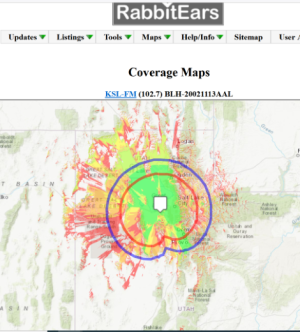
Here's a descriptive and graphic contour of a Salt Lake FM, obtainable from https://www.rabbitears.info/fmq.php, where one can make maps of FM coverage maps.

Screenshot 2022-01-01 162051-.png
 
This may be a 15-year-old thread you bumped up (A record?) but whoa! Cool find dondd! These are way better than the Radio-Locator maps. I'd say about 75%-80% accurate. For example, I can listen to a multipathed KORD-102.7 Richland here in my 3rd floor apartment in Ellensburg WA, 90 miles away. But the record shows not even a red line into Ellensburg...albeit it scatters into Yakima proper, which is correct. The R-L maps aren't even close.

The KXLE-FM map (95.3 Ellensburg) is closer to accurate in my opinion. It correctly shows KXLE with a 50+ dbu signal along Yakima's Pecks Canyon Rd near the top of the Scenic hill. That is correct. It also shows a red slash through Wapato and Toppenish - it was correct prior to 2019, but K237GY in Prosser has obliterated it with Spanish Religious programming.
 
I can get Spokane on seek, especially in the morning. Most common Spokane stations for me are KPBX 91.1 and KFOO 96.1.
 
Status
This thread has been closed due to inactivity. You can create a new thread to discuss this topic.


Back
Top Bottom