Since so many people have dropped cable, or live TV altogether, and only use streaming services, such as Hulu Live and YouTube TV, I know they usually carry the major networks, but not so much the really cheap ones, such as PBS. I think YouTube TV has PBS but didn't originally, and I don't think Hulu Live has it. But I don't think any of those have really cheap local channels such as WWDP 46, which is an Evine shopping network, and WMFP 62, which used to be SonLife network but I think is now all infomercials. Or even WHDH Channel 7 in Boston, which was once an NBC affiliate but has become independent. However, cable companies I believe are required to carry these channels, even though nobody watches them or cares about them. So what's the point of these channels even existing anymore? I've heard that some of them are even being sold. Same thing with all the digital subchannels.

-
Get involved.
We want your input!
Apply for Membership and join the conversations about everything related to broadcasting.
After we receive your registration, a moderator will review it. After your registration is approved, you will be permitted to post.
If you use a disposable or false email address, your registration will be rejected.
After your membership is approved, please take a minute to tell us a little bit about yourself.
https://www.radiodiscussions.com/forums/introduce-yourself.1088/
Thanks in advance and have fun!
RadioDiscussions Administrators
You are using an out of date browser. It may not display this or other websites correctly.
You should upgrade or use an alternative browser.
You should upgrade or use an alternative browser.
What's the point of cheap local TV stations anymore?
- Thread starter ssetta
- Start date
There are several things you don't seem to understand. First people still have cable. People still watch live TV. Sure there are online subscribers and those who choose that are increasing. To say 'what's the point' is akin to saying people can listen to radio online so, why have a radio station with a transmitter. The answer is people still listen that way.
All of these 'cheap local channels' all have bills to pay. They are businesses (yes even non-profits have bills). If they are existing it is simply because they are generating the money to pay the bills. If nobody watched the money to pay the bills (from advertising or donations) would not be there and the station would no longer exist.
Stations are bought and sold every day. Stations don't always sell because they are unsuccessful. Many sell because the owner wants to retire, is in failing health or simply wants to move on. Some do sell because they're broke. It is a truism that every radio and TV station is for sale. Flash the right dollar amount and you're buying a station that wasn't even listed for sale.
It tougher now to create a substantial audience no matter if it's over the air, via cable or online. It is equally difficult to monetize. For the local station it's about like selling burgers, chicken nuggets and kids meals next door to McDonalds. To make that work is a tall order but it gets done all over.
Frequently we think because our friends do one thing everybody does. Friends tend to be like-minded but friends are never a good cross-section of America.
All of these 'cheap local channels' all have bills to pay. They are businesses (yes even non-profits have bills). If they are existing it is simply because they are generating the money to pay the bills. If nobody watched the money to pay the bills (from advertising or donations) would not be there and the station would no longer exist.
Stations are bought and sold every day. Stations don't always sell because they are unsuccessful. Many sell because the owner wants to retire, is in failing health or simply wants to move on. Some do sell because they're broke. It is a truism that every radio and TV station is for sale. Flash the right dollar amount and you're buying a station that wasn't even listed for sale.
It tougher now to create a substantial audience no matter if it's over the air, via cable or online. It is equally difficult to monetize. For the local station it's about like selling burgers, chicken nuggets and kids meals next door to McDonalds. To make that work is a tall order but it gets done all over.
Frequently we think because our friends do one thing everybody does. Friends tend to be like-minded but friends are never a good cross-section of America.
It's also worth noting that many 'cord cutters' who have dropped their cable or dish subscriptions (many in an effort to save $$ or to stop paying $$ for so many channels of programming they're not interested in or never plan to watch) actually view a combination of internet streaming and local OTA stations picked up by an antenna located in or on their home. So even though they've dropped cable or dish, they're still watching local stations and channels, they're just pulling them in using an OTA antenna instead of paying a cable provider.
There's another discussion thread on this site that outlines just how much OTA content is available in various cities and parts of the country. There's a surprising amount of stuff available, all for the one-time cost of an antenna from your local Best Buy or online at Amazon.
There's another discussion thread on this site that outlines just how much OTA content is available in various cities and parts of the country. There's a surprising amount of stuff available, all for the one-time cost of an antenna from your local Best Buy or online at Amazon.
Except for the millions in brick/concrete apartment building with no windows on the side of the building facing in the direction of transmitters. My exposure is to the south. I bought an antenna and got exactly one signal -- from WTNH New Haven. All the others were blocked by the rest of the building. This was never a problem with analog.There's another discussion thread on this site that outlines just how much OTA content is available in various cities and parts of the country. There's a surprising amount of stuff available, all for the one-time cost of an antenna from your local Best Buy or online at Amazon.

For the most part over the air signals went to crap with the digital transition. You used to be able to pick up signals 40 miles away without an antenna. Now you can barely pickup a station 5 miles away if you are not in the right spot.Except for the millions in brick/concrete apartment building with no windows on the side of the building facing in the direction of transmitters. My exposure is to the south. I bought an antenna and got exactly one signal -- from WTNH New Haven. All the others were blocked by the rest of the building. This was never a problem with analog.
Or those who live outside the range of those stations supposedly in their market, unless they have a way to put that antenna somewhere high.Except for the millions in brick/concrete apartment building with no windows on the side of the building facing in the direction of transmitters. My exposure is to the south. I bought an antenna and got exactly one signal -- from WTNH New Haven. All the others were blocked by the rest of the building. This was never a problem with analog.
Or those living on the wrong side of a mountain.
It is for that reason that I had to revert back to a Mohu antenna. At least I could move it around to pick up stations as needed. For a while, I used a table-top Onn, which was sufficient for some signals, but not for a few others. Analog would have made them all come in, even if they were snowy.For the most part over the air signals went to crap with the digital transition. You used to be able to pick up signals 40 miles away without an antenna. Now you can barely pickup a station 5 miles away if you are not in the right spot.
For those interested in pulling in a nice, clear 4K OTA signal and being able to cut the cord completely, this weekend when I was at Burlington, I saw these for sale in the checkout line. For only $11.99 you can buy this wonderful device that will let you cut the cord, stick it to your dish or cable company and get ALL the content you want, OTA, for free. No more $150/month cable bill...You can get it all with this $11.99 miracle device!
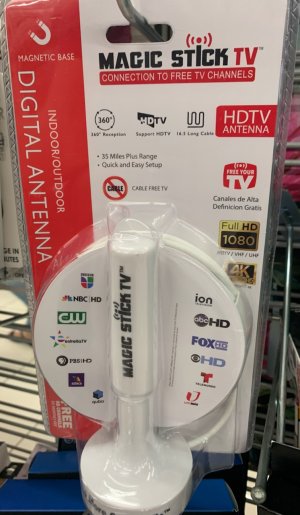
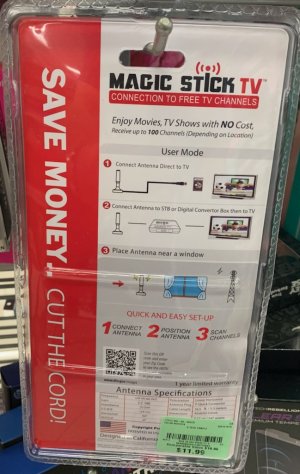
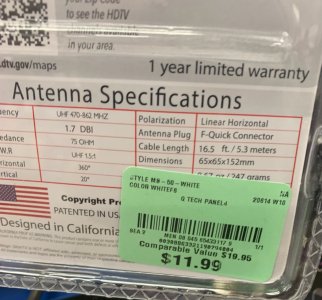
As long as you live in the right area.For those interested in pulling in a nice, clear OTA signal and being able to cut the cord completely, this weekend when I was at Marshall's, I saw these for sale in the checkout lines. For only $11.99 you can buy this wonderful device that will let you cut the cord, stick it to your dish or cable company and get ALL the content you want, OTA, for free. No more $150/month cable bill...You can get it all with this $11.99 miracle device!
View attachment 3203View attachment 3204View attachment 3205
Did you not pick up the immense amount of sarcasm in my post, for many reasons (including the one you state)? My post wasn't intended to be a serious sales pitch..As long as you live in the right area.
I saw the sarcasm, yes. But I was interpreting the post as saying "You DO know this is possible, don't you?"Did you not pick up the immense amount of sarcasm in my post, for many reasons (including the one you state)? My post wasn't intended to be a serious sales pitch..
Well, it says right on the packaging that it as a "-35 Miles Plus Range". How big of an area do you need to pull in coverage from? It's well known that marketing claims rarely lie or exaggerate, and we are talking about an $11.99 investment here, so you should expect big things!I saw the sarcasm, yes. But I was interpreting the post as saying "You DO know this is possible, don't you?"
I forget what I paid for the best antenna Sears had, but after 14 years it still works. But inside, it can't work all that well.Well, it says right on the packaging that it as a "-35 Miles Plus Range". How big of an area do you need to pull in coverage from? It's well known that marketing claims rarely lie or exaggerate, and we are talking about an $11.99 investment here, so you should expect big things!
Radio Shack would have installed a more expensive one outside. If it had worked, that would have been so much cheaper.
Is that a minus sign next to that 35? 🤣Well, it says right on the packaging that it as a "-35 Miles Plus Range". How big of an area do you need to pull in coverage from? It's well known that marketing claims rarely lie or exaggerate, and we are talking about an $11.99 investment here, so you should expect big things!
There will always be that one person who lives within a mile or two of the transmitters, so it "works" for them! The rest of us know better.I saw the sarcasm, yes. But I was interpreting the post as saying "You DO know this is possible, don't you?"

Since so many people have dropped cable, or live TV altogether, and only use streaming services, such as Hulu Live and YouTube TV, I know they usually carry the major networks, but not so much the really cheap ones, such as PBS. I think YouTube TV has PBS but didn't originally, and I don't think Hulu Live has it. But I don't think any of those have really cheap local channels such as WWDP 46, which is an Evine shopping network, and WMFP 62, which used to be SonLife network but I think is now all infomercials. Or even WHDH Channel 7 in Boston, which was once an NBC affiliate but has become independent. However, cable companies I believe are required to carry these channels, even though nobody watches them or cares about them. So what's the point of these channels even existing anymore? I've heard that some of them are even being sold. Same thing with all the digital subchannels.
Well we had a similar discussion for San Francisco when KOFY was flipped into the affiliate of GRIT TV. Prior to this KOFY was a general independent station.
Sure lots of this is tied to how KOFY has to deal some of the syndicated shows they once had were mainly being seen on streaming apps. Another part is staying relevant in this era with a special format to remain on Cable systems for carriage revenue.
Last edited:
Isn't most of these "cheap Local TV channels" usually automated somewhere else and sent to the transmitters across the country or direct to cable. Case and point KTBN Los Angeles the flagship station for the TBN Network carries religious programming from the network on OTA. Note most parts of the USA would get TBN via streaming or cable. Automation has to be from Los Angeles where the main offices for TBN are located.

On the subject of the mileage range of antennas I don't see why that Amazon and eBay can't do something about some of the antennas that are sold that have outright lies on their reception range with 100+ or more miles.
I can't help but Wonder what the people who sell this one were smoking at the time they chose the range to advertise on theirs: 🤪
I can't help but Wonder what the people who sell this one were smoking at the time they chose the range to advertise on theirs: 🤪
Last edited:

I've seen very little evidence that people who are unsubscribing from cable are connecting antennas. I'm sure some are, but probably not a majority.It's also worth noting that many 'cord cutters' who have dropped their cable or dish subscriptions (many in an effort to save $$ or to stop paying $$ for so many channels of programming they're not interested in or never plan to watch) actually view a combination of internet streaming and local OTA stations picked up by an antenna located in or on their home.

- Status
- This thread has been closed due to inactivity. You can create a new thread to discuss this topic.