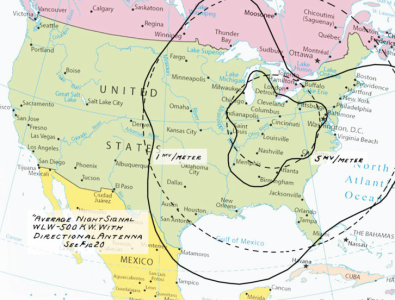
It also takes in Washington DC to the east. We've often discuss how there are very few radio stations in our nation's capitol with a signal strong enough to cover the market. That's because at the time when the frequencies were being assigned, they were given to certain stations that were meant to cover all of those areas.
Frequencies were not assigned as they do today with FM. It was pretty much a "first come" basis. That is why the major cities of the early 30's got the 1-A and 1-B clear channels.
Today, we might consider that Rochester, Buffalo, Schenectedy, Wheeling, Ft Wayne and the like did not deserve a clear as much as Phoenix, San Diego, Miami, Orlando, Tampa did. But at the time, those markets were very small and the surrounding areas not heavily populated (if at all) so nobody tried to build a big station there.
By the mid-30's, the prime real estate was pretty much taken... even on the regional channels. Much of what was licensed after WW II can be seen to have had to try very hard and very directionally to wedge the facility in while protecting the earlier protected licenses.
The FCC did not assign facilities to markets or frequencies, so what you have is most of the good facilities in those established markets and a lot of terrible ones in markets which grew in later decades.
As Greg points out, the DC market was adequately covered by 1500, 630, 980 and 570... and those later applications are notable for their deficiencies.