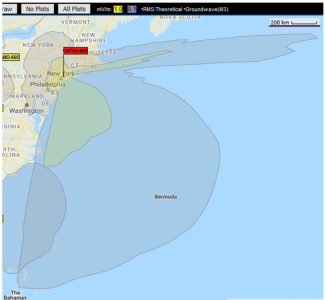
And this explains, to some extent, how Colombia can assign two non-directional 50 kw stations on the same channel in different parts of the country... and Colombia is only about 80% larger than Texas.
I've sometimes wondered if there are any
CITIES where, due to a combination of factors like a very geographically large city and very poor ground conductivity, it would be possible to have TWO co-channel non-directional daytime 50kW signals in the SAME city, with both their protected-from-interference contours (0.5 mV/m since I'm thinking Class D; I know no place where two co-channel 50kW class As would fit in the same city even at the upper end of the AM BCB) would be contained entirely within city limits?
The times I've re-allocated the AM band for fun, could not come up with a clear channel plan I liked, with requirement that there must be at least two clear channel stations in markets that have them (for competitive reasons).
I've tried a little "back of the brain" AM band reallocation too.

One of my ideas would have done clear channels differently, I think.
Basically instead of having individual big stations in certain cities like it is today, the "clear channels" would be for nationally-syndicated programming. Basically each network / whatever would get its own dedicated nationwide frequency, and build synchronized co-channel stations across the country. These would primarily be at the lower part of the AM BCB (and one idea I thought of also involved expanding down to longwave, and maybe using 20 kHz spacing above 540 and 18 kHz below 540).
(Also my idea would involve moving TV stations off channels 5 and 6, expanding the FM band there, and moving a lot of smaller stations there. Then....) For the upper part of the AM BCB (like above about 1200 or 1400 or so), that would be for smaller low power / local stations for which, due to simpler / less expensive equipment / etc (correct me where I'm wrong? I think FM can use less transmitter power so lower power bill there), small operations that would find it financially hard to set up on FM could still set up on AM with a small transmitter (like 10-250 watts or so) and short antenna (like 50-200 feet).
However ... with a lot of radio listening being done online these days ... I'm starting to think maybe that idea isn't all that feasible anymore. I wonder if there could be some other (even if non-broadcast) use of the AM BCB and other SW/MW/LW/etc frequencies, that would take advantage of their strengths (like longer distance propagation)?
I do still have a bit of a gripe with moving radio content entirely online, though....
With radio, the end user / listener can listen fairly cheaply - just buy a $5-10 radio, some batteries (rechargeable strongly recommended - I have some of the same Eneloop AAs that I've been using for 10-15 years, possibly more, and they're still working well enough), and you can listen.
But, with internet, you need a computing device (yeah you can get something for $50-100 but generally >$300-400 is much better), internet service (can be as cheap as $10-20/month but >$40-50/month is better), and even then you can have sudden dropouts, network hiccups, etc.
Internet radio does give you a lot more choice for programming content, true.
But then, analog AM radio, at least in my experience (especially listening in rural areas as I'm traveling away from a station) is more graceful as the signal degrades. (I even prefer AM over FM for weak signals.) Sure there's a lot of noise as the station gets weak, but most of the time for me (as long as you're not in a thunderstorm or near man-made noise generators) it's like white / pink noise (like a steady version of ocean waves)... and you can still hear the content, whereas with digital / internet, it's either perfect or it's gone, and it can be quite jarring.
Going back to the beginning of this discussion, A Class 1-A station was protected to its 0.1mv/m contour and because of a lack of man-made interference, you didn't need much signal to hear it.
I wasn't around back in the early days of radio - only born in 1981, and my first DXing memory was on a cheap-quality freebie radio that came with a bike I got for my 10th birthday, listening one night ... and sandwiched under (not between - selectivity was very poor on that radio) a Mexican music station on 860 (XEMO) and a religious station on 910 (KECR), was a very faint talk / news station that was right at the noise floor. I talked to my dad (a radio engineer, but not primarily broadcast) about it and he explained skip and other things to me, and that started a long hobby / fascination with radio.
(BTW that station was confirmed, with the aid of a much better quality car radio, to be 890 KDXU from St. George, Utah.)
Also I remember when I first had a slightly better quality radio (about when I was like 11 or 12 or 13 I don't remember now) ... hearing 600 (I think it was KOGO then) announcing on the air that they were the "brand new Hot Talk 600 KOGO" or something like that, I remember when Family Radio was still on 93.3 KECR (although I don't personally remember pre-FR 910 KMJC), I remember hearing the Padres on 760 KFMB, oldies on 1170 KCBQ, news/talk on 1130 KSDO, nostalgia on 1360 KPOP (now KLSD), oldies/nostalgia on 570 KLAC (as a kid I used to think it was a station located in some rural mountain / forest area for some reason), sports on 690 XETRA (now XEWW), I remember a couple news stations (one being 940 KFRE from Fresno, CA and really liking the music beds on the AP network news broadcasts), the KNX Drama Hour that we often listened to, Unshackled (when it was on Family Radio), and if i thought about it more I could probably come up with others.
I heard nothing, though, compared to many of you who could at least be my father (mother if there's any women here too?) or even possibly grandfather (although you'd likely have to be younger than him - my dad was born in 1946 and his dad was born in 1915. Dad's still living, grandpa passed away in 2002.) I feel like I *just* missed out on some fairly exciting radio listening, cause I heard of things (DX, etc) even as late as the 1980s that I wish I could have heard.
I was thinking/wondering, about that "lack of man-made interference" ... I think I've heard David Eduardo say recently (or at least several years ago, I wonder if the level is even higher now) that to get non-DXers to listen in a large metro area (like L.A. or NYC) you needed at least 10-15 mV/m of signal. I wonder what the equivalent would have been in the early days of radio? Would, for example, an 0.5 or even 0.1 mV/m signal (or even less) been totally adequate? Or were people more tolerant of fuzzy signals / interference because they had no other option, or some combination?
Also I think I may have heard WLW once near San Diego, CA, but I'm not 100% sure. I don't think I heard any ID, but I did pull up their stream on my phone and I think some of the voices may have sounded similar.
I kind-of think (based on the signal strength reading on the radio and the general sound) at that time that KALL (North Salt Lake, UT) may have had their transmitter on, but with an unmodulated carrier. (Normally they'd be MUCH louder than that here.)
I think gar got a better signal in HI than me in CA, though.
I've heard WLW here in Hawaii.
The ID comes near the end of the video.