Below is an example of that, as proposed by/for WJR.The FCC took another look at the clear-channel situation so a bunch of stations jumped in line, just in case. Some of those applications were directional as well.
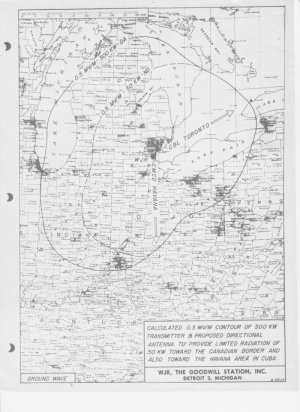

Below is an example of that, as proposed by/for WJR.The FCC took another look at the clear-channel situation so a bunch of stations jumped in line, just in case. Some of those applications were directional as well.

There are quite a few megawatt stations outside of the Western Hemisphere. The day coverage depends entirely on the ground conductivity in the area. If you look at the WJR map in this thread, multiplying the power by 10 only increases the coverage area by a little more than double in total square miles. Going from 500 kw to two megawatts doubles the land area.Here’s a good one, I’ve mentioned this on another topic in the past, but there’s a station in Budapest, Hungry on AM 540 with 2 million watts. I wonder what the coverage area daytime and nighttime would be for a 2 million watt signal on the low end of the AM band especially on 540.
And where the signal has to cover that sandbar called Long Island, it only gets a few dozen miles!Below for perspective is a daytime contour map for 50 kW. non-D WFAN, using a frequency toward the low end of the AM broadcast band and a transmit site on a small island in Long Island Sound.
In some compass directions looking down the length of the Sound they have groundwave propagation paths that are entirely across sea water.
The transmitter power multiplier at the common point of a directional array can be well below the multiplier for the maximum effective radiated power of the array compared to a non-D radiator, though.... If you look at the WJR map in this thread, multiplying the power by 10 only increases the coverage area by a little more than double in total square miles. ...
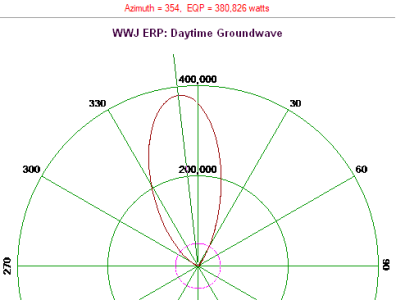
... I don't know if you could have only 50 kW equivalent toward Toronto with just two towers with a cardioid type pattern like that shown. ...
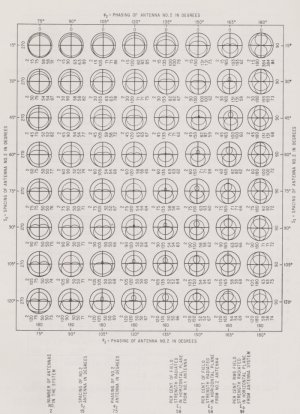
That would be interesting, SC. I don't have any of the details of that proposed array, unfortunately. I wonder if two towers might actually do the job, maybe even if one was parasitic.It would take more than two towers to design that pattern. We could reverse engineer the distances and recreate the actual pattern. That would give a better idea, if more application information is not available.
The issue was not the population... it was who got there first.Compared to the boundary of the city of Cincinnati?
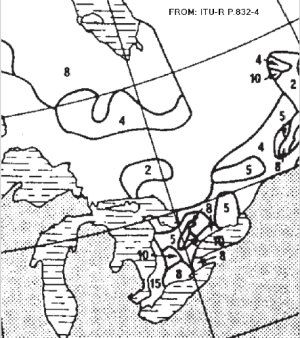
Have you ever seen a LEGIBLE Conductivity Map of Canada? I know there are areas of 15-20 mS/m in the Windsor, Sun Parlour, and Sarnia Area. One of the WTCM applications, I think it was the first of the relatively recent ones, for 15 kW Daytime, that showed CKWW radial conductivities that were around 20 mS/m.That would be interesting, SC. I don't have any of the details of that proposed array, unfortunately. I wonder if two towers might actually do the job, maybe even if one was parasitic.
Probably the M3 chart values should be used when backing into what would/might have worked, when that 500 kW, 0.5 mV/m contour was proposed.
The best one I've found is in the ITU library, although it is fairly primitive looking compared to what the FCC has published lately. Below is a clip showing conductivities for a section of Ontario.Have you ever seen a LEGIBLE Conductivity Map of Canada?...
Below for perspective is a daytime contour map for 50 kW. non-D WFAN, using a frequency toward the low end of the AM broadcast band and a transmit site on a small island in Long Island Sound.
In some compass directions looking down the length of the Sound they have groundwave propagation paths that are entirely across sea water.
View attachment 1624
That is true. I heard a sound file that someone sent me about 10 years ago when he was in Bermuda in June. He got several east coast stations at noon including the ones you mentioned and there were a few others. I think WINS was among them.I've heard more than one report that WFAN, WABC, and WCBS can be heard all day with a weak but listenable signal in Bermuda.
I've heard more than one report that WFAN, WABC, and WCBS can be heard all day with a weak but listenable signal in Bermuda.
Years ago I saw a letter exchange between one of the Crosley engineers and a EE at Blaw Knox. Powell had insisted on having an antenna built at WLW for maximum skywave, so there was a lot of back and forth on how to achieve it.That's correct - both WLW and WSM were reduced in height after they learned more about groundwave-skywave cancellation.
WLW's original design put a cancellation ring over Indianapolis, Columbus and Louisville, while WSM's cancellation ring landed on Knoxville and Birmingham, or so the story goes.
Those original coverage maps showing field strength borders of .5mVm are a lost classic, because it's wholly impractical that given the noise floor today, anyone could receive a signal attenuated that much.There are quite a few megawatt stations outside of the Western Hemisphere. The day coverage depends entirely on the ground conductivity in the area. If you look at the WJR map in this thread, multiplying the power by 10 only increases the coverage area by a little more than double in total square miles. Going from 500 kw to two megawatts doubles the land area.
The reason for such high power is to avoid having multiple transmitters for government stations. The objective is to reach as much of a country as possible with as few transmitters. But with today's noise levels, that's no longer practical as those distant transmitters just can't overcome the man-made noise. But the goal of those high-power AMs is to cover much of a small nation... not worth much in the era of FM and the Internet.
At night, people watch TV. Practically nobody listens to distant radio stations.

