• Get involved.
    We want your input!
    Apply for Membership and join the conversations about everything related to broadcasting.

    After we receive your registration, a moderator will review it. After your registration is approved, you will be permitted to post.
    If you use a disposable or false email address, your registration will be rejected.

    After your membership is approved, please take a minute to tell us a little bit about yourself.
    https://www.radiodiscussions.com/forums/introduce-yourself.1088/

    Thanks in advance and have fun!
    RadioDiscussions Administrators

WMVP AM 1000 Transmitter

Here across the Cheddar Curtain, WMVP sounds pretty much the same during the day (observations @ home & in car; no meter readings). At night, definitely worse. I can't tell if the signal strength is significantly different, but phase-shifting is decidedly worse.

According to the map up the thread, it still appears to have a pretty good-sized lobe aimed at me.
 
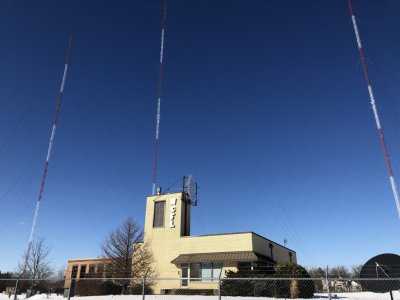
I was in the Chicago western suburbs in early November and took some last images of the old WMVP-1000 site in Downers Grove. I was back in the area one day last week (Feb. 13) and was surprised to see the towers still standing. I took some more images of the WCFL building on a bright, cold winter day. When WBBM moved from their longtime transmitter site in 2019, the towersWMVP site Feb-13.jpg were knocked down within days of the change.
 
Or maybe the WBBM towers had to come down quickly due to their proximity to O'Hare Airport. One less air hazard, no matter how well lit it was.
 
The license to cover for the new site is still pending. May have something to do with that?
The "License to Cover" from the Joliet site needs to be "Granted" by the FCC before the legacy Downers Grove site can be dismantled. Not sure if anyone is on the job right now at the FCC due to federal layoffs. It also appears the president now has direct control of the FCC with Brendan Carr being the middle man.
 
The WSCR tower has been there for many decades. I'm sure it was that the land becoming more valuable was the reason for moving, not the air hazard aspect. I'm seeing more and more incidences of this. Maybe it would be better to use the WMVP towers for other Class A stations, as they are much taller than the WYLL towers, which are electrically very short at 670 and 780. I think there will be a lot of complaints about fading with those short towers. Perhaps if they could have split the expenses between companies, using the taller towers would be more feasible.

The newer AM rules have caused many haphazard things to happen, as have the multiple ownership rules. The FCC allegedly made the new rules to improve the AM band. Much of what I have seen is the new rules causing the better AM facilities to be sacrificed, while Class C and Class D facilities with very low Night power continue to operate. Of course, some of that haphazard loss of stations was the preference for lower power facilities getting translators, once again at the expense of better AM facilities. And where stations have moved under these rules, rarely are the new locations significantly better, except in certain areas.

Of course, the younger people who have taken over from the legacy owners and managers will tell you that no one listens to AM anymore anyway.

Why anyone thought that 250 watt FM translators were going to save AM, except those lower power facilities in small towns where the 250 watt translators actually have comparable service areas, is a mystery. And the FM rules made in the early 1960s, and preference for "First Local Service" under Docket 80-90, made it nearly impossible to serve larger communities with substitute FM facilities in any meaningful way, as has been done in Canada and Mexico.

 
Last edited:
With the movement of population from Chicago's south and west sides to the far western suburbs in the early to mid 70s, the WCFL night time pattern provided a weaker or unlistenable signal in these areas. There were large areas of south western Downers Grove, Naperville, Bolingbrook Oswego, Joliet, Plainfield, etc just received side bands with hardly any carrier which made WCFL unlistenable at night. If you left your radio tuned to WLS when you went to bed at night, you were likely to leave it there when you woke up. Lou Witz even ordered his engineers to delay the afternoon pattern change during the winter in order to eek out a few extra rating points during the the Larry Lujack show as was reported by Gary Deeb back then.

One of my cousins used to live right off Ogden Ave in Naperville, and now lives just west of Naperville Central, and at both residences 1000 was awful after the pattern change from the old site. Quite a change for me as WMVP always has blasted into central Ohio and continues to do so.
I haven't been back to Naperville since they moved their towers to Joliet so I don't know how it sounds there now. Has to be better.
What is WMVP protecting to the southeast?
 
One of my cousins used to live right off Ogden Ave in Naperville, and now lives just west of Naperville Central, and at both residences 1000 was awful after the pattern change from the old site. Quite a change for me as WMVP always has blasted into central Ohio and continues to do so.
I haven't been back to Naperville since they moved their towers to Joliet so I don't know how it sounds there now. Has to be better.
What is WMVP protecting to the southeast?
Think it's an artifact of trying to put out a minor lobe towards the north / northwest to improve coverage towards Aurora and the far northwest suburbs at night.

Northeast of Joliet on the near south side of Chicago, there is very little difference in WMVP signal strength between the previous Downers Grove signal vs. the WCPT night site. The Night 37kw signal appears to be slightly stronger than the 50kW daytime signal. I'm sure the far north suburbs are experiencing a weaker signal from the Joliet site.
 
Last edited:
The WSCR tower has been there for many decades. I'm sure it was that the land becoming more valuable was the reason for moving, not the air hazard aspect. I'm seeing more and more incidences of this. Maybe it would be better to use the WMVP towers for other Class A stations, as they are much taller than the WYLL towers, which are electrically very short at 670 and 780. I think there will be a lot of complaints about fading with those short towers. Perhaps if they could have split the expenses between companies, using the taller towers would be more feasible.

The newer AM rules have caused many haphazard things to happen, as have the multiple ownership rules. The FCC allegedly made the new rules to improve the AM band. Much of what I have seen is the new rules causing the better AM facilities to be sacrificed, while Class C and Class D facilities with very low Night power continue to operate. Of course, some of that haphazard loss of stations was the preference for lower power facilities getting translators, once again at the expense of better AM facilities. And where stations have moved under these rules, rarely are the new locations significantly better, except in certain areas.

Of course, the younger people who have taken over from the legacy owners and managers will tell you that no one listens to AM anymore anyway.

Why anyone thought that 250 watt FM translators were going to save AM, except those lower power facilities in small towns where the 250 watt translators actually have comparable service areas, is a mystery. And the FM rules made in the early 1960s, and preference for "First Local Service" under Docket 80-90, made it nearly impossible to serve larger communities with substitute FM facilities in any meaningful way, as has been done in Canada and Mexico.
WGN has been slow to modify their current site to build a new 750FT tower on their land which the lower 2/3 are being redeveloped for a data center and pickle ball courts. Wonder if Nexstar has interest in purchasing the old WCFL site for WGN AM, use the center tower as the main stick and use one of the shorter ones as an aux. They may come out ahead financially buying the Downers Grove site and selling off the Elk Grove site in total.
 
Lou Witz even ordered his engineers to delay the afternoon pattern change during the winter in order to eek out a few extra rating points during the the Larry Lujack show as was reported by Gary Deeb back then.

In those days, the 'CFL pattern changes were pretty noticeable over the air. There was an audible "clunk" and about three seconds of silence. Some of the DJs used to backtime so it happened between songs or commercials. Others just let it interrupt whatever was on the air at the time.
 
There are quite a few factors in how pattern changes sound. And there have been improvements over the years. Newer array pattern changes seem to be faster, and if you aren't listening for them, you hardly hear them. Then there are those really slow ones like when CHYR changed frequencies. I've read where really old pattern changes sometimes involved manual changes in the connections, requiring several seconds off the air to complete. And where there were reductions of power without a pattern change, close by you didn't notice at all. Power increases were more noticeable, as the receiver AVC change was more noticeable.
 
There are quite a few factors in how pattern changes sound. And there have been improvements over the years. Newer array pattern changes seem to be faster, and if you aren't listening for them, you hardly hear them. Then there are those really slow ones like when CHYR changed frequencies. I've read where really old pattern changes sometimes involved manual changes in the connections, requiring several seconds off the air to complete. And where there were reductions of power without a pattern change, close by you didn't notice at all. Power increases were more noticeable, as the receiver AVC change was more noticeable.
Two things helped faster pattern changes. First, mostly or all solid state transmitters could be flicked momentarily off and back on in fragments of a second. Then, relays on the phaser that have auxiliary contacts can insure that the transmitter is off while the antenna / phaser inputs are switched. So the timer turns off the transmitter and the switch is activated between one parameter and the other and the transmitter is instantly back on. Plus, "space age" relays are faster than those ones that truly made loud clunking noises.

Speaking of clunking, I am always amused by movies and TV dramas where a power failure has a huge loud thunk noise and a city view has one building after another successively going dark rather than all at once. I wonder how many people think, "oh, there was still enough electricity in the wires to keep some buildings on for longer." Shure. Right.
 
WTMR drops carrier several times during day/night changes, with noticeable variations in signal strength between them -- almost as if they're doing it one tower at a time?
 
If your day/night power changes some stations have a day/night transmitter. Say if you are going from 50Kw day to 5KW you may have a 5KW transmitter you switch to at night. That might make two noticeable switches from transmitter to transmitter then the actual pattern change. When I was switching between a day and night transmitters because power would drop at night. I always switched to the lower power transmitter then did the pattern change after that. Then reversed the process for day mode.
 
If your day/night power changes some stations have a day/night transmitter. Say if you are going from 50Kw day to 5KW you may have a 5KW transmitter you switch to at night. That might make two noticeable switches from transmitter to transmitter then the actual pattern change. When I was switching between a day and night transmitters because power would drop at night. I always switched to the lower power transmitter then did the pattern change after that. Then reversed the process for day mode.
That is a common situation with stations that have gone to night power under 200 watts to eliminated a DA system. So they have a tiny little transmitter that is about 3 rack units high that gets flicked on when the higher power daytime rig is turned off. Few heritage transmitters can do a reduction to less than 5% of the normal power and do it well and efficiently.

I have not looked, but perhaps Fybush has photos of one of those 50 kw day and 120 watt night installations (I think Robin Mathis in MS immortalized that kind of immense power difference).
 
That is a common situation with stations that have gone to night power under 200 watts to eliminated a DA system. So they have a tiny little transmitter that is about 3 rack units high that gets flicked on when the higher power daytime rig is turned off. Few heritage transmitters can do a reduction to less than 5% of the normal power and do it well and efficiently.
When I worked in 1984 at WBNR in Beacon, New York, a 1 kw daytimer with a DA, the station had a separate, small solid-state transmitter for PSRA and PSSA operation, which was at power levels around 80 or 90 watts. I don't remember the exact figure. (This was before WBNR got its separate nighttime DA later in the 1980s.) The station owners often expressed their wish that the main transmitter would have sounded as good as the little PSRA/PSSA unit did. But, at least at the time, they weren't willing to spring for a new 1 kw transmitter.
 
If your day/night power changes some stations have a day/night transmitter. Say if you are going from 50Kw day to 5KW you may have a 5KW transmitter you switch to at night. That might make two noticeable switches from transmitter to transmitter then the actual pattern change. When I was switching between a day and night transmitters because power would drop at night. I always switched to the lower power transmitter then did the pattern change after that. Then reversed the process for day mode.
WKNR in Cleveland has this setup. Their pattern changes take about 3 or 4 seconds between towers and transmitter musical chairs.
 
I was listening to WCPT the other day. There was a period of 10 minutes where both daytime and night time transmitters were operating. The modulation effect sounded so cool, but it made the content unlistenable.

Even with modern setups, things still fail. I hope WCPT can get the issue resolved soon.
 
WCFL's night signal certainly hurt the White Sox between 1952 and 1966 and the Cubs became more popular downstate and in Iowa. Oddly, the White Sox became very popular in Buffalo, NY, 500 miles to the east.

When I was growing up in Boston, WCFL was by far the strongest signal from the Chicago area at night. 720 was overpowered by WOR from NYC and French CKAC Montreal. 670 was toast between WNBC and WNAC/WRKO Boston. 780 was between WABC NY and WEAN Providence and 890 just didn't do well in Boston.


Back
Top Bottom