• Get involved.
    We want your input!
    Apply for Membership and join the conversations about everything related to broadcasting.

    After we receive your registration, a moderator will review it. After your registration is approved, you will be permitted to post.
    If you use a disposable or false email address, your registration will be rejected.

    After your membership is approved, please take a minute to tell us a little bit about yourself.
    https://www.radiodiscussions.com/forums/introduce-yourself.1088/

    Thanks in advance and have fun!
    RadioDiscussions Administrators

You WCFL Listeners Told Us About Their Signal To The West Not Being That Good!

You said the WCFL signal was weak to the West, and it's not just the DA!

Some of the best names in the consulting engineering business worked on this over the years-Carl E. Smith and Glen Clark. And the measured conductivity to the West is less than M-3, which is 8 mS/m. It is actually better than M-3 to the East and North in some directions.

Here's the radials used in the WMVP 2006-2007 applications for the new DA array at the same TL in Downers Grove. It still says WCFL on the transmitter building, the last I looked, and you can see it on the 3D Satellite Maps!

https://licensing.fcc.gov/cdbs/CDBS...?appn=101160972&qnum=5160&copynum=1&exhcnum=4

The odd thing is you can read the call letters well enough to see it doesn't say WMVP, but on my Satellite Map viewer, only one tower shows with red and white paint! You can see all the tuning buildings/doghouses, and even some guy anchors.
 
Last edited:
I forgot to point out that this is the DAYTIME PATTERN that you talked about. Of course the Night Pattern is a lot less. The Daytime IDF off the back of the Directional Antenna is 2518 mV/m @ 1 km at about 261 degrees true, just short of the minimum Class I/Class A 50 kW efficiency of 2560 mV/m @ 1 km.
 
I'm a bit embarassed to confess that understanding those charts is a bit above my pay grade, but I think I get the general idea.

What I will say from my reaL world experiences in traveling as well as four years of collegew in southeast Iowa is that the WCFL/WMVP day signal is comfortably listenable along most of the stretch of the Mississippi river that forms the Iowa-Illinois border. My college location was 25 miles west of the river, and WCFL's signal would have been adequate were it not for splatter from WCAZ, a 1kw ND daytimer on 990 in Carthage, IL (now defunct). To the north, the WCFL/WMVP day signal is good throughout roughly the southeast third of the state. Wisconsin ground conductivity deteriorattes as you go north and west, and there's a 1kw daytimer local on 1010 in nearly the exact center of the state. Going east, deterioriating ground conductivity is also an issue in western Michigan. Not so much in Indiana. Going south, the day signal is generally listenable in the northern half of Indiana as well as slightly beyond the northern half of Illinois.

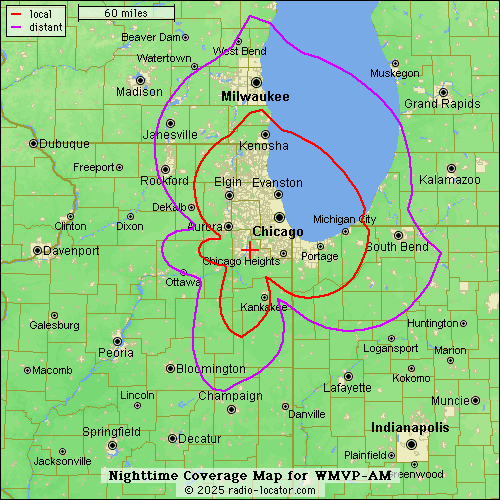
The night skywave signal is typically excellent to the east, and still good north and south (it can sound like a local in Minneapolis, for example. And I can usually still hear it in Winnipeg (if I'm able to null CBW on 990). The problem is to the west, and especially southwest. The groundwave signal is ceases to be competitive in parts of the suburban and exurban area. As radiomand has pointed out, night reception can be problematic in DeKalb, IL which is only a few miles west of the boundry of the metro area. In eastern Iowa, including my college location, the signal is still audible, but very prone to fades, interference from XEOY, and splatter from CBW.
 
I'd love to tell you how I remember WCFL (I believe then-religious) from my time in Quincy, IL (working in Hannibal) but I don't. I would think it would have had an OK signal, but the bluffs in Quincy seemed to do weird things to ground conductivity. I can remember WLS, with a weak signal during the day in Quincy, but the minute I crossed that bridge into Missouri, it's like I had just re-connected an antenna to my car radio. Where I grew up in Ohio, WLS and WCFL's signals were roughly equal at night (WCFL maybe with an edge) and were both very weak during the day.


I'm a bit embarassed to confess that understanding those charts is a bit above my pay grade, but I think I get the general idea.

What I will say from my reaL world experiences in traveling as well as four years of collegew in southeast Iowa is that the WCFL/WMVP day signal is comfortably listenable along most of the stretch of the Mississippi river that forms the Iowa-Illinois border. My college location was 25 miles west of the river, and WCFL's signal would have been adequate were it not for splatter from WCAZ, a 1kw ND daytimer on 990 in Carthage, IL (now defunct). To the north, the WCFL/WMVP day signal is good throughout roughly the southeast third of the state. Wisconsin ground conductivity deteriorattes as you go north and west, and there's a 1kw daytimer local on 1010 in nearly the exact center of the state. Going east, deterioriating ground conductivity is also an issue in western Michigan. Not so much in Indiana. Going south, the day signal is generally listenable in the northern half of Indiana as well as slightly beyond the northern half of Illinois.

The night skywave signal is typically excellent to the east, and still good north and south (it can sound like a local in Minneapolis, for example. And I can usually still hear it in Winnipeg (if I'm able to null CBW on 990). The problem is to the west, and especially southwest. The groundwave signal is ceases to be competitive in parts of the suburban and exurban area. As radiomand has pointed out, night reception can be problematic in DeKalb, IL which is only a few miles west of the boundry of the metro area. In eastern Iowa, including my college location, the signal is still audible, but very prone to fades, interference from XEOY, and splatter from CBW.
 
Navigation first used the 360 degree directions. 0 is N, 90 is E, 180 is S, and 270 is W, if you're not familiar. They measure the Field Intensity at a large number of locations along each direction. Then they match as best they can the FCC ground wave curves. They have the 270 degree radial and another to the SW, which are significantly less than the 8 mS/m conductivity shown on the M-3 conductivity map.

https://licensing.fcc.gov/cdbs/CDBS...?appn=101160972&qnum=5160&copynum=1&exhcnum=4

The radial at 270 degrees true, directly West, starts out at 1.5, then 3 out to about 5 miles, then 5 out to 9 miles, then 4 out to 12 miles. Much less than the 8 on the M-3 map.
 
Last edited:
I'm a bit embarassed to confess that understanding those charts is a bit above my pay grade, but I think I get the general idea.

What I will say from my reaL world experiences in traveling as well as four years of collegew in southeast Iowa is that the WCFL/WMVP day signal is comfortably listenable along most of the stretch of the Mississippi river that forms the Iowa-Illinois border. My college location was 25 miles west of the river, and WCFL's signal would have been adequate were it not for splatter from WCAZ, a 1kw ND daytimer on 990 in Carthage, IL (now defunct). To the north, the WCFL/WMVP day signal is good throughout roughly the southeast third of the state. Wisconsin ground conductivity deteriorattes as you go north and west, and there's a 1kw daytimer local on 1010 in nearly the exact center of the state. Going east, deterioriating ground conductivity is also an issue in western Michigan. Not so much in Indiana. Going south, the day signal is generally listenable in the northern half of Indiana as well as slightly beyond the northern half of Illinois.

The night skywave signal is typically excellent to the east, and still good north and south (it can sound like a local in Minneapolis, for example. And I can usually still hear it in Winnipeg (if I'm able to null CBW on 990). The problem is to the west, and especially southwest. The groundwave signal is ceases to be competitive in parts of the suburban and exurban area. As radiomand has pointed out, night reception can be problematic in DeKalb, IL which is only a few miles west of the boundry of the metro area. In eastern Iowa, including my college location, the signal is still audible, but very prone to fades, interference from XEOY, and splatter from CBW.

I'll just paraphrase what one of my fellow students who wasn't a radio guy said in De Kalb during the early 70s, during the day WCFL comes in about half as well as WLS, at night the strength of WCFL was about 10% of WLS. This was 60 miles due west of Chicago.
 
As close to the towers as parts of Naperville, the nighttime dropoff is noticeable. I've personally heard the night signal drop off past Aurora. Yet here in Ohio, because of the directional push, WMVP always is the loudest Chicago 50K. First to come in, last to leave. Years ago, back around 2005 or 2006, I heard it as early as 3 p.m. one December day.
 
The deepest null in the Night Pattern is toward Naperville. They went to a dogleg array so that the other null didn't have to be so deep. A 3 tower in line like they used to have has symmetrical nulls, so the nulls had to be equal. The new array allowed one null to be shallower.

WMVP_AM_LN.gif
 
As close to the towers as parts of Naperville, the nighttime dropoff is noticeable. I've personally heard the night signal drop off past Aurora. Yet here in Ohio, because of the directional push, WMVP always is the loudest Chicago 50K. First to come in, last to leave. Years ago, back around 2005 or 2006, I heard it as early as 3 p.m. one December day.

You're exactly right. I remember driving to De Kalb at night and then WCFL dropping off big time around Aurora. Going east I remember being in the NYC area in the 60s and WCFL was the most solid Chicago signal at night.
 
Status
This thread has been closed due to inactivity. You can create a new thread to discuss this topic.


Back
Top Bottom