• Get involved.
    We want your input!
    Apply for Membership and join the conversations about everything related to broadcasting.

    After we receive your registration, a moderator will review it. After your registration is approved, you will be permitted to post.
    If you use a disposable or false email address, your registration will be rejected.

    After your membership is approved, please take a minute to tell us a little bit about yourself.
    https://www.radiodiscussions.com/forums/introduce-yourself.1088/

    Thanks in advance and have fun!
    RadioDiscussions Administrators

Analog TV Spectrum

Well most of it is being reused for digital TV. The FCC sold of parts of the upper UHF band and some of its being used by cell companies for 4G LTE.
 
a question based on pure curiosity .if someone hooked up an tv antena and tuned the channels what,if anything , would they get?
 
a question based on pure curiosity .if someone hooked up an tv antena and tuned the channels what,if anything , would they get?

Unless you're in an area with TV stations in that band, probably nothing. Here in Phoenix, the VHF low band is completely empty, and there are only a half-dozen or so translators in the rest of the state.
 
In the Chicago market, only 2 LPTV stations broadcast in VHF-LO, 1 digital, & the other in analog. The analog is a franken FM, WKQX-LP on channel 6. The digital station is WOCK-CD on channel 4 (maps to 13.1 - 13.5).
 
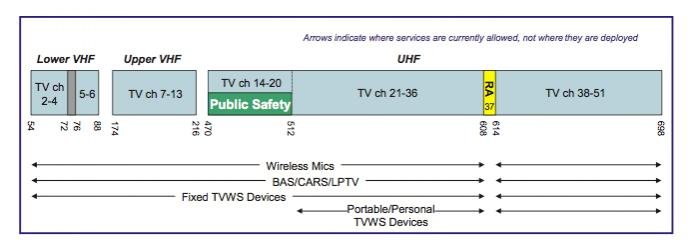
Here is an FCC graphic showing how the U/V Band is used:
 

Attachments

  • U:V_Band.jpg
    U:V_Band.jpg
    24.6 KB · Views: 17
Last edited:
i just thought of a question.

if the analog tv band is so unused, why the hell did we go to digital tv?
 
There is no "analog TV band." There's a single "TV" band (stretched across three bands...) and it's mostly very well used. I think there are two discussions happening here, you asked about the TV band in general, but people thought you were referring to channels 2-6 (which nobody, not even TV, wants). An analog TV would get you nothing or maybe one or two analog stragglers in most places. A digital TV would usually get you a lot of stuff, but almost none of it would be on RF channels 2-6.

- Trip
 
another question.

exactly why was tv switched to digital?
 
Because it allowed for HD and multicasting. More importantly to most people, it allowed for stations to be placed closer together, freeing channels 52-69 for public safety and cell phone applications.

- Trip
 
digital tv certainly made it more difficult to get good tv reception with aan antenna.i tried to do without cable for some time to save money.i was never able to get a consistant signal for all the channels on the sets in my apartment.during analog at least often it was a fuzzy picture at least.with digital it is all good or nothing.
 
digital tv certainly made it more difficult to get good tv reception with aan antenna.i tried to do without cable for some time to save money.i was never able to get a consistant signal for all the channels on the sets in my apartment.during analog at least often it was a fuzzy picture at least.with digital it is all good or nothing.

If you got a lousy analog picture with your antenna, you'll probably get nothing from digital signals. If you only have a VHF antenna, you'll probably get next to nothing because most digital transmitters are on the UHF band, even though you select stations using their old VHF numbers. For example: KTVK Channel 3.x Phoenix actually transmits on UHF Channel 24. RF Channels 2 thru 6 (VHF-LO) are not used in Arizona other than for translators.

An antenna that will work well for digital TV must be highly directional, have both VHF and UHF elements, and be pointed exactly in the right direction. A preamp may or may not be necessary, depending on your location and how far away you are from the transmitters. An overloaded preamp will cause signals to distort, making them disappear. If the preamp can pass FM stations, they can also overload a preamp. An FM trap may be necessary (I needed one).

Planes flying overhead, the wind blowing leaves on the trees around (especially with UHF), even the sun in the same direction from you as the station, may cause stations to disappear. Multipath created ghosts on analog signals. It is a killer of digital signals.

Digital signals have almost no margin for error. But they give a much better picture if everything is working properly.
 
before i got rid of cable which was in 2010 i have not tried to get an antenna to pull over the air tv since 1986.from what you are saying and what i heard elsewhere a person has to do way too much research to do something as basic as pulling in an over the air tv signal.i have lived in this general area most of my life and on an analog set i never had trouble getting analog tv signals.digital was another case.

EDIT:i never needed more the the rabbit ears that came with the set and the uhf clip on antenna to get analog.
 
Last edited:
BTW, at home I was able to get several analog channels via Tropospheric Ducting back in the summer of 2009, and again in 2010, 2011, and 2012. These often included bursts of programming from Mexico on channels 2, 3, 4, and even up to 6. I had very good reception of a station in Eastern Canada for a couple of days once.

Most of what I get in 2013 is now just huge black vertical lines (six of them across the screen) on the low-band channels, which I think are due to the 45 KHz square-wave from switch-mode power supplies nearby, and a lot of detailed "noise" with a rolling, weaker "sync bar", which I think comes from neighbors' plasma TV sets.
 
before i got rid of cable which was in 2010 i have not tried to get an antenna to pull over the air tv since 1986.from what you are saying and what i heard elsewhere a person has to do way too much research to do something as basic as pulling in an over the air tv signal.i have lived in this general area most of my life and on an analog set i never had trouble getting analog tv signals.digital was another case.

New technology always requires some study. Imagine what the early adopters of analog TV prior to 1945 had to go through, what with changing standards (prior to 1941) and channel frequencies. Existing TVs had to be modified when the post-war allocations were approved. Of course, there were only a few stations and a few thousand sets, mostly in New York, Chicago, and Philly, then.

Early UHF stations also had problems, what with low powered transmitters (most were at about the level of Class A stations - less than 20 kW ERP - at first), "wooden" converters that were impossible to tune, and cheap antennas. That's why they didn't survive outside of UHF-only markets. But people learned how to make it work as good as possible. Later on, of course, technology got better.

EDIT:i never needed more the the rabbit ears that came with the set and the uhf clip on antenna to get analog.

Rabbit ears and UHF loops are problematic with digital. They can work if you're close enough, but the lack of directivity is a problem. Plus, they are hard to adjust because the signal doesn't just fade in and out with adjustment. It goes away completely. A good outside VHF/UHF antenna on the roof is best.
 
living in an apartment building excludes me having a roof antenna.
 
Status
This thread has been closed due to inactivity. You can create a new thread to discuss this topic.


Back
Top Bottom
