
-
Get involved.
We want your input!
Apply for Membership and join the conversations about everything related to broadcasting.
After we receive your registration, a moderator will review it. After your registration is approved, you will be permitted to post.
If you use a disposable or false email address, your registration will be rejected.
After your membership is approved, please take a minute to tell us a little bit about yourself.
https://www.radiodiscussions.com/forums/introduce-yourself.1088/
Thanks in advance and have fun!
RadioDiscussions Administrators
You are using an out of date browser. It may not display this or other websites correctly.
You should upgrade or use an alternative browser.
You should upgrade or use an alternative browser.
WPLO Towers
- Thread starter trusty
- Start date

This might help:
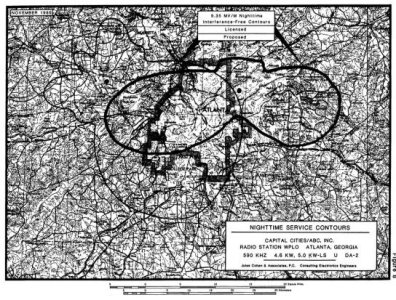
Having fun with this picture upload feature...not sure of all the ins and outs yet.
You can click the pic for a larger view. The dot in the center of the two-lobe is the old tower array. The dot in the snow angel to the west is the new array (and the old day/current night pattern).
The map itself is quite old for 1986...it shows PIB as Highway 13W (not 141) and I-75 ending in Marietta.
The WPLO array appears to be SSW of PDK and about a mile and a half south of Buford Highway. IIRC an apartment complex is there now.
Having fun with this picture upload feature...not sure of all the ins and outs yet.
You can click the pic for a larger view. The dot in the center of the two-lobe is the old tower array. The dot in the snow angel to the west is the new array (and the old day/current night pattern).
The map itself is quite old for 1986...it shows PIB as Highway 13W (not 141) and I-75 ending in Marietta.
The WPLO array appears to be SSW of PDK and about a mile and a half south of Buford Highway. IIRC an apartment complex is there now.
Last edited:
The old WPLO towers were on North Druid Hills Road between Briarcliff and Clairmont. They were south of what is now a Target and immediately south of a church on the east side of the road. As Jabba said, an apartment complex now occupies the site. It used to be called Arbor Hills but recently changed its name, and I can't recall what it is.
The current 590 site is way out in Powder Springs, north of Robert Clay Road and west of Ewing. The move really destroyed the signal in a lot of Atlanta though the recent increase to 12KW daytime helped.
The current 590 site is way out in Powder Springs, north of Robert Clay Road and west of Ewing. The move really destroyed the signal in a lot of Atlanta though the recent increase to 12KW daytime helped.
Thanx. I have that pic, but I was looking for the exact location - like an address.
And, after having time to do a little more research, I found it on:
http://www.geocaching.com/mark/details.aspx?PID=DG2744
Checked it on Google Maps. Everything fits - even Street View. The website has more detail.
*EDIT*
written before Roddy's post. Thanks, guys.
And, after having time to do a little more research, I found it on:
http://www.geocaching.com/mark/details.aspx?PID=DG2744
Documented History (by the NGS)
1/1/1973 by NGS (FIRST OBSERVED)
DESCRIBED BY NATIONAL GEODETIC SURVEY 1973 (JCL) THE STATION IS THE TOP AND CENTER OF THE ATLANTA RADIO STATION WPLO, OWNED BY THE PLOUGH BROADCASTING COMPANY INCORPORATED. IT IS THE CENTER ONE OF THREE IDENTICAL MAST IN A NORTH-SOUTH LINE. IT IS A STEEL TRUSS-WORK, GUYED MAST, PAINTED ALTERNATELY RED AND WHITE AND IS APPROXIMATELY 305 FEET HIGH.
STATION IS LOCATED IN THE NORTHEAST SECTION OF ATLANTA AT 2694 NORTH DRUID HILLS ROAD.
Checked it on Google Maps. Everything fits - even Street View. The website has more detail.
*EDIT*
written before Roddy's post. Thanks, guys.
Last edited:
Thanx. I have that pic, but I was looking for the exact location - like an address.
And, after having time to do a little more research, I found it on:
http://www.geocaching.com/mark/details.aspx?PID=DG2744
Checked it on Google Maps. Everything fits - even Street View. The website has more detail.
*EDIT*
written before Roddy's post. Thanks, guys.
The Geocaching link says the towers are still there as of 2006 (!). Google Maps shows no towers, and I would be HIGHLY surprised if they were still there, unless they were talking about the NGS marker at the center tower location and not the tower itself.
What is it about the Cheshire Bridge/Druid Hills/LaVista/Briarcliff area that made it such a favorite for AM radio towers? WPLO 590 was there and WSB, WQXI (4 tower DA array), WNIV, WGKA, WAFS, and WMLB are still there--you could include WATB's three-tower array (and former home of WMLB) if you are willing to stretch the area to Scottdale. IIRC WMLB shares a tower with one of the other nondirectionals (or is it another station that is piggybacked?)
My dad used to listen to WPLO and I seem to remember its signal being just about as good as WSB's during the day. My daughter used to listen to WDWD, and it wasn't as good until they upgraded the day signal (now it booms). At night, WDWD is full of regional channel interference.
Also the FM 103.3 WPLO was there too, I believe?? 590 had a huge signal during the day at even 5k.
Correct on both counts.
Jabba, remember WSB-AM's tower is not far from there also. Generally on which side of town towers are located has a lot to do with their directional pattern. WSB's tower seems close in for a 50,000 watter, but maybe the ground conductivity around here had something to do with that. And the stations on Cheshire Bridge are non-directional (with the exception of WQXI at night), and being there gives them a centralized signal that goes throughout the market.
The Geocaching link says the towers are still there as of 2006 (!). Google Maps shows no towers, and I would be HIGHLY surprised if they were still there, unless they were talking about the NGS marker at the center tower location and not the tower itself.
Guess I wasn't that clear. When I said "everything fits", I was talking about the lay of the land which is the same as it was when the towers were there even though they have been replaced by condos.
What is it about the Cheshire Bridge/Druid Hills/LaVista/Briarcliff area that made it such a favorite for AM radio towers? WPLO 590 was there and WSB, WQXI (4 tower DA array), WNIV, WGKA, WAFS, and WMLB are still there--you could include WATB's three-tower array (and former home of WMLB) if you are willing to stretch the area to Scottdale. IIRC WMLB shares a tower with one of the other nondirectionals (or is it another station that is piggybacked?)
I always thought the Cheshire Bridge area was only good for AM towers because it was a floodplain for Nancy Creek and probably provides the best ground conductivity in the area which needs all the help it can get.
My dad used to listen to WPLO and I seem to remember its signal being just about as good as WSB's during the day. My daughter used to listen to WDWD, and it wasn't as good until they upgraded the day signal (now it booms). At night, WDWD is full of regional channel interference.
I remember listening on the north side (close to ATL city limits) to the day/night changeover on both stations. When WQXI went directional, it sometimes got lost in the mix of other 790 skywave. However, when WPLO went directional, there was hardly any difference.
WSB's tower was WAY out in the country when it was built. Remember there was no I-285 then - just a little 2-lane road (LaVista) between Buckhead and Tucker.WSB's tower seems close in for a 50,000 watter, but maybe the ground conductivity around here had something to do with that.

I always thought the Cheshire Bridge area was only good for AM towers because it was a floodplain for Nancy Creek and probably provides the best ground conductivity in the area which needs all the help it can get.
WSB's tower was WAY out in the country when it was built. Remember there was no I-285 then - just a little 2-lane road (LaVista) between Buckhead and Tucker.
I mentioned WSB-AM. I was wondering if the Cheshire Bridge tower gulch was in a floodplain - cheap real estate not good for much else and good ground conductivity. That's why WCNN is where they are out in Peachtree Corners, also in a floodplain, and I am assuming WDWD is also in a floodplain (or it is now, since it flooded a few years back).
Isn't that northeast quadrant also one of the few areas ITP not claimed by Hartsfield's or Dobbins's flight patterns, hence all the tall TV/FM candelabras nearby?
I always thought the Cheshire Bridge area was only good for AM towers because it was a floodplain for Nancy Creek and probably provides the best ground conductivity in the area which needs all the help it can get.
Correction: Peachtree Creek
That's why WCNN is where they are out in Peachtree Corners, also in a floodplain,
The flood plain part is mostly likely correct about the exact location, but the former Sylvia NC 680 and going south-southwest directional at night might have entered into the picture. A long time ago there was a link that went into detail the "relationship" between the two 680's. WCNN's site was picked a long time ago. I am sure if the former owners of 680 had a time machine, the nighttime antenna site would have been in the flood plain on the other side of Lake Lanier and some kind of "deal" would have been made with WPTF Raleigh and 680 Sylvia to allow night time coverage for most of what now is the market. WCNN might still be able to modify both day and night patterns now that Sylvia is no longer on 680 with out any new towers at it's existing site.
Isn't that northeast quadrant also one of the few areas ITP not claimed by Hartsfield's or Dobbins's flight patterns, hence all the tall TV/FM candelabras nearby?
I am not an expert on FAA limits on towers but PDK is not that far from the site.
You're right about Cheshire Bridge having good ground conductivity, and I'm thinking maybe the engineers have always enjoyed the "entertainment" around there. (Just kidding!).
WCNN might still be able to modify both day and night patterns now that Sylvia is no longer on 680 with out any new towers at it's existing site.
WCNN has 8 towers; they ought to be able to come up with any pattern they want.
But wouldn't they still have to have that big ol' null towards Raleigh? They might be able to fill in the northern part, but the NE-ENE part would likely have to remain.
The 5kw AM xmitter and the 100Kw FM xmitter were both located at the N Druid Hills site. A little converted brick house. I did the midnight to six AM show for 14 months in 70/71. I had to go to the downtown studios to pick up the program log new carts and music before the show. Very time consuming. They paid a journeyman engineer to work till midnight . The all night jock had to have a first ticket. The jock had to stay till the daytime switch over . In the summer they paid a couple hours of overtime for this. The station also went directional one day a week , usually Tue or Wed for xmitter tests. Usually lasted an hour or so.
Good info, but wouldn't it be the winter when the switch to daytime operation (or is it a daylight savings thing?) Also, why did they have to go directional one day a week when they went directional every evening - or is there something else involved here?The 5kw AM xmitter and the 100Kw FM xmitter were both located at the N Druid Hills site. A little converted brick house. I did the midnight to six AM show for 14 months in 70/71. I had to go to the downtown studios to pick up the program log new carts and music before the show. Very time consuming. They paid a journeyman engineer to work till midnight . The all night jock had to have a first ticket. The jock had to stay till the daytime switch over . In the summer they paid a couple hours of overtime for this. The station also went directional one day a week , usually Tue or Wed for xmitter tests. Usually lasted an hour or so.
I remember a slight difference in mic reverb between the uptown studios and xmtr studio (in the 60s - the shift was covered by Perry Woods). You wouldn't notice it if you weren't listening for it.
You are correct got my months mixed up. Winter when the all night jock had to stay till 7:45 in the morning for switch to non directional.
WPLO was owned by Plough INC. They had a two three man daytime engineering staff. Thats when they did most of their required work. So thats when they did whatever they needed to do test wise. You could run the downtown studio audio through the board at the xmitter or make a switch to run it straight from downtown to the xmitter. You could hear a slight difference in quality between the two setups. The engineering staff was always tweeking everything. They shut down the FM xmitter at midnight on Sunday night the all night jock had to turn it back on Monday morning at six. It was easy to forget since you only did it once a week.
WPLO was owned by Plough INC. They had a two three man daytime engineering staff. Thats when they did most of their required work. So thats when they did whatever they needed to do test wise. You could run the downtown studio audio through the board at the xmitter or make a switch to run it straight from downtown to the xmitter. You could hear a slight difference in quality between the two setups. The engineering staff was always tweeking everything. They shut down the FM xmitter at midnight on Sunday night the all night jock had to turn it back on Monday morning at six. It was easy to forget since you only did it once a week.
My dad used to listen to WPLO and I seem to remember its signal being just about as good as WSB's during the day.
The old WPLO did have a strong daytime AM signal. It was the country music station in Atlanta before FM developed prominence. The night time signal for WPLO was also very good, but directional. The signal spread through Atlanta and went directionally westbound to Carrollton and eastbound toward Augusta. The signal at night deteriorated north and south of Atlanta.
How did Plough, a drug and cosmetic company (Maybelline, Coppertone, Solarcaine, St. Joseph's aspirin, etc., later merged with Schering) get into radio? Just 1950s/1960s corporate conglomerations + limits on how many licenses someone could have in a market?
I read somewhere that Plough, Inc had used radio to advertise their products, and it worked really well. So they decided to buy radio stations. I'm guessing part of the motivation was to advertise their own products free of charge. In Baltimore, where I grew up, Plough owned WCAO and constantly ran spots for things like St. Joseph's Aspirin and Coppertone.
I read somewhere that Plough, Inc had used radio to advertise their products, and it worked really well. So they decided to buy radio stations. I'm guessing part of the motivation was to advertise their own products free of charge.
Oh, yes. They ran Plough products spots all ... the ... time.
Before WPLO, there was WAGA/590, owned by Storer. I believe the xmtr building had little columns on it, a trademark of Storer.
- Status
- This thread has been closed due to inactivity. You can create a new thread to discuss this topic.