
Does anyone know what the actual technical facilities of various Mexican stations are? As in, I'm thinking of transmitter coordinates, field strength at 1 km, taking into account the antenna efficiency and transmitter power, and where applicable directional pattern. (I believe I could calculate the FS if I have the pattern data and/or antenna efficiency & transmitter power.) I'm primarily interested in Mexican stations that put any trace of a signal into southern California or southwest Arizona, especially those with at least a 5 µV/m groundwave signal anywhere in San Diego or Imperial counties.
I'm wanting to calculate their signal strengths at several various rural locations, using the M3 map, and GW curves, or radio-timetraveller's field calculator program (in which case I would pick an average conductivity, or calculate for a range along the path, to get some general idea).
I'm wanting to plan another outing to a rural place sometime this spring or summer (the sooner the better) to see how my various portable AM radios perform when they're away from strong local stations, and the few places I've been the strongest signals are still too strong - for example 1390 XEKT, the strongest at Cameron Corners, is about 20-30 dB stronger there than I like. And of course we know how inaccurate the FCC, radio-locator, etc, are for data on Mexican stations. When I've checked at that location, or in Pauma Valley, I've sometimes had stations show up with a fairly strong signal that don't even show up on a radio-locator search.
I'd ideally like to find a place where even the strongest station won't trip the scan function, or indicates below 20 dBµ on my Tecsuns, or is below 200 µV/m groundwave, for example, preferably without having to travel too far as I would be going and coming back the same day. Some places I'm considering are Descanso, Pine Valley, Lake Cuyamaca, Julian, Santa Ysabel, Lake Henshaw, Boulevard, Jacumba, Borrego Springs (have been here once something like 10 years ago, but bus that goes there no longer goes & returns to San Diego the same day - only comes to San Diego in morning & returns to Borrego Springs in the afternoon), Anza, Niland, Newberry Springs, Ludlow (all in CA), or Wellton, AZ.
I'd be using a bus to get as close as the route will get me, then biking the rest of the way (I need to drop some weight anyway). (Of course if I'm able to get a $1k-3k car that gets > 25-35 mpg at 80+ mph by then that would change how far I'm willing to go, but I'd still be doing the round trip in one day.)
Is there any chance that our resident Mexican station expert, D.E., knows their technical parameters? Examples of stations I'm interested in include, but are not limited to ...
Tijuana area: 540 XESURF, 620 XESS, 690 XEWW, 800 XESPN, 860 XEMO, 950 XEKAM, 1030 XESDD, 1090 XEPRS, 1270 XEAZ, 1310 XEC, 1420 XEXX, 1470 XERCN, 1550 XEBG, 1630 XEUT, 1700 XEPE
Ensenada area: 730 XEEBC, 920 XESDA, 1010 XEDX, 1230 XESCT, 1400 XEPF, 1590 XEHC
Mexicali area: 790 XESU, 820 XEABCA, 850 XEZF, 910 XEAO, 940 XEWV, 990 XECL, 1050 XED, 1120 XEMX, 1150 XERM, 1190 XEMBC, 1340 XEAA, 1370 XEHG, 1590 XEYX
San Luis Rio Colorado area: 1080 XEDY, 1260 XEMW, 1350 XELBL, 1450 XECB, 1480 XEMCA, 1520 XEEH
Others: 1160 XEQIN San Quintin, 1390 XEKT Tecate
Also what's the ground conductivity in northwest Mexico like? Looking at KBLU's daytime coverage map (1 kW non-directional) implies it's much less than the USA side of the border:
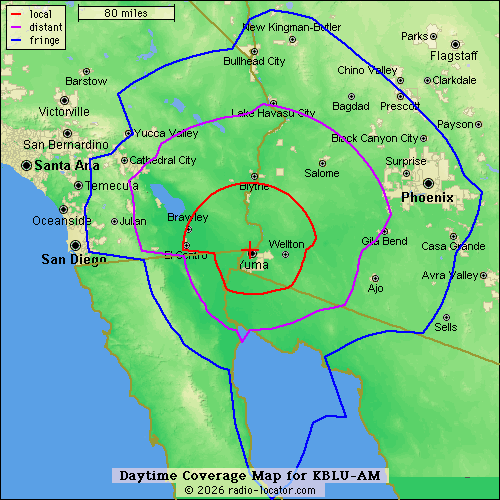
but the fact that I hear 1160 XEQIN at Cameron Corners on a portable in spite of being something like 2-3x outside their predicted fringe contour on radio-locator, and don't hear USA stations that far outside their fringe much if at all, tells me the conductivity is higher than what the maps lead me to believe.
I'm wanting to calculate their signal strengths at several various rural locations, using the M3 map, and GW curves, or radio-timetraveller's field calculator program (in which case I would pick an average conductivity, or calculate for a range along the path, to get some general idea).
I'm wanting to plan another outing to a rural place sometime this spring or summer (the sooner the better) to see how my various portable AM radios perform when they're away from strong local stations, and the few places I've been the strongest signals are still too strong - for example 1390 XEKT, the strongest at Cameron Corners, is about 20-30 dB stronger there than I like. And of course we know how inaccurate the FCC, radio-locator, etc, are for data on Mexican stations.
When I've checked at that location, or in Pauma Valley, I've sometimes had stations show up with a fairly strong signal that don't even show up on a radio-locator search.I'd ideally like to find a place where even the strongest station won't trip the scan function, or indicates below 20 dBµ on my Tecsuns, or is below 200 µV/m groundwave, for example, preferably without having to travel too far as I would be going and coming back the same day. Some places I'm considering are Descanso, Pine Valley, Lake Cuyamaca, Julian, Santa Ysabel, Lake Henshaw, Boulevard, Jacumba, Borrego Springs (have been here once something like 10 years ago, but bus that goes there no longer goes & returns to San Diego the same day - only comes to San Diego in morning & returns to Borrego Springs in the afternoon), Anza, Niland, Newberry Springs, Ludlow (all in CA), or Wellton, AZ.
I'd be using a bus to get as close as the route will get me, then biking the rest of the way (I need to drop some weight anyway). (Of course if I'm able to get a $1k-3k car that gets > 25-35 mpg at 80+ mph by then that would change how far I'm willing to go, but I'd still be doing the round trip in one day.)
Is there any chance that our resident Mexican station expert, D.E., knows their technical parameters? Examples of stations I'm interested in include, but are not limited to ...
Tijuana area: 540 XESURF, 620 XESS, 690 XEWW, 800 XESPN, 860 XEMO, 950 XEKAM, 1030 XESDD, 1090 XEPRS, 1270 XEAZ, 1310 XEC, 1420 XEXX, 1470 XERCN, 1550 XEBG, 1630 XEUT, 1700 XEPE
Ensenada area: 730 XEEBC, 920 XESDA, 1010 XEDX, 1230 XESCT, 1400 XEPF, 1590 XEHC
Mexicali area: 790 XESU, 820 XEABCA, 850 XEZF, 910 XEAO, 940 XEWV, 990 XECL, 1050 XED, 1120 XEMX, 1150 XERM, 1190 XEMBC, 1340 XEAA, 1370 XEHG, 1590 XEYX
San Luis Rio Colorado area: 1080 XEDY, 1260 XEMW, 1350 XELBL, 1450 XECB, 1480 XEMCA, 1520 XEEH
Others: 1160 XEQIN San Quintin, 1390 XEKT Tecate
Also what's the ground conductivity in northwest Mexico like? Looking at KBLU's daytime coverage map (1 kW non-directional) implies it's much less than the USA side of the border:
but the fact that I hear 1160 XEQIN at Cameron Corners on a portable in spite of being something like 2-3x outside their predicted fringe contour on radio-locator, and don't hear USA stations that far outside their fringe much if at all, tells me the conductivity is higher than what the maps lead me to believe.

