• Get involved.
    We want your input!
    Apply for Membership and join the conversations about everything related to broadcasting.

    After we receive your registration, a moderator will review it. After your registration is approved, you will be permitted to post.
    If you use a disposable or false email address, your registration will be rejected.

    After your membership is approved, please take a minute to tell us a little bit about yourself.
    https://www.radiodiscussions.com/forums/introduce-yourself.1088/

    Thanks in advance and have fun!
    RadioDiscussions Administrators

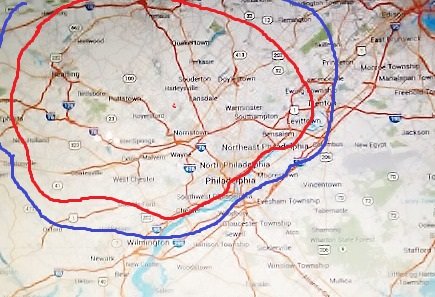
coverage map of wifi 1976

In my travels, I found this rare coverage map of WIFI 92.5 around 1976 as you can see the coverage is very minimal at best for the metro area. For 50kw at 500 feet they really did not get out much to the southeast and I always remember WMMR running all over them in the immediate Philadelphia area. But after you were out of the city they did make it to the shore...go figure...

wifi coverage.jpg
 
According to Radio Locator today's 92.5 WXTU:
Effective Radiated Power 15,000 Watts
Height above Avg. Terrain 279 meters (915 feet)
Height above Ground Level 267 meters (876 feet)
Height above Sea Level 343 meters (1125 feet)
Antenna Pattern Directional

Their signal does not go as far West as it did in WIFI 92 days, but the "local signal" does goes further south to below Wilmington to just below New Castle and further east to almost Vineland. From Radio Locator's description it appears that today's 92.5 is using far less power 15Kw vs 50Kw, but the tower is higher than the 500 feet of WIFI's tower. I'm not a radio engineer, but my guess is the added height really helps get the signal out so far less power is needed. Apparently today's 92.5 is a directional signal, don't know about in WIFI's days. That too may make a difference. There are plenty of radio engineers here who can give us the straight scoop on this.

I'd have printed the Radio Locator map, but couldn't figure out how to copy and paste it here. To see their map the link: http://www.radio-locator.com/cgi-bin/pat?call=WXTU&service=FM&status=L&hours=U
 
I didn't know WIFI had even been invented in 1976.

Were hackers and the NSA spying through it back then, too?
 
You can notice on the old coverage map the strict null to the southeast, although they were omni back then, for some reason they could not get a clear signal in center city and points beyond, east and south. But going Northwest they were gangbusters, I remember picking them up in Lebanon like a local, even though their stereo separation was very tight. I remember someone telling me they had to compress it to get a better signal out.
 
Last edited:
One could look at that map and envision WIFI 92 having its tower in Norristown and being directional, with the signal to the southeast eroded as a result.
Sort of like having a round cookie nibbled at, or like the start of a lunar eclipse.

Whether that map was a typo or not : WIFI indeed was the toughest FMer licensed to Philly proper to hear on Long Island during tropo reception in the late 70's. WYSP and WSNI and WMGK and WMMR would rip through the tropo passage. Even the Beautiful Music on 106.1 would come in (with Long Island's WBLI 106.1 on the air, too!).

But WIFI was at best, an UnID station. * Something * was there, probably they, but the signal wouldn't permit a definitive, official logging.
 
This helps explain why they didn't come in well on a clock radio in Cherry Hill in that period, and also why they had advertisers from Reading.
 
Someone on the "OTHER" board under the KGO thread, insists that WIFI killed WIBG and WFIL, which is totally false. Granted, most other metros and smaller markets did have their heritage AM top 40 destroyed by the new kid on the block, which was the top 40 FM Stereo format. Some local examples were WSTW killing WAMS, WMGM killing WMID, WXLO killing WABC and so on. These new FM's were powerful, static free, clear and blanketed the market with true Stereo Separation and great reception. In the Philly market it was a different story, the local FM top 40 WIFI, had no coverage, sounded flat, was prone to drops and static and had no true Stereo Separation, they were not a big player although their presentation was very good. WCAU-FM Hot Hits was the big player, Great Stereo Separation, fantastic coverage and crystal clear reception, if they started in the mid 70's like other market Top 40's then I would say that was the end of WIBG and WFIL but they came on much later.

wifi.jpg
 
Last edited:
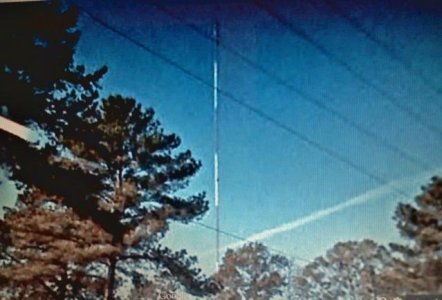
Happen to find a photo of the WIFI tower taken fall 1974 on Potshop Road, its really hard to make out the bays, I don't know how many they used but for 50kw it had to be four or more...I think...heck it looks there were chem trails way back then in the background lol

wifi nov 1974.jpg
 
heck it looks there were chem trails way back then in the background lol
View attachment 271
Maybe someone accidentally launched a Nike Missle from the base up the road. :)

Seriously though, I pass WIFI's old site several times a week and, for as high as it is on the ridge, the signal path between there and center city looks like it would be a tough nut to crack with the additional ridges between the two. From Potshop Road you cannot see center city (even the newer tall buildings that are far higher than Willie Penn's hat). Roxborough, Lafayette Hill, etc block the line of sight. Even from a much higher elevation on Whitehall Road with a clear view to the SE, you can't see anything beyond the Roxborough towers. I'm sure that had to hurt their signal in center city.
 
Its been ages since I have been up that way, I know the WIFI tower was taken down years ago. I am kinda sure the old WTEL four tower site was on the opposite side of Germantown Pike, funny thing is from the same location as WIFI, WTEL had a good signal into the city. I guess AM is much different than FM.
 
Yes, AM is quite a bit different. For one thing AM not a line of sight as is FM.

The use of directional antennas by many AM stations also makes a difference. In the case of 860 WTEL (now WWDB), although they are licensed at 10KW, they have a highly directional pattern directly toward center city. The equivalent power in that main lobe is about 45KW! That's going to give them a very dynamic signal over center city. And because line of sight is less of an issue on AM, all of those high ridges between the East Norriton/Eagleville area and center city has minimal effect on 860's signal.
 
@Hangman .....

Agreed here that WIFI 92 wasn't what caused the downslide of WFIL and WIBG, but for another reason.

See, I'm not originally from Philly. But my Folks moved to Fairless Hills in 1971 from Long Island, and my wife is from the Pennsylvania Levittown. So, working in AoR for about eight years right at those times, I did manage to compile lots of travel miles to, and much radio listening in, Philadelphia.

The recall here is that Top 40 was on the definite decline, not just in Philadelphia, but everywhere. Through those mid- and late-Seventies, AoR had devoured teen and college-age listenership. And Philly AoR was very, very well represented that way, by the Abrams-esue WYSP, the Metromedia WMMR, and WIOQ.

The glory 'survey' days of WFIL and WIBG faded, as the AM dial allegiance faded. But WIFI was not the reason, agreed.

(I liked the station, by the way :- )

 
WIFI put a nice signal into Allentown/ Bethlehem in the late 70s/ early 80s, not that they intended to. But it sounded good in the car, where WCAU-FM and WSNI would tend to drop out with lots of picket fencing.

The two local top 40 AMs were evolving into AC with some specialty talk shows at night. The teen camp seemed split between AOR and Top 40 with WIFI taking some of the pop audience. Byron and Tanaka, Bill O’Brian, Liz Kiley, Andre Gardner were all known here. It would be 1983 before the Lehigh Valley had an FM flip to CHR.
 
If I'm not mistaken, 92.5 -- I think they were already WXTU by the time they did this -- paid WOBM Toms River at 92.7 to accept interference from their Philly signal so they could move their tower (or increase their height or so non-directional. Something like that.) I believe it was back in the 1980s.
 
Last edited:
I agree with AOR being the biggest reason for the demise of AM top 40 in philly. By 1978 not many teens were talking about the top 40 channels but WMMR and WYSP were all the rage and the stage was set for MMR to rule the 80’s like it did and I’m glad they are still thriving in this day and age. I do remember WIFI and was a fan but by the time I was 12 I was clearly in the AOR camp. I am 52 now and WIFI was a tough catch in the car in Browns Mills around that time. WOBM interfered with it
 
My memory of WIFI-92 is that it was more top 40 than the station I listened to, WIOQ. In the early 70s, WIOQ was trying to stay afloat with its heritage format from the WFIL-FM days, but struggled with their identity a bit. As a result, listenership dropped and WIFI was like the harder competitor for pop music on FM, but WIFI's signal was crap. I got it OK on my home stereo in Upper Darby, and I still recall that it always sounded like there was a ton of compression on the audio.

From 1974 to 1976, I worked at WIOQ. When I started, WIFI was still a competitor. WIOQ began its transition to an AOR station in those years, being full-on progressive rock by the time I left and looked on WMMR and WYSP as competitors.

Now, I cannot 100% vouch for my next statement. It may have been hearsay, but it's what I heard back in the day. As WIOQ was failing, it was believed that it was going to go bankrupt and turn in the license. In that eventuality, the owners of WIFI were all set to swoop in and move the programming, lock stock and barrel up the dial and become WIFI 102 with its better signal. But a group named Outlet came in and saved WIOQ from the auction block and it survives through to today.
 
Status
This thread has been closed due to inactivity. You can create a new thread to discuss this topic.


Back
Top Bottom