By definition, at least one end of a "ground lead" must connect to ground.
Unfortunately a true r-f ground does not exist at the top of a long, vertical conductor connected to one or more buried conductors at its base.
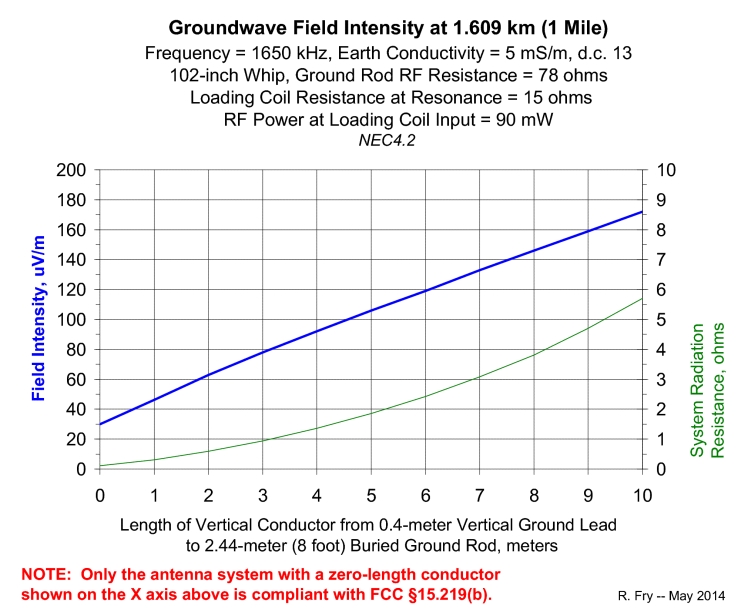
Below is a chart showing how for other things equal, the groundwave field intensity of a Part 15 AM setup at 1 mile varies with the length of vertical conductor used between the end of the ground lead, and a buried ground rod.
The conductor lengths were chosen to cover the range of systems from one fully compliant with FCC §15.219(b) to those where the transmitter and whip are elevated up to 10 meters (32.8 feet) above the earth. A standard 8-foot long ground rod was used. The length of the whip antenna was 102 inches. Earth conductivity was set to "average."
The transmitter power was set to that possible from a transmitter having a Class E final amplifier capable of driving this load resistance with 90% d-c input to r-f output efficiency when adjusted to meet FCC §15.219(a).
The fields shown in the chart can be modified for other output powers by multiplying them by the SQRT(Other Output Power in mW/90).
The field improvement at 1 mile for the system shown in the chart at 10-meter elevation is better than 5:1 compared to the system using only a 0.4-meter conductor length to the ground rod.
The system at zero elevation would need more than 25 times that 90 mW transmitter power to produce the same ~ 170 µV/m field at 1 mile as the system elevated 10 meters.
Also note that the system compliant with FCC §15.219 produces a higher groundwave field at one mile than is permitted at 30 meters for this frequency by §15.209.
I know I've posted such information in the past, but new questions continue to appear, so I keep responding to them -- hopefully in a way that better explains this subject.

Unfortunately a true r-f ground does not exist at the top of a long, vertical conductor connected to one or more buried conductors at its base.
Below is a chart showing how for other things equal, the groundwave field intensity of a Part 15 AM setup at 1 mile varies with the length of vertical conductor used between the end of the ground lead, and a buried ground rod.
The conductor lengths were chosen to cover the range of systems from one fully compliant with FCC §15.219(b) to those where the transmitter and whip are elevated up to 10 meters (32.8 feet) above the earth. A standard 8-foot long ground rod was used. The length of the whip antenna was 102 inches. Earth conductivity was set to "average."
The transmitter power was set to that possible from a transmitter having a Class E final amplifier capable of driving this load resistance with 90% d-c input to r-f output efficiency when adjusted to meet FCC §15.219(a).
The fields shown in the chart can be modified for other output powers by multiplying them by the SQRT(Other Output Power in mW/90).
The field improvement at 1 mile for the system shown in the chart at 10-meter elevation is better than 5:1 compared to the system using only a 0.4-meter conductor length to the ground rod.
The system at zero elevation would need more than 25 times that 90 mW transmitter power to produce the same ~ 170 µV/m field at 1 mile as the system elevated 10 meters.
Also note that the system compliant with FCC §15.219 produces a higher groundwave field at one mile than is permitted at 30 meters for this frequency by §15.209.
I know I've posted such information in the past, but new questions continue to appear, so I keep responding to them -- hopefully in a way that better explains this subject.

 Do I read the comparison correctly that a 102" whip with radials at 1 mile will produce 30uv yet a 118" whip with no ground will yield 24uv at 2 miles? If so, would that translate to 96uv at 1 mile? If this is the case, the ground system's importance seems to be of minimal value--unless all of that "gain" can be attributed to the extra 16" of antenna.