
• Get involved.
    We want your input!
    Apply for Membership and join the conversations about everything related to broadcasting.

    After we receive your registration, a moderator will review it. After your registration is approved, you will be permitted to post.
    If you use a disposable or false email address, your registration will be rejected.

    After your membership is approved, please take a minute to tell us a little bit about yourself.
    https://www.radiodiscussions.com/forums/introduce-yourself.1088/

    Thanks in advance and have fun!
    RadioDiscussions Administrators

English song on 106. 5

I had to laugh - the guy that cuts my grass is Mexican. He actually HAS limited English skills. In his case, I use Latin to communicate, somehow he gets the message. ...A little Latin goes a long way - hardly a dead language.

Strange.

I did my final year (out of 6) of Latin at the Colegio Americano in Quito. I was the only Gringo in the class, which was famous for being among the most tedious and difficult of all the classes. Even for the kids who had been taking Latin for the previous five years, it was not easy and knowing Spanish did not make it easier.

Using Latin to speak to Spanish speakers is sort of like those comic-strip tourists who add an -a or an -o to the end of English words to make them sound like Spanish. There are enough similar words to sometimes make a point, but you can't really communicate that way.
 
Let's see, where was the outrage by whites when Guantanamera played on the radio? Or La Bamba? Or the Spanish / partially Spanish version of Love Will Keep Us Together? Or Sukiyaki - for that matter - which was Japanese less than two decades after WW2? It doesn't automatically become racial when a Spanish or other foreign language song plays on a English speaking station. So why should the reverse be true?

Some of us really wish this whole "racial victim" thing would just go away and be replaced by people that are proud of who and what they are - and not be so sensitive when they see or hear something they don't like.

I REALLY like my black and hispanic friends. They don't include a single one who have a chip on their shoulder: "I'm offended by that song / that flag / what you watch / your race". People like that are nasty, unpleasant people with poor self image who need to get over themselves.

Coming from the same fingers that typed, "If you're going to be in this country, learn the language!" Only one around here with a chip on his shoulder is you, sir. I'm no victim. Good grief man, I married a Mexican woman. We had a mixed race child together. I am extremely proud to be White, and that my child is fortunate enough to be able to experience and appreciate both family's heritages. You are right, however, on one thing. People like that are nasty and unpleasant, oh and btw, they also tend to justify their own bigoted thoughts by STRESSING that they have Black friends and Mexican friends, etc. My wife was just that, my wife. Not my Mexican wife. My friends are my friends period, no need for the qualifying adjective placed before it. Of course, I'm not the one trying to mask what I really am, either. Let's be honest here, you were the subject of my example, Bruce. You'd be the first one to flip the dial if Spanish music suddenly came across your radio's speakers.
 
You are right, however, on one thing. People like that are nasty and unpleasant, oh and btw, they also tend to justify their own bigoted thoughts by STRESSING that they have Black friends and Mexican friends, etc.

Which brings me to my perspective: I don't have bigoted or racist friends. Anyone else qualifies.
 
I wish there were a way to give you a thumbs up, or a reputation point, or something, David. That was beautiful. Well stated!
 
You can give him a thumbs-up. Do you see the little "star" on the bottom of his post? Click the star and click on "I APPROVE" ....


Strange.

I did my final year (out of 6) of Latin at the Colegio Americano in Quito. I was the only Gringo in the class, which was famous for being among the most tedious and difficult of all the classes. Even for the kids who had been taking Latin for the previous five years, it was not easy and knowing Spanish did not make it easier.

Using Latin to speak to Spanish speakers is sort of like those comic-strip tourists who add an -a or an -o to the end of English words to make them sound like Spanish. There are enough similar words to sometimes make a point, but you can't really communicate that way.

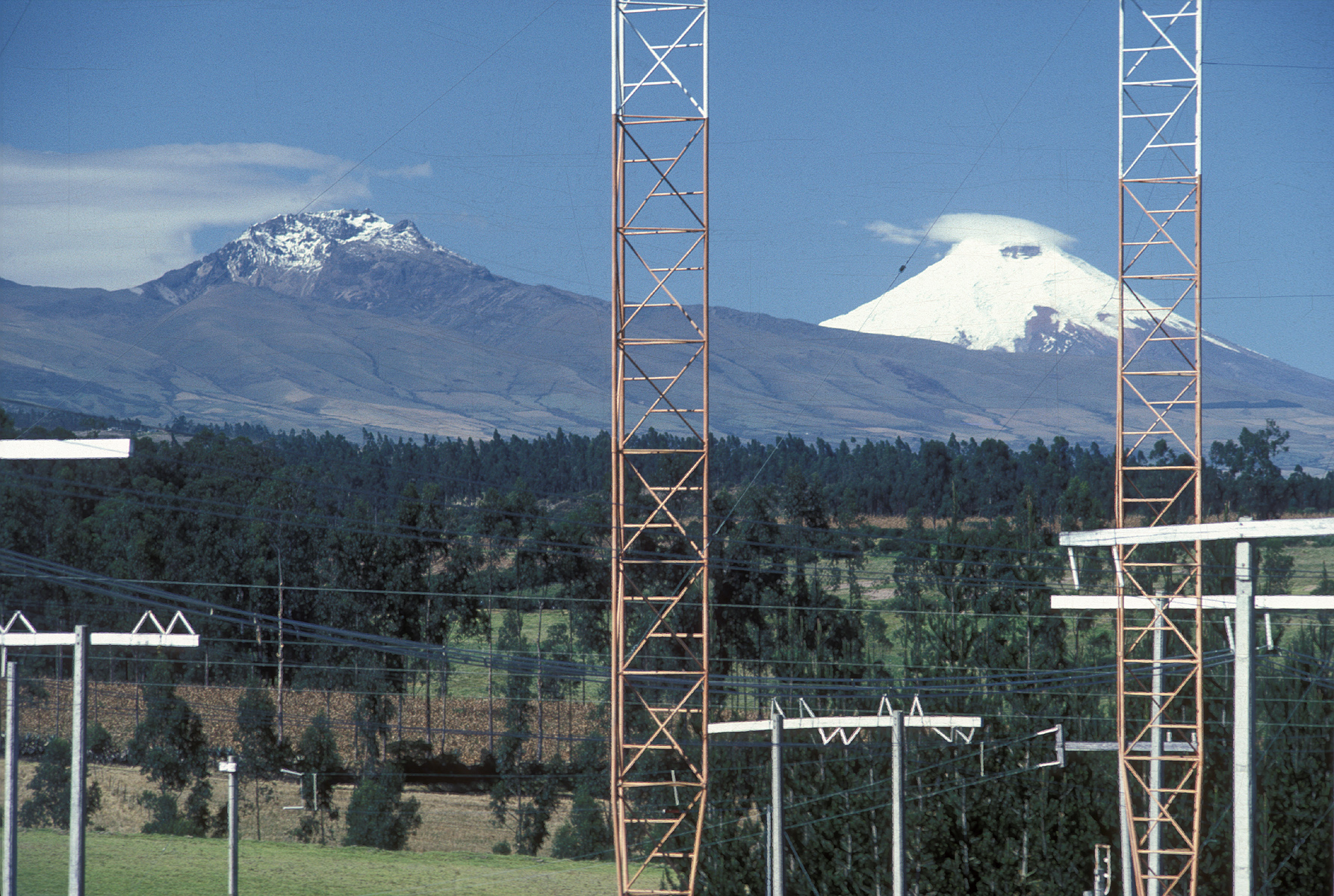
David, the Andes are so beautiful... Did you ever visit radio station HCJB down there in Quito?

pif0065r.jpg
 
How this became a racial topic surprises me. I was referring to a station that caters to us bilingual Hispanics. So us Hispanics could listen to all the music we like instead of having to flip frequencies when we are in different moods. Sometimes we feel like listening to music in Spanish. Sometimes music in English. With a bilingual station that caters to us Hispanics we wouldn't have to flip stations.
 
David, the Andes are so beautiful... Did you ever visit radio station HCJB down there in Quito?

I not only visited, I was on the air for a while on the DX Mailbag program on HCJB.

Two years later, some of the wonderful WRMF (World Radio Missionary Fellowship) engineers helped me design the transmitter for my first FM station. I later built a half-dozen transmitters using that design.

The transmitter site in your picture was about 35 miles NE of Quito at Pifo. A great Short Wave site, but not so good for their AM station as it was a bit too far out of the city. I had all my AM sites in Quito (3 of them for 4 stations) right on the edge of the city in different locations. Allowed for lower power to be used efficiently and ready access for maintenance (the road to Pifo back then was all paved with cobblestones... not asphalt or concrete).
 
How this became a racial topic surprises me. I was referring to a station that caters to us bilingual Hispanics. So us Hispanics could listen to all the music we like instead of having to flip frequencies when we are in different moods. Sometimes we feel like listening to music in Spanish. Sometimes music in English. With a bilingual station that caters to us Hispanics we wouldn't have to flip stations.

It shouldn't surprise you, mrtejano. No fault of yours though. You just keep on posting topics for our Spanish speaking community, I'll keep on shutting down Bruce Carter every time he summons up his inner Archie Bunker.


I not only visited, I was on the air for a while on the DX Mailbag program on HCJB.

Two years later, some of the wonderful WRMF (World Radio Missionary Fellowship) engineers helped me design the transmitter for my first FM station. I later built a half-dozen transmitters using that design.

The transmitter site in your picture was about 35 miles NE of Quito at Pifo. A great Short Wave site, but not so good for their AM station as it was a bit too far out of the city. I had all my AM sites in Quito (3 of them for 4 stations) right on the edge of the city in different locations. Allowed for lower power to be used efficiently and ready access for maintenance (the road to Pifo back then was all paved with cobblestones... not asphalt or concrete).

Wow! Small world. Remember the "Queen of DXing" Audrey McNeil from Blackpool Lancashire, England? She was a very good friend of mine. She's with the Lord now.

For those of you who don't know what I'm talking about, back in the 80s and 90s when it came to shortwave broadcasting HCJB was a flamethrower. They had a weekly mailbag English program called "Saludos Amigos" hosted by Ken McHarg. See pic. Individuals from across the planet not only connected with the station for reception reports, but also connected with each other as pen pals.

macharg_couple_lr.jpg
 
For those of you who don't know what I'm talking about, back in the 80s and 90s when it came to shortwave broadcasting HCJB was a flamethrower. They had a weekly mailbag English program called "Saludos Amigos" hosted by Ken McHarg. Individuals from across the planet not only connected with the station for reception reports, but also connected with each other as pen pals.

I loved those shortwave mailbag shows. My favorites were Radio Canada's (with Earle Fischer) and Radio Australia's (with Keith Glover). Joe Adamov's show on Radio Moscow had a certain offbeat charm to it as well. I never listened to HCJB much, though, and am surprised that its mailbag show evolved into a Facebook-like way for people with similar interests to form long-distance friendships. As far as I knew, the letter-writers on those other mailbag shows were one-and-done -- they wrote in with their reception reports and brief descriptions of their lives and home countries, and that was it. Did HCJB do anything to encourage listeners to keep writing in? Was there Christian content in the mailbag show that created a natural transition to fellowship?
 
Was there Christian content in the mailbag show that created a natural transition to fellowship?

When I was part of the mailbag show, there was only DX schedule information, and no religious content. Many of HCJB's shows were "magnets" and not religious. THey hoped listeners would also hear some of the religious shows.
 
For those of you who don't know what I'm talking about, back in the 80s and 90s when it came to shortwave broadcasting HCJB was a flamethrower.

HCJB began broadcasting domestically in the early 30's and became international later that decade. By the 50's they were running multiple 50 kw transmitters, and in the 60's they had a bunch of 100 kw RCA transmitters as well as the 50 kw units. 500 kw transmitters came in the 70's.
 
Last edited:
For those of you who don't know what I'm talking about, back in the 80s and 90s when it came to shortwave broadcasting HCJB was a flamethrower. They had a weekly mailbag English program called "Saludos Amigos" hosted by Ken McHarg. See pic. Individuals from across the planet not only connected with the station for reception reports, but also connected with each other as pen pals.

Also well known on HCJB 40 and 50 years ago were Clayton and Helen Howard, who hosted the DX Partyline show, which had lots of DX reports, loggings, schedules, and other shortwave news. This is all in the pre-internet age where such shows, along with DX Club newsletters and hobby magazines, were the primary source of shortwave information. Both Clayton and Helen passed away a few years ago.
 

HCJB began broadcasting domestically in the early 30's and became international later that decade. By the 50's they were running multiple 50 kw transmitters, and in the 60's they had a bunch of 100 kw RCA transmitters as well as the 50 kw units. 500 kw transmitters came in the 70's.

An interesting thing about the overall HCJB ministry is that the organization has its own technical manufacturing branch, building transmitters and other broadcast equipment for not only HCJB, but other religious broadcasters. It is now known as SonSet Solutions; more info here: http://sonsetsolutions.org/

HCJB Global recently renamed itself, and is now known as Reach Beyond https://reachbeyond.org/

HCJB now only has one 10kw shortwave transmitter operating out of Ecuador, running Spanish, Quechua, and various indigenous languages on 6050 kHz. The international shortwave service from Ecuador was shut down several years ago in favor of satellite delivery to local stations, but a shortwave operation in Australia continues for audiences in Asia. HCJB still operates AM and FM stations in Quito.
 
Status
This thread has been closed due to inactivity. You can create a new thread to discuss this topic.


Back
Top Bottom