• Get involved.
    We want your input!
    Apply for Membership and join the conversations about everything related to broadcasting.

    After we receive your registration, a moderator will review it. After your registration is approved, you will be permitted to post.
    If you use a disposable or false email address, your registration will be rejected.

    After your membership is approved, please take a minute to tell us a little bit about yourself.
    https://www.radiodiscussions.com/forums/introduce-yourself.1088/

    Thanks in advance and have fun!
    RadioDiscussions Administrators

Sony kills off Betamax

Sony’s Betamax, recognised by many as the superior recording tape mechanism, is about to be discontinued.

Betamax was formally introduced by Sony in 1975 and its tape formula inherited many of the design characteristics of the higher-end U-matic format. VHS was introduced by Japan’s JVC the following year, and quickly gained popular consumer acceptance in most markets. By 1980 VHS had won over 60 per cent of the US market.

Sony finally threw in the towel as far as consumer products were concerned in 2002 and had by then been producing its own VHS units since 1988.

However, Sony’s Betacam spin-off product, and DigiBeta, found considerable acceptance amongst ENG and SNG users, and helped by its professional picture search functionality that worked on both fast-forward and fast playback.

Sony hasn’t made Beta-based players or recorders since 2002. Now it says it is ending the production of Betamax tape, including its MicroMV tapes, in Japan (the only country in which the format is still sold) in March 2016.

http://advanced-television.com/2015/11/11/sony-kills-off-betamax/
 
It wasn't just ENG and SNG which used the Betacam format. Most U.S. television stations used analog and digital Beta machines (and tapes) for program and commercial playback until well into the twenty-first century.
Television stations across the country have decades of archived Betacam tapes. Hopefully, the stations will get busy and transfer the tapes to some kind of digital storage media before the tapes can no longer be played.
 
The end of an era. Betamax was a popular format competing with VHS in the 1980s. Then Betacam (and SP) showed up, and many TV stations used the format. We are continuing into a digital age, folks.

-crainbebo
 
The end of an era. Betamax was a popular format competing with VHS in the 1980s. Then Betacam (and SP) showed up, and many TV stations used the format. We are continuing into a digital age, folks.

-crainbebo

Betamax was admittedly the better technical product but lost out to VHS on recording time and cost of equipment. If memory serves, Betamax was a maximum of 2 hours recording time per cassette whereas VHS was 6 and the difference in picture quality was not very noticeable (when both machines were running at the 2 hour per cassette speed). Because the initial cost of empty cassettes was something around $20 the recording time constraint was significant to most purchasers.

Beta machines were also significantly more expensive due mainly to lack of competition whereas VHS had many licensees and a dozen major manufacturers.


Betamax was admittedly the better technical product but lost out to VHS on recording time and cost of equipment. If memory serves, Betamax was a maximum of 2 hours recording time per cassette whereas VHS was 6 and the difference in picture quality was not very noticeable (when both machines were running at the 2 hour per cassette speed). Because the initial cost of empty cassettes was something around $20 the recording time constraint was significant to most purchasers.

Beta machines were also significantly more expensive due mainly to lack of competition whereas VHS had many licensees and a dozen major manufacturers.

Beta started with a one hour speed. VHS quickly moved to a two hour speed and Beta spent the rest of its existence playing "catch-up". Six hours was the slow(SLP)speed for VHS. I believe Beta got up to five hours. Beta-1 was actually quite good and was incorporated for playback only in later models.
 
A big part of the problem with the lack of acceptance of Beta that it was exclusively a Sony product vs. VHS being licensed to multiple brands, similar to Apple vs. Windows in PCs and Android in phones and tablets. But Apple has managed to succeed where Sony didn't for as long with Beta.
 
A big part of the problem with the lack of acceptance of Beta that it was exclusively a Sony product vs. VHS being licensed to multiple brands, similar to Apple vs. Windows in PCs and Android in phones and tablets. But Apple has managed to succeed where Sony didn't for as long with Beta.

Beta wasn't exclusively Beta for that long. I had a Sanyo, at about the time prices started to come down. Not long before that, they were in the 2,000.00 range!
 
I purchased the very first Betamax model in 1976. I paid $1350 for the machine. It did make good recordings ... better than VHS machines.
Years later, I purchased a Sanyo Beta hi-fi deck. I liked it because it had audio recording level controls and VU meters.
 
The first VCR I can remember seeing was in my high school in 1975, and must have been Beta because I thought VHS came out a year or two later.
 
Beta started with a one hour speed. VHS quickly moved to a two hour speed and Beta spent the rest of its existence playing "catch-up". Six hours was the slow(SLP)speed for VHS. I believe Beta got up to five hours. Beta-1 was actually quite good and was incorporated for playback only in later models.
I was buying 8-hour VHS tapes. The last several I bought were 6-hour. Anyway, all the machines I have now eat the tapes and I don't know how to remove them. And the repairman I bought one of the TVs from is out of business. This is why I have three TiVos.
 
This thread got me into the research mode.
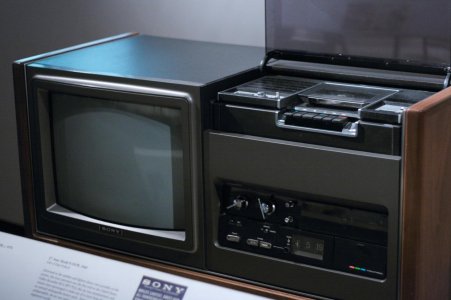
The Betamax LV-1901 was released in the USA in November or December, 1975.
It consisted of a 19" Trinitron television and an SL-6200 Beta 1 videocassette recorder.

Sony LV-1901D.jpg

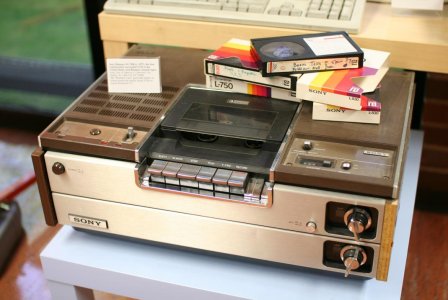
In 1976, Sony came out with the SL-7200 Beta 1 tabletop unit.
That is the unit which I purchased in September, 1976.

Betamax SL7200.jpg
 
I was buying 8-hour VHS tapes. The last several I bought were 6-hour. Anyway, all the machines I have now eat the tapes and I don't know how to remove them. And the repairman I bought one of the TVs from is out of business. This is why I have three TiVos.

The 8 hour VHS tapes were thinner than the 6 hour tapes, and could be eaten easily by even a good quality VCR.
 
Yes. The VHS machine had to be designed to use the 8 hour tapes. I believe that there was a warning on the tape boxes.
 
I was buying 8-hour VHS tapes. The last several I bought were 6-hour. Anyway, all the machines I have now eat the tapes and I don't know how to remove them. And the repairman I bought one of the TVs from is out of business. This is why I have three TiVos.

It is a simple matter to remove a VHS tape cartridge from a recorder.

Unplug it.
Remove the outer case by removing the various screws on back and sides (location and # of screws varies by manufacturer).
Using scissors or small, sharp knife, cut tape and unthread from tape transport.
Plug in and use control keys to eject cartridge. If this doesn't work you will need to unplug machine and work cartridge loose from drive slowly and carefully.
Plug in and reset controls by pushing eject button.
Insert new cartridge and test.

If new cartridge doesn't operate normally the machine will probably need adjustment and/or lubrication which is not usually done by end customer.

There are lots of moving parts in a tape recorder. Don't start changing things if you don't know what you are doing.
 
Ah, yes - electronic nostalgia. My first VCR was an early VHS -I bought it about 1982, and it cost about $850. It was big, you loaded the tapes from the top, and it weighed about as much as a cinder-block. It had a wired remote whose only function was "pause." I ran a video store from 1983 thru 1990, and during the first 5 years or so, we carried most titles in both VHS and Beta. But as Beta lost market share, we transitioned to VHS only. About 1985, I bought a Sony Beta recorder, and IIRC - the picture qualify was superior.

I still have a VHS recorder - I seem to recall that I bought it in the late 90s or 00s, and it cost around $59. I probably haven't used it in 7-8 years. Basically, it's now only a digital clock that sits on a shelf below my DirecTV box and DVR, and above my amplifier. I still have a small "library" of about 50 films - mostly Disney and other kid's titles that I bought for my kids (now 32 and 28) during their childhood. I may dig them out and watch a few some day.
 
Last edited:
I still have a VHS recorder - I seem to recall that I bought it in the late 90s or 00s, and it cost around $59.

Probably doesn't even have a tuner. I still have 3 VHS in working condition and the two latest versions both have no tuner (not that they would work now anyway).
 
I acquired a couple of second-hand VCRs rather recently - a JVC unit at a thrift store, and a Mitsubishi HS-U36 (1992) off eBay. Both run well, and play rental tapes from as early as 1980, and home-recorded as early as 1983. Most were acquired second-hand tapes (the 1980 is a Magnetic Video copy of Alien, and the 1983 is a 6-hour TDK VHS with two Gene Kelly movies, one off WFLD Chicago, and the December 83 NBC special "Here's Television Entertainment" off WMAQ with commercials).
 
T-200s. They were made by BASF and Memorex in the late 1990s and early 2000s. VERY thin tape.
Maxell still had 9 hour T-180 tapes until recently.


It is a simple matter to remove a VHS tape cartridge from a recorder.

Unplug it.
Remove the outer case by removing the various screws on back and sides (location and # of screws varies by manufacturer).
Using scissors or small, sharp knife, cut tape and unthread from tape transport.
Plug in and use control keys to eject cartridge. If this doesn't work you will need to unplug machine and work cartridge loose from drive slowly and carefully.
Plug in and reset controls by pushing eject button.
Insert new cartridge and test.

If new cartridge doesn't operate normally the machine will probably need adjustment and/or lubrication which is not usually done by end customer.

There are lots of moving parts in a tape recorder. Don't start changing things if you don't know what you are doing.
I generally don't. By the way, all of these VCRs are part of a TV.

So that changes the procedure. I once removed a tape that was keeping the TV from even working by breaking the tape itself, but I hope there's a way some genius can put the thing back together so I can watch something I taped.
 
Status
This thread has been closed due to inactivity. You can create a new thread to discuss this topic.


Back
Top Bottom