Here is a broadcasting and DX quiz. I got help compiling this info from Wikipedia, Broadcasting Yearbook and other sources. Answers below.
1. What is the highest power AM station in North America?
2. What is the highest power AM station in the U.S.?
3. What powerful American AM station has no call letters?
4. What is the highest power FM station in North America?
5. What is the oldest radio station in North America?
6. What is the oldest radio station in New York City?
7. What is the oldest TV station in North America?
8. What is the oldest FM station in North America?
9. What is the oldest FM station in New York City?
10. Where is the tallest broadcasting tower in North America?
11. How many stations east of the Mississippi River have call signs beginning with K?
12. What is the westernmost station with W call letters?
+
+
+
+
+
+
+
+
+
+
+
+
+
+
+
+
+
+
+
1. Highest Power AM Station in North America... 900 XEW Mexico City - 250,000 watts. Mexico has several AM stations that run 100,000 watts or more, with XEW the most powerful.
2. Highest Power AM Station in USA... 1180 Radio Marti, Marathon-Miami - 100,000 watts. Radio Marti is owned and operated by the U.S. Board of Broadcasting Governors, with a very directional signal aimed at Cuba from the Florida Keys. All AM stations licensed by the FCC and Canada's CRTC are limited to 50,000 watts. But Radio Marti is not subject to FCC rules. In 1934, 700 WLW Cincinnati got special FCC permission to run 500,000 watts. But other stations complained about interference and being at a competitive disadvantage, so authorization was withdrawn in 1939. General Electric experimented at times with 100 kw and 200 kw broadcasts on WGY Schenectady, but those never became permanent.
3. No Call Letters... Also 1180 Radio Marti, Marathon-Miami. It operates outside the jurisdiction of the FCC so it has no call sign.
4. Highest Power FM station in North America... 93.7 WBCT Grand Rapids broadcasts with 320,000 watts from a 720 foot tower. 96.9 CKOI Verdun-Montreal comes close, with 307,000 watts on a 710 foot tower. 94.9 WHOM Mount Washington NH-Portland ME claims to have the largest coverage of any FM station in North America, touching five states and two provinces (NH, ME, VT, MA, NY, Que., Ont.). It runs 48,000 watts from the highest peak in the Northeast, more than 3700 feet above average terrain. The building housing WHOM's transmitter is tied down with chains due to high winds on Mount Washington. The most powerful FM station on the West Coast is probably 103.3 KVYB Santa Barbara, 105 kw on a tower nearly 3000 feet above average terrain. But much of its signal falls on the Pacific Ocean. Several Denver stations run 100,000 watts from towers 1100 feet above average terrain... which means they are more than 7000 feet above sea level and can be heard well over 100 miles away. Several Colorado Springs and Pueblo stations run 50 to 70 kw from towers that are over 9000 feet above sea level. Several stations in Albuquerque are more than 4000 feet above average terrain, putting them over 10,000 feet above sea level. By contrast, most New York City FM stations run around 6 kw from the Empire State Building, apx. 1400 feet tall.
5. Oldest Radio Station in North America... The history books give this honor to KDKA Pittsburgh, licensed by the FCC as a commercial radio station in 1921 and broadcasting continuously to this day. But other stations make other claims...
--1907, 9BC Rock Island, Illinois, now 1420 WOC Davenport, Iowa, (both communities part of the Quad Cities), starts experimenting with Morse Code, and later with voice transmissions, although the station has not been on the air continuously to this day, due to World War I.
--1909, KCBS San Francisco, originally KQW San Jose, begins broadcasting voice transmissions as an experimental wireless telephone service. (One of the men involved in putting the station on the air went on "I've Got A Secret" with Steve Allen in the 1960s. He looked to be around 75. His secret was his voice was "the first heard on a radio station" according to the show's producers.)
--1911, University of Iowa begins transmitting Morse Code as 9YA. It starts voice broadcasts in 1919 and gets a full non-commercial license in 1922. Today it is KSUI Iowa City.
--1911, Iowa State Univeristy also sets up a Morse Code station, as 9YI. It broadcasts an hour of concert music in 1921 and in 1922 it becomes the first fully-licensed non-commercial station west of the Mississippi, as WOI, Ames.
--1911, The Mallory Battery Company of Lincoln IL begins transmitting Morse Code. By 1924, the station is commercially licensed as WBBM Chicago, the call letters standing for World's Best Battery Maker.
--1912, General Electric begins experimental broadcasts as 2XI at its facility in Schenectady NY, although WGY didn't get its commercial license until 1922.
--1912, 9ZP Pierre SD gets its experimental license to begin Morse Code transmissions. The station then starts voice transmissions as 9CLS in 1916 and today that same station is 1060 KGFX.
--1915, University of Wisconsin's 9XM, now 970 WHA Madison, gets its experimental license, at first transmitting Morse Code. 9XM stays on the air through WWI, providing weather reports to ships on the Great Lakes. But being owned by a university, it never seeks a commercial license.
--1919, another Pittsburgh station, KQV, says it beat KDKA on the air by more than a year, signing on as 8ZAE, although it didn't get its commercial license until 1922.
--1919, CFCF Montréal would often say that it was "Canada's First Station," going on the air as XWA, "eXperimental Wireless Apparatus." By May of 1920, it has a regular weekly schedule, months before KDKA.
--1920, WWJ Detroit says it broadcast the nation's first regularly-scheduled radio newscasts and religious programs as 8MK.
--1921, WBZ Boston, originally in Springfield MA, says it gets its commercial license on September 15, more than a month before KDKA.
--1922, WEAF New York, now WFAN, broadcasts what may have been the first paid radio commercial when it was commissioned by a new apartment complex in Jackson Heights, Queens, near the just-completed #7 subway line, to air a ten minute talk advertising for tenants.
--Westinghouse engineer Frank Conrad puts 8XK on the air in 1916 from his garage in Wilkinsburg PA, a suburb of Pittsburgh. In 1919, a Pittsburgh music store agrees to give him a phonograph and records if he credits the business on the air. Some say that was the first radio
commercial, although it was for trade, not cash. As 8XK grows in popularity, Westinghouse asks Conrad to help construct a company-owned
radio station at its facility in East Pittsburgh, going on the air in 1920. The following year it got a commercial license as KDKA. So can we say
KDKA was the successor to 8XK and KDKA should be credited with the first commercial broadcast? Or should we simply say KDKA was the first "commercially-licensed" station, which means it is only one of many American radio stations with "firsts"?
6. New York's oldest radio station is WABC. The station, then owned by Westinghouse, went on the air as WJZ Newark in October 1921, eleven months after co-owned KDKA. Both stations got their commercial license on the same day. WOR (then owned by Bamberger's Department Store in Newark), WFAN (then AT&T's WEAF, later WNBC) and WEPN (then WHN) got their commercial licenses the following year. WCBS (originally WAHG, later WABC, but not related to today's WABC) and WINS (originally WGBS, which stood for Gimbel Brothers Department Store) signed on in 1924.
7. Oldest TV Station in North America... W2XB, unofficially called WGY-TV, now WRGB 6, started experimental video broadcasts at the General Electric complex in Schenectady in January 1928. The station is credited with airing the first TV drama when it televised a community theater play. In March 1929, RCA started W2XBS New York (later WNBT, then WRCA-TV, now WNBC) with a daily schedule beginning in 1939 to coincide with RCA's TV exhibit at the NY World's Fair. In 1931, CBS set up W2XAB, later WCBW, now WCBS-TV, in studios on Madison Avenue, with broadcasts featuring Kate Smith and George Gershwin. Also in 1931, VE9VC Montreal, co-owned by CKAC Radio, became Canada's first experimental TV station, although it took until 1952 for Canada to get its first permanent TV station, CBFT 2 Montreal. NBC's WNBT and CBS's WCBW both became America's first fully-licensed commercial TV stations on the same date, July 1, 1941, although WNBT beat WCBW on the air by an hour. That same day, WNBT aired the first TV commercial, a ticking watch with the words "Bulova Watch Time" on the screen.
8. Oldest FM Station in USA... Major Edwin Armstrong began FM experiments for RCA from the Empire State Building in 1934, although NBC, part of RCA at the time, didn't put a real FM station on the air till 1940. Later in 1934, the Buffalo Evening News started W8XH, simulcasting WBEN at around 60 MHz, which puts it between the old FM band (42 - 50 MHz) and the current FM band (88 - 108 MHz). Today that station is 102.5 WTSS. In Meridan CT, W1XPW (now 105.9 WHCN Hartford) went on the air in 1936, in the old FM band (42 - 50 MHz). That was followed by General Electric's W2XDA Schenectady (later WGFM, then WGY-FM, now 99.5 WRVE) at 48.5 MHz. WGFM was the first FM station to broadcast fulltime in stereo, in June 1961.
9. Several stations can make the case for being New York City's first FM station... WNYE-FM, WOR-FM, WQXR-FM or was it a station in Alpine NJ that was on the air from the 1930s to the 50s? In 1938, the city's Board of Education began airing classroom instructional broadcasts in the Apex band, between 25 and 42 MHz. This station became what is today 91.5 WNYE-FM. Because the Apex band is a short distance from the FM band, WNYE-FM is credited as going on the air in 1938. In August of 1939, WOR began experimenting with FM broadcasts as W2XWI from its AM transmitter site in Carteret, NJ. That station moved to New York to became WOR-FM, and is today 98.7 WEPN-FM. The first permanent commercial FM station in five boroughs of New York City was W2XQR (later WQXR-FM, now 96.3 WXNY). It went on the air at 42.3 MHz in November 1939, simulcasting WQXR-AM. In January of 1940, NBC put W2XWG on the air, later WNBC-FM and now 97.1 WQHT. CBS followed in 1941 with W67NY at 46.7 MHz (now 101.1 WCBS-FM), with its transmitter on top of 500 Fifth Avenue.
As early as 1934, Major Edwin Armstrong, working for NBC's parent company, RCA, began FM experiments from the Empire State Building. After leaving RCA, Armstrong put his own FM station, W2XMN, on the air in 1939 from a tower in Alpine NJ, just north of NYC. He used his own money, although that station stopped broadcasting in 1954 after Armstrong's suicide. It's a sad but interesting story that Armstrong was at first encouraged by RCA, his employer, to experiment with FM radio. But when NBC chief David Sarnoff heard FM's better sound quality, he apparently tried to stop the development of FM, fearing it would ruin NBC's investment in AM stations. Reports say the legal hassles between Armstrong and RCA are what drove him to jump from his apartment's 13th floor window, believing his life's work was a failure.
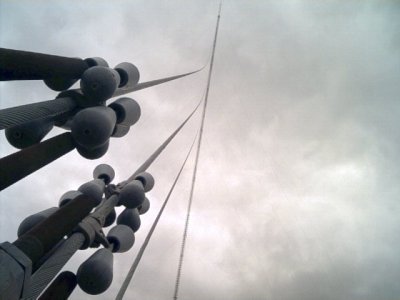
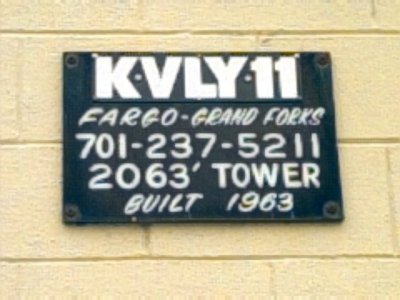
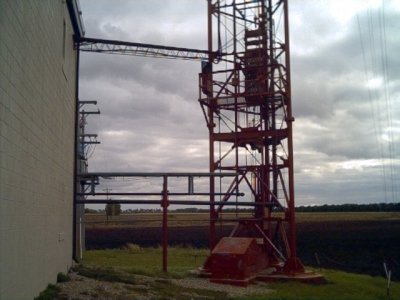
10. Tallest Broadcasting Tower... KVLY 11 Fargo has a 2063 foot tower in Blanchard, North Dakota, which was the tallest structure in the world when it was built and remains the tallest in the U.S. today. Nearby, KXJB 4 Valley City-Fargo put up a tower that is three feet shorter. When it was completed, workers put a four foot flagpole on top, temporarily making the KXJB tower the world's tallest structure. Both towers are more than 600 feet taller than the Empire State Building. The FAA and FCC now discourage the construction of broadcasting towers taller than 2000 feet. In Canada, the tallest broadcasting structure is the CN Tower in Toronto at 1815 feet.
11. There are ten stations with K call signs east of the Mississippi, not counting stations in markets straddling the Mississippi River, such as Memphis and St. Louis, or in markets based in the two states where the Mississippi passes through the middle: Louisiana and Minnesota. Stations in those markets and states can have call signs that begin with either a K or W, regardless of whether they are physically located east or west of the Mississippi. The ten stations east of the Mississippi with K call signs that are outside those markets and states are...
--KDKA-AM-FM-TV Pittsburgh
--KQV Pittsburgh
--KYW-AM-TV Philadelphia
--KFIZ Fond du Lac, WI
--KTGG Spring Arbor, MI
--KYAI (FM) McKee, KY
--KJWP (TV) Wilmington, DE
KDKA, KQV and KYW date back to the earliest days of broadcasting, before the K-W split was strictly followed. Nobody seems to know how KFIZ Fond du Lac, Wisconsin, got K call letters. Perhaps the FCC got confused with Fond du Lac, Minnesota, a section of Duluth, a market with both K and W call signs. FCC confusion also apparently led to K call letters being assigned to Spring Arbor, Michigan. It seems someone at the FCC, when assigning the station random call letters, looked at the application and misread MI as Missouri, which is west of the Mississippi River. Educational Media Foundation, the K-Love and Air-1 religious broadcaster, originally had the call letters KYAI for a station planned for construction in Texas. When that fell through, the FCC allowed EMF to move the construction permit to the Lexington, KY market, along with the same call letters, which spell out "KentuckY Air-1." KJWP, Channel 2, moved from Jackson WY to the Philadephia market, using a law passed by Congress in analog days encouraging VHF move-ins, when Delaware and New Jersey had no commercial VHF television stations. Despite the move east, KJWP kept its old call letters, and is now the Me-TV affiliate for Philadelphia. Its sister station in the NYC market originally had the call letters KVNV after it also moved from the West. But it has since switched to a call sign beginning with a W, WJLP.
Left off the list are KDWZ and KUWS in Superior, WI. They are far east of the Mississippi River. But they are part of the Duluth market, which, based in Minnesota, also has both W and K call letters. There was also a KBUD in Sardis MS, 30 miles east of the Mississippi River. The station is just within the Memphis market, which has both W and K call letters. The station switched to a W call sign in 2014.
12. Farthest west W call letters... 1200 WOAI, San Antonio, 450 miles west of the Mississippi River. There are about 25 stations west of the Mississippi with W call signs, not counting markets or states that straddle the river. The K-W dividing line originally followed the western borders of Texas, Oklahoma, Kansas, Nebraska and the Dakotas. That's why some of the oldest stations in those states, plus Iowa and Missouri, have W call signs. By 1923, the dividing line had been moved to the Mississippi River.
1. What is the highest power AM station in North America?
2. What is the highest power AM station in the U.S.?
3. What powerful American AM station has no call letters?
4. What is the highest power FM station in North America?
5. What is the oldest radio station in North America?
6. What is the oldest radio station in New York City?
7. What is the oldest TV station in North America?
8. What is the oldest FM station in North America?
9. What is the oldest FM station in New York City?
10. Where is the tallest broadcasting tower in North America?
11. How many stations east of the Mississippi River have call signs beginning with K?
12. What is the westernmost station with W call letters?
+
+
+
+
+
+
+
+
+
+
+
+
+
+
+
+
+
+
+
1. Highest Power AM Station in North America... 900 XEW Mexico City - 250,000 watts. Mexico has several AM stations that run 100,000 watts or more, with XEW the most powerful.
2. Highest Power AM Station in USA... 1180 Radio Marti, Marathon-Miami - 100,000 watts. Radio Marti is owned and operated by the U.S. Board of Broadcasting Governors, with a very directional signal aimed at Cuba from the Florida Keys. All AM stations licensed by the FCC and Canada's CRTC are limited to 50,000 watts. But Radio Marti is not subject to FCC rules. In 1934, 700 WLW Cincinnati got special FCC permission to run 500,000 watts. But other stations complained about interference and being at a competitive disadvantage, so authorization was withdrawn in 1939. General Electric experimented at times with 100 kw and 200 kw broadcasts on WGY Schenectady, but those never became permanent.
3. No Call Letters... Also 1180 Radio Marti, Marathon-Miami. It operates outside the jurisdiction of the FCC so it has no call sign.
4. Highest Power FM station in North America... 93.7 WBCT Grand Rapids broadcasts with 320,000 watts from a 720 foot tower. 96.9 CKOI Verdun-Montreal comes close, with 307,000 watts on a 710 foot tower. 94.9 WHOM Mount Washington NH-Portland ME claims to have the largest coverage of any FM station in North America, touching five states and two provinces (NH, ME, VT, MA, NY, Que., Ont.). It runs 48,000 watts from the highest peak in the Northeast, more than 3700 feet above average terrain. The building housing WHOM's transmitter is tied down with chains due to high winds on Mount Washington. The most powerful FM station on the West Coast is probably 103.3 KVYB Santa Barbara, 105 kw on a tower nearly 3000 feet above average terrain. But much of its signal falls on the Pacific Ocean. Several Denver stations run 100,000 watts from towers 1100 feet above average terrain... which means they are more than 7000 feet above sea level and can be heard well over 100 miles away. Several Colorado Springs and Pueblo stations run 50 to 70 kw from towers that are over 9000 feet above sea level. Several stations in Albuquerque are more than 4000 feet above average terrain, putting them over 10,000 feet above sea level. By contrast, most New York City FM stations run around 6 kw from the Empire State Building, apx. 1400 feet tall.
5. Oldest Radio Station in North America... The history books give this honor to KDKA Pittsburgh, licensed by the FCC as a commercial radio station in 1921 and broadcasting continuously to this day. But other stations make other claims...
--1907, 9BC Rock Island, Illinois, now 1420 WOC Davenport, Iowa, (both communities part of the Quad Cities), starts experimenting with Morse Code, and later with voice transmissions, although the station has not been on the air continuously to this day, due to World War I.
--1909, KCBS San Francisco, originally KQW San Jose, begins broadcasting voice transmissions as an experimental wireless telephone service. (One of the men involved in putting the station on the air went on "I've Got A Secret" with Steve Allen in the 1960s. He looked to be around 75. His secret was his voice was "the first heard on a radio station" according to the show's producers.)
--1911, University of Iowa begins transmitting Morse Code as 9YA. It starts voice broadcasts in 1919 and gets a full non-commercial license in 1922. Today it is KSUI Iowa City.
--1911, Iowa State Univeristy also sets up a Morse Code station, as 9YI. It broadcasts an hour of concert music in 1921 and in 1922 it becomes the first fully-licensed non-commercial station west of the Mississippi, as WOI, Ames.
--1911, The Mallory Battery Company of Lincoln IL begins transmitting Morse Code. By 1924, the station is commercially licensed as WBBM Chicago, the call letters standing for World's Best Battery Maker.
--1912, General Electric begins experimental broadcasts as 2XI at its facility in Schenectady NY, although WGY didn't get its commercial license until 1922.
--1912, 9ZP Pierre SD gets its experimental license to begin Morse Code transmissions. The station then starts voice transmissions as 9CLS in 1916 and today that same station is 1060 KGFX.
--1915, University of Wisconsin's 9XM, now 970 WHA Madison, gets its experimental license, at first transmitting Morse Code. 9XM stays on the air through WWI, providing weather reports to ships on the Great Lakes. But being owned by a university, it never seeks a commercial license.
--1919, another Pittsburgh station, KQV, says it beat KDKA on the air by more than a year, signing on as 8ZAE, although it didn't get its commercial license until 1922.
--1919, CFCF Montréal would often say that it was "Canada's First Station," going on the air as XWA, "eXperimental Wireless Apparatus." By May of 1920, it has a regular weekly schedule, months before KDKA.
--1920, WWJ Detroit says it broadcast the nation's first regularly-scheduled radio newscasts and religious programs as 8MK.
--1921, WBZ Boston, originally in Springfield MA, says it gets its commercial license on September 15, more than a month before KDKA.
--1922, WEAF New York, now WFAN, broadcasts what may have been the first paid radio commercial when it was commissioned by a new apartment complex in Jackson Heights, Queens, near the just-completed #7 subway line, to air a ten minute talk advertising for tenants.
--Westinghouse engineer Frank Conrad puts 8XK on the air in 1916 from his garage in Wilkinsburg PA, a suburb of Pittsburgh. In 1919, a Pittsburgh music store agrees to give him a phonograph and records if he credits the business on the air. Some say that was the first radio
commercial, although it was for trade, not cash. As 8XK grows in popularity, Westinghouse asks Conrad to help construct a company-owned
radio station at its facility in East Pittsburgh, going on the air in 1920. The following year it got a commercial license as KDKA. So can we say
KDKA was the successor to 8XK and KDKA should be credited with the first commercial broadcast? Or should we simply say KDKA was the first "commercially-licensed" station, which means it is only one of many American radio stations with "firsts"?
6. New York's oldest radio station is WABC. The station, then owned by Westinghouse, went on the air as WJZ Newark in October 1921, eleven months after co-owned KDKA. Both stations got their commercial license on the same day. WOR (then owned by Bamberger's Department Store in Newark), WFAN (then AT&T's WEAF, later WNBC) and WEPN (then WHN) got their commercial licenses the following year. WCBS (originally WAHG, later WABC, but not related to today's WABC) and WINS (originally WGBS, which stood for Gimbel Brothers Department Store) signed on in 1924.
7. Oldest TV Station in North America... W2XB, unofficially called WGY-TV, now WRGB 6, started experimental video broadcasts at the General Electric complex in Schenectady in January 1928. The station is credited with airing the first TV drama when it televised a community theater play. In March 1929, RCA started W2XBS New York (later WNBT, then WRCA-TV, now WNBC) with a daily schedule beginning in 1939 to coincide with RCA's TV exhibit at the NY World's Fair. In 1931, CBS set up W2XAB, later WCBW, now WCBS-TV, in studios on Madison Avenue, with broadcasts featuring Kate Smith and George Gershwin. Also in 1931, VE9VC Montreal, co-owned by CKAC Radio, became Canada's first experimental TV station, although it took until 1952 for Canada to get its first permanent TV station, CBFT 2 Montreal. NBC's WNBT and CBS's WCBW both became America's first fully-licensed commercial TV stations on the same date, July 1, 1941, although WNBT beat WCBW on the air by an hour. That same day, WNBT aired the first TV commercial, a ticking watch with the words "Bulova Watch Time" on the screen.
8. Oldest FM Station in USA... Major Edwin Armstrong began FM experiments for RCA from the Empire State Building in 1934, although NBC, part of RCA at the time, didn't put a real FM station on the air till 1940. Later in 1934, the Buffalo Evening News started W8XH, simulcasting WBEN at around 60 MHz, which puts it between the old FM band (42 - 50 MHz) and the current FM band (88 - 108 MHz). Today that station is 102.5 WTSS. In Meridan CT, W1XPW (now 105.9 WHCN Hartford) went on the air in 1936, in the old FM band (42 - 50 MHz). That was followed by General Electric's W2XDA Schenectady (later WGFM, then WGY-FM, now 99.5 WRVE) at 48.5 MHz. WGFM was the first FM station to broadcast fulltime in stereo, in June 1961.
9. Several stations can make the case for being New York City's first FM station... WNYE-FM, WOR-FM, WQXR-FM or was it a station in Alpine NJ that was on the air from the 1930s to the 50s? In 1938, the city's Board of Education began airing classroom instructional broadcasts in the Apex band, between 25 and 42 MHz. This station became what is today 91.5 WNYE-FM. Because the Apex band is a short distance from the FM band, WNYE-FM is credited as going on the air in 1938. In August of 1939, WOR began experimenting with FM broadcasts as W2XWI from its AM transmitter site in Carteret, NJ. That station moved to New York to became WOR-FM, and is today 98.7 WEPN-FM. The first permanent commercial FM station in five boroughs of New York City was W2XQR (later WQXR-FM, now 96.3 WXNY). It went on the air at 42.3 MHz in November 1939, simulcasting WQXR-AM. In January of 1940, NBC put W2XWG on the air, later WNBC-FM and now 97.1 WQHT. CBS followed in 1941 with W67NY at 46.7 MHz (now 101.1 WCBS-FM), with its transmitter on top of 500 Fifth Avenue.
As early as 1934, Major Edwin Armstrong, working for NBC's parent company, RCA, began FM experiments from the Empire State Building. After leaving RCA, Armstrong put his own FM station, W2XMN, on the air in 1939 from a tower in Alpine NJ, just north of NYC. He used his own money, although that station stopped broadcasting in 1954 after Armstrong's suicide. It's a sad but interesting story that Armstrong was at first encouraged by RCA, his employer, to experiment with FM radio. But when NBC chief David Sarnoff heard FM's better sound quality, he apparently tried to stop the development of FM, fearing it would ruin NBC's investment in AM stations. Reports say the legal hassles between Armstrong and RCA are what drove him to jump from his apartment's 13th floor window, believing his life's work was a failure.
10. Tallest Broadcasting Tower... KVLY 11 Fargo has a 2063 foot tower in Blanchard, North Dakota, which was the tallest structure in the world when it was built and remains the tallest in the U.S. today. Nearby, KXJB 4 Valley City-Fargo put up a tower that is three feet shorter. When it was completed, workers put a four foot flagpole on top, temporarily making the KXJB tower the world's tallest structure. Both towers are more than 600 feet taller than the Empire State Building. The FAA and FCC now discourage the construction of broadcasting towers taller than 2000 feet. In Canada, the tallest broadcasting structure is the CN Tower in Toronto at 1815 feet.
11. There are ten stations with K call signs east of the Mississippi, not counting stations in markets straddling the Mississippi River, such as Memphis and St. Louis, or in markets based in the two states where the Mississippi passes through the middle: Louisiana and Minnesota. Stations in those markets and states can have call signs that begin with either a K or W, regardless of whether they are physically located east or west of the Mississippi. The ten stations east of the Mississippi with K call signs that are outside those markets and states are...
--KDKA-AM-FM-TV Pittsburgh
--KQV Pittsburgh
--KYW-AM-TV Philadelphia
--KFIZ Fond du Lac, WI
--KTGG Spring Arbor, MI
--KYAI (FM) McKee, KY
--KJWP (TV) Wilmington, DE
KDKA, KQV and KYW date back to the earliest days of broadcasting, before the K-W split was strictly followed. Nobody seems to know how KFIZ Fond du Lac, Wisconsin, got K call letters. Perhaps the FCC got confused with Fond du Lac, Minnesota, a section of Duluth, a market with both K and W call signs. FCC confusion also apparently led to K call letters being assigned to Spring Arbor, Michigan. It seems someone at the FCC, when assigning the station random call letters, looked at the application and misread MI as Missouri, which is west of the Mississippi River. Educational Media Foundation, the K-Love and Air-1 religious broadcaster, originally had the call letters KYAI for a station planned for construction in Texas. When that fell through, the FCC allowed EMF to move the construction permit to the Lexington, KY market, along with the same call letters, which spell out "KentuckY Air-1." KJWP, Channel 2, moved from Jackson WY to the Philadephia market, using a law passed by Congress in analog days encouraging VHF move-ins, when Delaware and New Jersey had no commercial VHF television stations. Despite the move east, KJWP kept its old call letters, and is now the Me-TV affiliate for Philadelphia. Its sister station in the NYC market originally had the call letters KVNV after it also moved from the West. But it has since switched to a call sign beginning with a W, WJLP.
Left off the list are KDWZ and KUWS in Superior, WI. They are far east of the Mississippi River. But they are part of the Duluth market, which, based in Minnesota, also has both W and K call letters. There was also a KBUD in Sardis MS, 30 miles east of the Mississippi River. The station is just within the Memphis market, which has both W and K call letters. The station switched to a W call sign in 2014.
12. Farthest west W call letters... 1200 WOAI, San Antonio, 450 miles west of the Mississippi River. There are about 25 stations west of the Mississippi with W call signs, not counting markets or states that straddle the river. The K-W dividing line originally followed the western borders of Texas, Oklahoma, Kansas, Nebraska and the Dakotas. That's why some of the oldest stations in those states, plus Iowa and Missouri, have W call signs. By 1923, the dividing line had been moved to the Mississippi River.