• Get involved.
    We want your input!
    Apply for Membership and join the conversations about everything related to broadcasting.

    After we receive your registration, a moderator will review it. After your registration is approved, you will be permitted to post.
    If you use a disposable or false email address, your registration will be rejected.

    After your membership is approved, please take a minute to tell us a little bit about yourself.
    https://www.radiodiscussions.com/forums/introduce-yourself.1088/

    Thanks in advance and have fun!
    RadioDiscussions Administrators

BE FM10B Arc 'n' spark

Hopefully someone has run into this before.
I have a BE FM10B which was running fine until it decided to stop. At the site, the HV breaker AND the one in the panel were both tripped. Resetting them, the transmitter started to come up until it got to about 30% and POW! again. There was a Plate Overload showing (no surprise there). The plate xfmr is sitting up on wood, but I don't know why. Apparently this transmitter would occasionally do the same thing, under a past engineer. Troubleshooting for real will start tomorrow, starting with the PS. BTW, I changed the tube already. Same thing. Any hints or experience would be appreciated.
 
A couple thoughts (okay four): 1. Are you sure the plate transformer is sitting on wood and not the HV filter choke? It's much more common for a filter choke to short to ground. Isolating the choke above ground is a cheap solution because the choke keeps working fine once isolated. I suppose the plate transformer could fail to ground, but usually the windings short or open, causing immediate blowing of the plate breaker.

2. BE tube transmitters use 1/2 wave PA cavities. 1/2 wave cavities are great, but the voltages at the 1/2 wave point are very high. Dirt or dead bugs can cause arching, followed by carbon tracking which causes more arching. Pull the tube and get yourself a flashlight. Look up the aluminum stack that slides over the tube. Check for dirt, carbon marks or some signs of arching between the stack and the copper tuning stub going up the middle. If you see burn marks, there's your problem. You'll have to take it apart and use Scotchbrite pads to clean the carbon marks. DO NOT USE SANDPAPER OR STEEL WOOL.

3. Remove the inspection plate and check under the tube socket for burned up resistors. You may have to use a flashlight and inspection mirror. There is a grid swamping resistor used for grid neutralization. If that resistor burned up. (pretty common), your PA neutralization will be off and unstable. Also check for dead bugs and dirt that could cause arching under the socket.

4. While the tube is out, look into the socket for bent or burnt finger stock. If some idiot rotated the tube while removing or installing it, there may be severely bent or missing finger stock. This PA is VERY finicky when it comes to everything being in balance. Missing, or bent fingers will cause PA miss-tuning and instability. You would probably also see screen overload trips in this scenario too.

Good luck!

Kelly
 
Last edited:
A couple thoughts (okay four): 1. Are you sure the plate transformer is sitting on wood and not the HV filter choke? It's much more common for a filter choke to short to ground. Isolating the choke above ground is a cheap solution because the choke keeps working fine once isolated.

I saw one case of a choke being put on a piece of plywood for this reason. A few months later, problem returned and they could not figure it out. They had fastened the plywood to the cabinet floor with metal hardware.

Over the months, vibration from the fans made the choke walk on the plywood until it hit one of the bolts. Zap.

I replaced the bolts with nylon/synthetic hardware and told them to order a new f---g choke before some moron did an override on the interlocks and killed themselves.
 
Kelly is dead on, I have a 30B that pulls the wall breaker occasionally. After exhaustive hours of searching nothing. If anything is on plywood then do yourself a favor and take a hi-pot machine with you. Rent one if you have to. Start with whatever is on plywood. Then the plate xfmr and screen xfmr then the rectifier stacks. Ill bet you find your problem rather quick. Also another thing to look at is the kapton caps on the floor of tube cavity I have made it routine to replace them every couple years. Again a hi-pot comes in real handy. If you want any more info I will be glad to help.
 
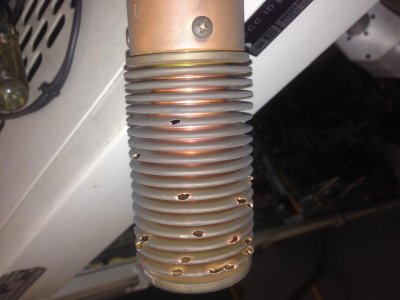
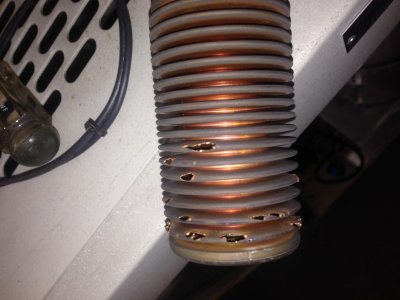
Here's what I found so far:
IMG_2444.jpgIMG_2445.jpg
Also lots of dust, dirt and not too many insects. Time for spring cleaning. Glad this is only a backup. Still have one more backup in case the main poops.
 
Here's what I found so far:
View attachment 752View attachment 753
Also lots of dust, dirt and not too many insects. Time for spring cleaning. Glad this is only a backup. Still have one more backup in case the main poops.

Oh yeah, your tuning bellows is toast right at the highest voltage, the 1/2 wave point. No doubt you'll find lots of arc marks inside the aluminum can. Those sharp edges from the burned holes only make it arc that much more. You may want to replace the aluminum can too. There is probably so much carbon tracking embedded in the aluminum, you risk burning up your tuning bellows again. I'd say the reason for this level of failure, is this thing was probably being forced to run badly out of tune.
 
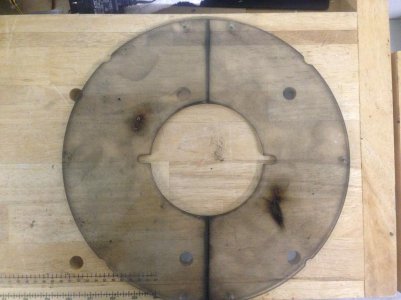
So I started the serious clean-up in preparation for the arrival of the bellows, and you're right, a lot of burn marks in the can. Also, the plexiglas spaced that supports the can shows damage, too.
IMG_2446.jpg
Holes burned right through at both points.
Everything under the tube looks OK. I think the resistor has been replaced before, but it is OK now. Thanks for your suggestions.
 
Sorry in advance if I'm suggesting you already know; but make sure when replacing the tuning stub (bellows), you either set the course tuning height above the copper tube it clamps into, either exactly at the same height as the original, or refer to the height for that frequency in the manual. In fact, I'd confirm to the correct distance for that operating frequency in the BE service manual anyway, just in case a previous engineer moved it. An incorrect course tuning adjustment may have caused all the damage to begin with.
 
I actually had to remove the top plate of the cavity with the tuning line left intact, because it won't pull out (tried that first) due to the screws holding the bellows. But just to be sure I got it back exactly where it was, I first wrapped a piece of tape around it right at the clamp. Although, looking at the final test data, they say 11.70 inches, and I measured about 11.325. The graph in the book works out to just over 11 inches. Probably close enough. The transmitter seemed to tune OK, as I could see a distinct dip in the Ip and the counter was near the factory setting. I'm thinking this actually started a long time ago, as Central Florida gets a lot of lightning. This box has been in standby service for about 5 years, and just recently been running 24/7 since early December. I have had a couple of instances where it would trip breakers, but would always come back up normally. This time I guess we passed the bellows blow-out threshold.
 
I suppose that sort of damage could have been caused by lightning, although I've never seen lightning damage at that point in the PA. If that's the indeed the case, I wonder what shape the antenna is in? Gotta believe there had been some serious arching in the inter-bay lines and potentially damaged bullets. What's the reflected power look like?
 
Reflected is around 1.1:1, maybe a little less. I have a Gates FM3K that happily shares that antenna. (Yes, that's the THIRD transmitter. Quite a luxury.)
 
You might want to visually inspect your harmonic filter. I had a 25T that had the same issues, and we found that the harmonic filter was badly burned up. We installed a new bellows and harmonic filter, and did a rigorous inspection and cleaning of the PA cavity,. We also used scotchbrite pads as had been suggested earlier to clean up any signs of arcing on the inside of the chimney.

Once all of this was completed, the transmitter has been trouble free ever since. As others have mentioned, the half wave design of the cavity causes some extremely high RF voltages to be present.

Best of luck!
 
UPDATE:
New chimney, new plexi ring, new bellows, new screen bypass kapton caps, new screen rectifier (probably didn't need to.) Now can get power up to about 55%, and all metering looks OK. Efficiency is correct, runs for between 5-10 minutes and then back to square one. Taking the area below the tube socket apart now. The 750 ohm swamper reads about 1180 ohms, and that's above the 10% tolerance. Also going to shotgun the doorknob caps. Nobody sells these antique parts anymore. Used to be able to go to Newark or Mouser, but no more. RF Parts has the caps. Still looking for the 50 watt on-inductive resistor.
 
Hi again Bill. So, when you say 55% and back to square one, are you getting a flash-over at the same point of the PA? Are you able to run the screen (APC Manual Mode) down and are retuning IPA input (grid), then PA tuning and PA loading as you come up 10% at a time? If so, are you seeing a sharp clear dip in plate current as you rock the tuning and loading controls and at the same time a peak in output? The reason I ask, is this thing sure is acting like it's way out of tune.

Finally, what is your plate voltage at idle? (no drive or output)
 
Hi Kelly,

Yes, getting the flash-over. I've been running the screen manually, and making sure it was all the way down when applying HV. And, yes, I am retuning all three controls as I bring it up. The Ip does dip at about the same point as the output peak. The frustrating part is everything seems to be normal, tuning cyclometer settings near the factory values, grid and screen seems to be OK. The grid current peaks at about the same point (within a few degrees rotation) as the IPA reflected is minimum.

I haven't tried applying plate voltage with no drive. At the time I do turn it on with the screen at minimum I get about 8% output and Ep is 6.7 kV. Ip is about 360 ma.

The output level is more than I was able to get before replacing the screen bypass caps, (50% vs 30%) and it will run at that 50% level for several minutes. Before it would pop off at 30% immediately. Making progress, but just not there yet.

Thanks for your help.

Bill
 
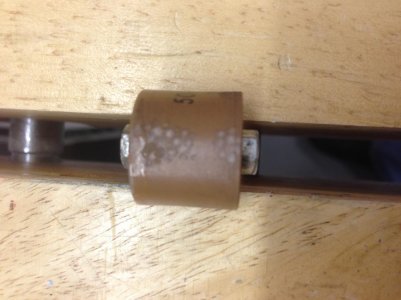
This is the screen capacitor. I've never seen the mottled marking. The other one in the grid doesn't have it. They are otherwise the same (value, WV, type, etc.)
IMG_2494.jpg
 
Hi Bill,

Right before it goes bang, do you see any indication of the screen current shooting up or dropping to zero? Any other forms of unstable readings right before or at the time of failure? It sure sounds like something is going into parasitic oscillation right before overload.
 
I had taken the grid swamper out and measured it and it was about 1160 ohms, more than the 10% tolerance would allow. Hard to find these things nowadays. Used to be Newark, etc., would have them, but unless it's surface mount, forget it.

Anyway, I put the bottom of the socket back together, swapping the two doorknob caps and brought it up briefly to 50% to make sure it would. Then took the tube out and ran for over 30 minutes with no issues. I brought the screen up to about 600VDC. Plate voltage was about 6900V with no load.

Next will be taking the output tuning out and inspecting the inside of it. Then the low pass filter and output line. That'll be fun, since I have the PS cabinet bolted to the PA cabinet, as most people do.
 
Well, it looks like problem solved. Not only was the tube bad, so was the spare! I was able to get a used tube from one of our other stations, and the box came up to rated power, and has been there since last Thursday morning. Chased the tuning/loading for a couple of hours, but has been stable since. Thanks to those who contributed suggestions, especially Kelly A. There's a newly rebuilt Econco on the way.
 
Status
This thread has been closed due to inactivity. You can create a new thread to discuss this topic.


Back
Top Bottom