• Get involved.
    We want your input!
    Apply for Membership and join the conversations about everything related to broadcasting.

    After we receive your registration, a moderator will review it. After your registration is approved, you will be permitted to post.
    If you use a disposable or false email address, your registration will be rejected.

    After your membership is approved, please take a minute to tell us a little bit about yourself.
    https://www.radiodiscussions.com/forums/introduce-yourself.1088/

    Thanks in advance and have fun!
    RadioDiscussions Administrators

Theoretical station reception questions

How far could a 100 Kw station on Mt McKinley go? (As in cities, state boundaries, into Canada-province/territory boundaries)
How far could a 250W station on Mt Washington go?
Would it be possible to move Los Angeles' radio stations to Mount San Antonio?
Would it be possible to move Portland OR stations to Mount Hood?
Could a Miami rimshot from Bimini work?
 
How far could a 100 Kw station on Mt McKinley go? (As in cities, state boundaries, into Canada-province/territory boundaries)
How far could a 250W station on Mt Washington go?
Would it be possible to move Los Angeles' radio stations to Mount San Antonio?
Would it be possible to move Portland OR stations to Mount Hood?
Could a Miami rimshot from Bimini work?

Obviously, you're talking FM here.

One thing to remember is that FM is basically line of sight. Sometimes it will bounce off the edges of distant ridges and mountains, it will dip down into nearby valleys at reduced strengths, and sometimes tropo and other propagation factors kick in, but a 100 KW station on top of Mt. McKinley would undoubtedly stay inside Alaska.
 
Obviously, you're talking FM here.

One thing to remember is that FM is basically line of sight. Sometimes it will bounce off the edges of distant ridges and mountains, it will dip down into nearby valleys at reduced strengths, and sometimes tropo and other propagation factors kick in, but a 100 KW station on top of Mt. McKinley would undoubtedly stay inside Alaska.

I remember being really excited to try DX from the parking lot at the top of Pike's Peak. What I quickly discovered was HAAT - height above average terrain -as opposed to elevation above sea level. The 14,000 foot height of Pike's Peak is actually more like 7000 feet. Denver FM was great. Cheyenne was there. But not a trace of Casper, Wichita, Amarillo, or Albuquerque. Dejected, I visited the gift shop, took pictures of the view, and left with my DX dreams dashed. Line of sight. You don't see it, you don't get it. I do remember the passenger in front of me on a commercial flight from Miami to San Juan in the 80's - illegally listening to a portable radio. FM went about 400 miles. A drive to and from Albuquerque is fun - the stations on Sandia Peak hang in what seems like a long way. Sandia peak disappears over the horizon - done. But - drive up the mountain in Flagstaff, and they are back again - but weak. I haven't crunched the numbers to see what the line of sight is like from Sandia Peak.
 
How far...How far...Would it be possible...Would it be possible...
Not as far as one in earth orbit or on the moon!
Could a Miami rimshot from Bimini work?
Probably, but not from Bermuda to North Carolina!
FM stations in Luxembourg cover parts of five countries, but Luxy is a small place.
 
Last edited:
The idea of 100Kw FMs in Alaska fascinates me too, as someone who lives in AK. I do know that KIAK/102.5 in Fairbanks is 92,000 watts and it reportedly gets out pretty far, according to both reception reports and their on-air weather forecasts...they do weather reports for Delta Junction, Glenallen, Paxson, etc. They also mention Nenana but that's basically just a rim-shot for Fairbanks radio anyway...plug Nenana into Radio-Locator and most Fairbanks FMs show up as mid-strength signals. I think KWLF/98.1 also gets out really far reportedly, although its tower seems to be at a lower elevation, unlike most other stations, which although 28Kw are up on Ester Dome outside Fairbanks' suburb of Ester.

I know there's one in I think Homer, I think K-Bay 93.3, which really gets out. While I don't condone it, I'm guilty of airplane DXing. Flying from Juneau to Fairbanks, via Anchorage, you lose the Juneau stations, then get nothing for awhile (totally empty dial even at 30,000 feet), then you start getting stations from places like Homer, Kenai, Seward, etc. 93.3 being one of the first, but there's something else also on 93.3 somewhere, they alternate quite a bit at 30K ft. As you get closer to Anchorage of course you start getting their stations too, at one point I counted well over 30 stations from Anchorage, Kenai, Homer, etc. All really strong and clear too. Sometimes more than one on the same channel, but clear; move an antenna slightly and the other station comes in just as clearly.

Descend into Anchorage and of course you lose the Seward, Homer, Kenai, etc. stations. Take off for Fairbanks and you get all those again for awhile heading toward Fairbanks. By the time you lose the Kenai, etc. stations you start getting Fairbanks and North Pole stations, clearly, in stereo and everything. These results are quite repeatable in my experience; the first Fairbanks station is KWLF/98.1. It mixes with something else (I think classical) in Anchorage, it's interesting hearing a really upbeat CHR mixing/alternating with a classical! The Anchorage stations persist for awhile after you can hear the Fairbanks stations too about equally as well, fairly decent reception with a weak enough signal to get hiss into the stereo but still be in stereo. Of course once you get over the Alaska Range you lose all the Anchorage stations and the Fairbanks stations are quite strong, of course all the way into Fairbanks.

Elevation is a big thing in Alaska for FM. In Fairbanks, if you drive to Chena Hot Springs you will have a completely blank FM dial, at least a car radio on Seek will stop at nothing, though some Fairbanks and North Pole stations may be just BARELY there on a good receiver, I didn't try. Same if you drive down the Seward Highway from Anchorage to Seward, you quickly lose the Anchorage stations after about Girdwood, then it's just a couple really weak Anchorage stations until about Portage, then nothing until Seward, but flying over it you get almost 40 FM signals!

 
The Homer station is K-BAY 93.3...KXBA. The other 93.3 must be KVAK Valdez, AK, airing soft rock.
98.1 in Anchorage is KLEF (Classical). Interesting how Anchorage and Seattle both have classical on 98.1 mHz. However, KLEF is a commercial classical station, as opposed to the non-commercial KING-FM. KING-FM was commercial until 2011.
 
Line of sight. You don't see it, you don't get it. .

I owned a couple of FMs that were located at approximately 13,000 feet AMSL. But the elevation over the market was only between 3200' and 2800 feet, less than the height of the LA stations that broadcast from Mt. Wilson. So really the issue is what the elevation of the intended service area is an how much higher the transmitter site is above it.
 
Would it be possible to move Los Angeles' radio stations to Mount San Antonio?

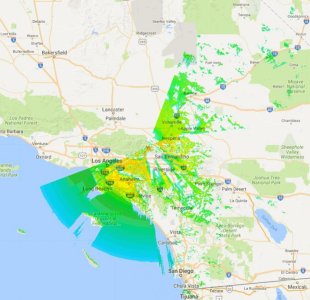
You would have terrain blockage into the populated areas, and would not cover LA at all at any power level. You'd only get a mediocre signal into the Inland Empire, too. Terrain blockage or horizon blockage is where the path from the antenna to the market hits the surrounding terrain and can not achieve a downward angle that goes into the populated areas... so you end up heating the surrounding mountains and highlands with RF.

[/QUOTE]Could a Miami rimshot from Bimini work?[/QUOTE]

No. While about 50 miles from South Beach, Bimini is 60 to 90 miles from most of the market's population. Even with the equivalent of a Class C it would take a 2000' tower just to get a marginal signal into the eastern part of the market. And experience tells us not to build 2000' towers on hurricane zone islands that are, at best, 25 feet above sea level and which have poor infrastructure for electric power and other needs. That is why towers in the Florida Keys typically don't go much above 500'.
 
And experience tells us not to build 2000' towers on hurricane zone islands that are, at best, 25 feet above sea level and which have poor infrastructure for electric power and other needs. That is why towers in the Florida Keys typically don't go much above 500'.
What about something like the tethered balloon that R. Marti has near Key West on FM and TV?
BTW...why can I not find Marti's FM frequency listed anywhere? Do they hop around to avoid QRM.


You would have terrain blockage into the populated areas, and would not cover LA at all at any power level. You'd only get a mediocre signal into the Inland Empire, too. Terrain blockage or horizon blockage is where the path from the antenna to the market hits the surrounding terrain and can not achieve a downward angle that goes into the populated areas... so you end up heating the surrounding mountains and highlands with RF.


Here is what 100kw from Mt San Antonio would look like - you'd get decent coverage into Anaheim and parts of northern OC, along with most of the south side of LA. Forget about the IE though, most of it would be terrain blocked with just a few slivers of signal punching through. And the entire northwest quadrant of the signal would be blocked out as well, so nothing up the coast past Santa Monica and nothing in the valley. That's what makes Mt Wilson such a spectacular site, while there is a significant amount of terrain blocking there, it is all toward much less populated areas to the north.
 

Attachments

  • MtSanAntonio100k.jpg
    MtSanAntonio100k.jpg
    82.8 KB · Views: 38
Would it be possible to move Portland OR stations to Mount Hood?

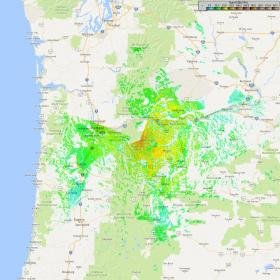
Possible, but foolish. You'd have nowhere near the signal or coverage, with lots of patchy reception and thanks to terrain blocking, nothing north of the river. You would however, be wasting a ton of signal over vast sparsely populated areas in the middle of the state.
 

Attachments

  • MtHood100k.jpg
    MtHood100k.jpg
    15.6 KB · Views: 30
Possible, but foolish. You'd have nowhere near the signal or coverage, with lots of patchy reception and thanks to terrain blocking, nothing north of the river. You would however, be wasting a ton of signal over vast sparsely populated areas in the middle of the state.
What did you use to make those maps?
 
Here is what 100kw from Mt San Antonio would look like - you'd get decent coverage into Anaheim and parts of northern OC, along with most of the south side of LA. Forget about the IE though, most of it would be terrain blocked with just a few slivers of signal punching through. And the entire northwest quadrant of the signal would be blocked out as well, so nothing up the coast past Santa Monica and nothing in the valley. That's what makes Mt Wilson such a spectacular site, while there is a significant amount of terrain blocking there, it is all toward much less populated areas to the north.

The other issue is that a move to the east of the distance between San Antonio and Wilson would result in spacing issues of such consideration that the stations involved would have to significantly directionalize and/or reduce power. In a couple of cases I eyeballed it appears that they would have to directionalize more than the FCC rules allow for FM directionals.

->I edited here as I had to do a reality check as I remembered what Mt San Antonio really is. Most folks in Southern CA do not know what Mt San Antonio is. It is called Mt Baldy by, literally, everyone. And it is home to KLYY and KGGI. KGGI, a B, is reduced to 2.5 kw on that site. Grandfathered KLYY is at 72 kw. Both are at the highest point that is practical for a radio station to locate, which is about 3000 feet below the summit; this is also the sweet spot for not getting horizon blockage into the city of license of each of those stations.

There is also the issue that they would loose their current grandfathered status with such a move, also meaning that nearly every moving station would have to drop power to a conforming Class B standards. So the maximum power would be 50 kw and depending on average terrain calculations, each station might be much lower powered.

Also of concern is that the signal that gets back to LA from that distance would not be as good anywhere as the current signal, meaning not as penetrating a signal in the intended coverage area.

I would mention to the OP that the only real interest of an LA FM is covering LA, not the surrounding markets. Adding coverage of the Inland Empire, high desert, etc., produce no revenue and any reduction of field strength in LA would be seen as a major negative.
 
Last edited:
Would it be possible to move Los Angeles' radio stations to Mount San Antonio?
Would it be possible to move Portland OR stations to Mount Hood?

The question is why would you want to move the stations farther away from the LA market? None of the LA stations, despite many showing in ratings in the Inland Empire and Ventura markets, makes money from coverage of anything except the LA metro.
 
Another one I've always wondered about: 100Kw FMs in southeast Alaska! Sure, you'd be wasting signal over largely unpopulated areas, but of you could also get the stations serving Juneau, Sitka, Ketchikan, etc. to move somewhere and up power to the maximum allowed you'd get rid of some serious FM no-zones, there's so many places with LITERALLY NOTHING on FM. Nada, not even one weak signal.
 
I calculated a 100KW on 106.3 from the mountains outside Ketchikan. The coverage would reach Craig AK and parts of the Prince Rupert BC area.
Another calculation of a 92.3 100KW signal from east of Petersburg (near the peak called Devil's Thumb) results in Port Alexander being in the 60dbu area!
I don't think there's any way for a Juneau signal to serve Ketchikan and vice versa. Too far.

However, a 100KW 92.3 on Mt. Denali (McKinley) would result in a LOCAL like signal in Anchorage, Big Lake, Kenai, even Soldotna. To the east, Glenallen gets a fair signal, but not very strong...same with Lake Louise AK. Paxson doesn't get a signal (mountain blockage). To the west, McGrath is in the 60dbu signal range. With no radio station in McGrath anymore (KSKO went defunct in 2015), a 100KW on Denali would help that community greatly. Fairbanks wouldn't get the signal (mountain blockage), nor would Galena and other communities along the Yukon River.
 
How far could a 100 Kw station on Mt McKinley go? (As in cities, state boundaries, into Canada-province/territory boundaries)
How far could a 250W station on Mt Washington go?
Would it be possible to move Los Angeles' radio stations to Mount San Antonio?
Would it be possible to move Portland OR stations to Mount Hood?
Could a Miami rimshot from Bimini work?
. There are in fact, several rimshots on Mt. Hood. The strongest ones are on the low end of a Class C1 and cover about half of Gresham within 60dbu. By contrast, Seattle rim shots are within the 60dbu contour of much of the Seattle area, including the city itself.
 
Last edited:
Status
This thread has been closed due to inactivity. You can create a new thread to discuss this topic.


Back
Top Bottom