For anyone who was in the radio biz in the 80s/90s, do you remember when your station switched from turntables to CD players? Did the time differ for different formats (say oldies)? Were there syndicators or record labels that were unusually early or late in bringing out CDs?

-
Get involved.
We want your input!
Apply for Membership and join the conversations about everything related to broadcasting.
After we receive your registration, a moderator will review it. After your registration is approved, you will be permitted to post.
If you use a disposable or false email address, your registration will be rejected.
After your membership is approved, please take a minute to tell us a little bit about yourself.
https://www.radiodiscussions.com/forums/introduce-yourself.1088/
Thanks in advance and have fun!
RadioDiscussions Administrators
You are using an out of date browser. It may not display this or other websites correctly.
You should upgrade or use an alternative browser.
You should upgrade or use an alternative browser.
When did radio stations switch to CD?
- Thread starter installLSC
- Start date
Didn't carts replace vinyl before CDs replaced carts, at least at stations with singles-based formats?
Didn't carts replace vinyl before CDs replaced carts, at least at stations with singles-based formats?
In some places traditional carts were replaced by Pacific Recorders carts with noise reduction. Not long after that, music was on hard drive.

Didn't carts replace vinyl before CDs replaced carts, at least at stations with singles-based formats?
Carts started replacing vinyl at some stations in the early 60's. In many cases, it was a question of cost... not just of the set of cart playbacks for the studio and cart recorders for production, but the price of one cart for every song on the playlist. So the transition was gradual.
And some stations continued to like vinyl... either they were purists or they played large lists, such as classical stations and the more progressive of the rock and AAA stations.
CDs started replacing carts when there was enough product on CD... depending on format, the period was around the mid 80's, give or take a few years.
Digital systems really started to ramp up around 1995, and as hard drive prices decreased, more and more stations added systems because they not only stored music, they held jingles, liners, and, of course, commercials.
In some places traditional carts were replaced by Pacific Recorders carts with noise reduction. Not long after that, music was on hard drive.
The TomCat ran at double speed and had a unique head design, and came on the market, IIRC, around 1979 or 1980.
Here is a rather fun history of the cart machine, with the prologue dealing with reel to reel devices.
https://www.americanradiohistory.co...acturers/SBE-1959-History-of-Cart-Machine.pdf
I remember it being sort of gradual (no, not turntables to CDs but carts and/or automation reels.). Some might remember radio stations with Laserdisc players that played some cuts from them with fanfare. CD introduction was like that, you'd play a cut "direct from digital Compact Disc". You might even sell a sponsorship (the latest from Whitney Houston on Compact Disc, brought to you by Main Street Electronics). A surprising number of stations started playing CDs off consumer machines because the professional ones hadn't been rolled out yet. As David mentioned above, all product wasn't being released on CD in the mid/late 80s).
I remember it being sort of gradual (no, not turntables to CDs but carts and/or automation reels.). Some might remember radio stations with Laserdisc players that played some cuts from them with fanfare. CD introduction was like that, you'd play a cut "direct from digital Compact Disc". You might even sell a sponsorship (the latest from Whitney Houston on Compact Disc, brought to you by Main Street Electronics). A surprising number of stations started playing CDs off consumer machines because the professional ones hadn't been rolled out yet. As David mentioned above, all product wasn't being released on CD in the mid/late 80s).
And the early pro grade players, like the Studer A725, were a coupla' kilobucks each. That machine came out in 1985, per the Studer website.
I was at a Top 40 in 1987. We were all cart but were serviced with records. By mid-1987 I was put in sales. I know it only took a couple of years before all the companies were sending us CDs. Sometimes you got the vinyl and the CD.
Before computers, we opted at one station to use mini disc. With CDs you couldn't edit but with mini disc you could edit to within 1/10 of a second. And you couple program it, so record it tightly it sounded much like computer driven programming today. I found the first mini discs we had back in 1994. I have a deck at home. They still play without a glitch 24 years later. I was amazed.
We got our first computer around 1994...I think it was a gig hard drive. I had 28.8 kb dial up then.
Before computers, we opted at one station to use mini disc. With CDs you couldn't edit but with mini disc you could edit to within 1/10 of a second. And you couple program it, so record it tightly it sounded much like computer driven programming today. I found the first mini discs we had back in 1994. I have a deck at home. They still play without a glitch 24 years later. I was amazed.
We got our first computer around 1994...I think it was a gig hard drive. I had 28.8 kb dial up then.
When the station I was working for in the early 80's (circa 1983) went from Tapecaster and Spotmaster 500s to ITC Delta and "Triple-Decker"s....it was a technical quantum leap!!
The FM side of this station was the first station in the city to play a Compact Disc; I hooked up my Sanyo/Sears 10-track (!!) single-disc player in the control room (with a small pre-amp to boost the level.....)
with a 10k/600 ohm transformer......First song???? "Sister Christian" by Night Ranger.....Yes --- I STILL HAVE THE CD (I'm holding it now!!!)!!!
The FM side of this station was the first station in the city to play a Compact Disc; I hooked up my Sanyo/Sears 10-track (!!) single-disc player in the control room (with a small pre-amp to boost the level.....)
with a 10k/600 ohm transformer......First song???? "Sister Christian" by Night Ranger.....Yes --- I STILL HAVE THE CD (I'm holding it now!!!)!!!
I remember it being sort of gradual (no, not turntables to CDs but carts and/or automation reels.). Some might remember radio stations with Laserdisc players that played some cuts from them with fanfare. CD introduction was like that, you'd play a cut "direct from digital Compact Disc". You might even sell a sponsorship (the latest from Whitney Houston on Compact Disc, brought to you by Main Street Electronics). A surprising number of stations started playing CDs off consumer machines because the professional ones hadn't been rolled out yet. As David mentioned above, all product wasn't being released on CD in the mid/late 80s).
This is the way I remember hearing a CD for the first time on X104 in Fresno. Had to be about 87, can't remember the song but I remember the DJ being real excited about it.

The first CDs started being played in 1983. The first show I remember with all CD was in 1983 with Seattle's classical KING-FM's Sonic Spectacular show. In 1984, KPLZ started adding CDs. Here's a KPLZ promo from that time:
https://www.youtube.com/watch?v=tzWXK384_2M
But it was a very slow adaptation until 1987 when the first all-CD stations (primarily NAC/Smooth Jazz on CD carts) appeared. Even then, the transformation in the business overall wasn't mostly complete until the early '90s and even then, some lower budget stations still used carts until the end of the '90s.
https://www.youtube.com/watch?v=tzWXK384_2M
But it was a very slow adaptation until 1987 when the first all-CD stations (primarily NAC/Smooth Jazz on CD carts) appeared. Even then, the transformation in the business overall wasn't mostly complete until the early '90s and even then, some lower budget stations still used carts until the end of the '90s.
But it was a very slow adaptation until 1987 when the first all-CD stations (primarily NAC/Smooth Jazz on CD carts) appeared. Even then, the transformation in the business overall wasn't mostly complete until the early '90s and even then, some lower budget stations still used carts until the end of the '90s.
One issue was start-up speed. Carts were instant. Press the button, and boom. There was a slight lag to the CD. So for formats where running a tight board was important, CD was not the best way to go. And as we said, the sound quality of carts improved with the TomCats, so dubbing CDs to cart for broadcast wasn't unusual.
Classical stations were in a different area, and in addition to sonic quality, the program time of a CD was better for classical, where you could have a complete work on one CD, while you might have to flip a vinyl album.
One issue was start-up speed. Carts were instant. Press the button, and boom. There was a slight lag to the CD. So for formats where running a tight board was important, CD was not the best way to go. And as we said, the sound quality of carts improved with the TomCats, so dubbing CDs to cart for broadcast wasn't unusual.
Classical stations were in a different area, and in addition to sonic quality, the program time of a CD was better for classical, where you could have a complete work on one CD, while you might have to flip a vinyl album.
The NAC/Smooth Jazz stations had much looser segues, which made CDs more ideal for that format than any other outside of Classical and maybe AOR at that time. I do remember some CHR/AC jocks being defeated by the CD's lag problem, which sometimes lead to colorful language on the air and once, from a female weekender who was never heard from again; "F---!!!......Oh s---, this thing is on, isn't it?"

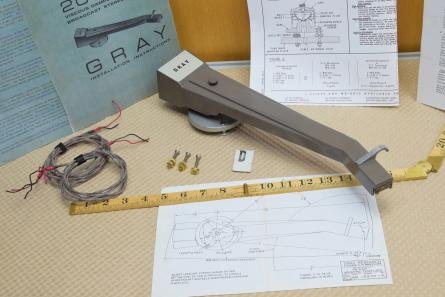
I miss the old Grey Research tonearms.
Didn't those things have about 15 lbs of pressure? Or it there a counterweight/anti-skate I'm missing in this pic. They look awfully heavy.
Attachments
The NAC/Smooth Jazz stations had much looser segues, which made CDs more ideal for that format than any other outside of Classical and maybe AOR at that time.
Even today, classical non-comms usually leave a bit of silence between the introduction of a piece (composer, title, orchestra, conductor, soloist) and the start of the music. Back in the '60s and '70s, I recall the standard intro also involving the label and number of the LP, and still, that pause before the first note. Nobody was, or is, talking up classical music the way we're used to it being done on pop or country formats.
Didn't those things have about 15 lbs of pressure? Or it there a counterweight/anti-skate I'm missing in this pic. They look awfully heavy.
The "opposite end" was a counterweight.
Some of the arms of that style were silicon damped, meaning that the arm had a ball base that set in a socket and the surface was coated with silicone grease. Think a leg-to-hip joint, and you have the idea.
Upon blowing up the pic on the post, I can read "viscous damped" on the cover of the manual, so this was one of the silicone jobs. I had about 12 of them in use at my stations in the late 60's.
Some of them had little additional weights that were used to balance lighter or heavier pickup cartridges. In the 60's they seem to have come ready for a VR II cartridge which a lot of stations preferred because the stylus cost was low and they resisted back-cuing fairly well.
Last edited:
The NAC/Smooth Jazz stations had much looser segues, which made CDs more ideal for that format than any other outside of Classical and maybe AOR at that time. I do remember some CHR/AC jocks being defeated by the CD's lag problem, which sometimes lead to colorful language on the air and once, from a female weekender who was never heard from again; "F---!!!......Oh s---, this thing is on, isn't it?"
The Denon broadcast CD units did cuing, but required that every CD be put in a special case, like a cartridge. There was no lag issue in them, but, IIRC, they were about $1350 each and the cases about $1.50 in bulk. We were using them on KLVE / KTNQ in LA until around 1997, when music moved to Audio Vault (commercials had moved to AV in about 1995).
The Denon broadcast CD units did cuing, but required that every CD be put in a special case, like a cartridge. There was no lag issue in them, but, IIRC, they were about $1350 each and the cases about $1.50 in bulk.
IIRC, those Denon units had adjustments for speeding up music (3%?) à la Bill Drake.
Even today, classical non-comms usually leave a bit of silence between the introduction of a piece (composer, title, orchestra, conductor, soloist) and the start of the music. Back in the '60s and '70s, I recall the standard intro also involving the label and number of the LP, and still, that pause before the first note. Nobody was, or is, talking up classical music the way we're used to it being done on pop or country formats.
KING-FM used to read off the tile, composer, conductor/orchestra and record label up until the mid '80s. You could hear the announcer switch off the studio mic, maybe a quiet tick and pop or few in the vinyl, then music. Unless the work came on CD, which was also mentioned until the end of the '80s.
- Status
- This thread has been closed due to inactivity. You can create a new thread to discuss this topic.