They’ve been really malfunctioning lately. Their signal is being interrupted by unusually high levels of white noise and multipath (?) What’s up? Are they doing transmitter testing?

-
Get involved.
We want your input!
Apply for Membership and join the conversations about everything related to broadcasting.
After we receive your registration, a moderator will review it. After your registration is approved, you will be permitted to post.
If you use a disposable or false email address, your registration will be rejected.
After your membership is approved, please take a minute to tell us a little bit about yourself.
https://www.radiodiscussions.com/forums/introduce-yourself.1088/
Thanks in advance and have fun!
RadioDiscussions Administrators
You are using an out of date browser. It may not display this or other websites correctly.
You should upgrade or use an alternative browser.
You should upgrade or use an alternative browser.
WXLO
- Thread starter Tomgsinger
- Start date
They’ve been really malfunctioning lately. Their signal is being interrupted by unusually high levels of white noise and multipath (?) What’s up? Are they doing transmitter testing?
WXLO now reportedly has three on-channel booster transmitters on the air in an attempt to improve their reception in metro Boston. One on the Hancock Tower, one between Route 2 and Concord Ave. in Lexington (at the WWDJ and WAZN site), and one on Bear Hill in Waltham (off Route 117 and 95/128).
These can possibly hurt more than help the reception if you're in an area where you're receiving more than one of them, or if you're receiving any of them along with their main signal transmitting from Leominster, at approximately equal power where you are. That can cause multipath distortion because, though the programming is the same, more than one signal is being received by your radio coming from different locations and arriving at minutely different times.
WXRV "The River" also has on-channel boosters on the air from those three sites, and two others.
WXLO now reportedly has three on-channel booster transmitters on the air in an attempt to improve their reception in metro Boston.
Seems they are intent on doing better in the Boston Metro. I just saw an electronic billboard off the highway, with a "Now Playing...(insert song/artist).."
I don't think their programming is competitive enough to take away any listeners from the established stations.
Maybe they believe a lot of their Worcester/Fitchburg listeners travel to Boston and this would ensure the signal stays with their commute?
They’re doing more remote broadcasts in the Boston market — they even did two in downtown Boston itself recently. Definitely seems like they’re trying to snag some of 104.1’s listeners. The ratings show a 1.6 share thoughi

WXLO now reportedly has three on-channel booster transmitters on the air in an attempt to improve their reception in metro Boston. One on the Hancock Tower, one between Route 2 and Concord Ave. in Lexington (at the WWDJ and WAZN site), and one on Bear Hill in Waltham (off Route 117 and 95/128).
These can possibly hurt more than help the reception if you're in an area where you're receiving more than one of them, or if you're receiving any of them along with their main signal transmitting from Leominster, at approximately equal power where you are. That can cause multipath distortion because, though the programming is the same, more than one signal is being received by your radio coming from different locations and arriving at minutely different times.
WXRV "The River" also has on-channel boosters on the air from those three sites, and two others.
This is another variation of attempts to defy the laws of physics with translators, and would be particularly bad in a moving car. With one on-channel booster, the odds of being in a location where both the main and translator signal are at approximately the same level is small. With 5 or 6, that changes greatly.

from radio-locator
WXLO-1 104.5 FM Boston, MA (10 watts)
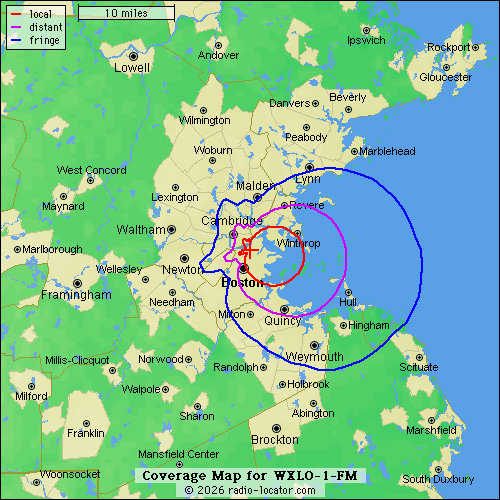
WXLO-2 104.5 FM Lexington, MA (450 watts)
https://radio-locator.com/cgi-bin/pat?call=WXLO-2&service=FB
WXLO-3 104.5 FM Waltham, MA (700 watts)
https://radio-locator.com/cgi-bin/pat?call=WXLO-3&service=FB
WXLO-1 104.5 FM Boston, MA (10 watts)
WXLO-2 104.5 FM Lexington, MA (450 watts)
https://radio-locator.com/cgi-bin/pat?call=WXLO-2&service=FB
WXLO-3 104.5 FM Waltham, MA (700 watts)
https://radio-locator.com/cgi-bin/pat?call=WXLO-3&service=FB
Seems they are intent on doing better in the Boston Metro. I just saw an electronic billboard off the highway, with a "Now Playing...(insert song/artist).."
I don't think their programming is competitive enough to take away any listeners from the established stations.
Maybe they believe a lot of their Worcester/Fitchburg listeners travel to Boston and this would ensure the signal stays with their commute?
They may not be as concerned about taking many listeners from Boston stations as they may be about just getting more advertisers in the Boston market, who (I'm guessing) may pay higher rates and be potentially more numerous than advertisers in the Worcester/Central MA/Metro-West market. These decisions are usually all about the (potential) billing.

They may not be as concerned about taking many listeners from Boston stations as they may be about just getting more advertisers in the Boston market, who (I'm guessing) may pay higher rates and be potentially more numerous than advertisers in the Worcester/Central MA/Metro-West market. These decisions are usually all about the (potential) billing.
How can they document Boston listenership without corroborative ratings? Wouldn't any increase in WXLO's Boston share come at the expense of other stations?
How can they document Boston listenership without corroborative ratings? Wouldn't any increase in WXLO's Boston share come at the expense of other stations?
Usually, but not necessarily. If they show ratings in metro Boston, they'll be more likely to get advertisers in the area, even if the ratings of similarly formatted Boston stations don't decline much as a result of their increase.
I've seen stations in the same market flip to competing with another station with a similar format, and though the station that flipped got somewhat higher ratings than they did before, the ratings for the longtime established station with the format didn't decline. So where did the station that flipped get their new listeners? I don't know, but apparently not many from the established station with the format.

This is another variation of attempts to defy the laws of physics with translators, and would be particularly bad in a moving car. With one on-channel booster, the odds of being in a location where both the main and translator signal are at approximately the same level is small. With 5 or 6, that changes greatly.
it also dependson terrain.. i worked for a station that had abooster... the booster was in a bowl..... there were certain parts of two towns, outside the bowl that the booster and main conflicted in residential areas

This is another variation of attempts to defy the laws of physics with translators, and would be particularly bad in a moving car. With one on-channel booster, the odds of being in a location where both the main and translator signal are at approximately the same level is small. With 5 or 6, that changes greatly.
There are new technologies that synchronize boosters with the main signal (the WXLO operations are not translators but boosters) so that "flutter" zones are significantly reduced if not eliminated. We are going to see a lot more of this, I believe.
The results of the boosters for WXRV seem to sound better than those for WXLO in many areas, and looking at the pattern maps on radio-locator, I noticed this:
WXRV has one booster in Natick beamed west toward Natick, Framingham and the metro-west along Route 9, but east of that, WXRV has a string of three boosters over the west suburbs within Route 128 in a line north/northwest of Boston from Bear Hill in Waltham, Concord Ave. in Lexington, and behind Sullivan Station at the Somerville/Charlestown line, and then the downtown booster on the Hancock, all beamed south, away from their main Haverhill transmitter far north of Boston, and also away from one another. Each booster is directional intended to augment WXRV in an area south of its location, not east or west toward another booster.
However, WXLO, with its main transmitter west/northwest of Boston, has the two boosters in Waltham and Lexington beamed mainly east, away from their main signal, but the patterns of both boosters appear to be aimed right for the back of the next one in line to its east, and they are both ultimately aimed somewhat toward the Hancock.
The easterly directional patterns of the WXLO boosters, one toward the next one, may be causing more multipath than the southerly patterns of the WXRV boosters that more effectively avoid one another, but because WXLO's main transmitter is west, they have to beam the boosters east.
WXRV has one booster in Natick beamed west toward Natick, Framingham and the metro-west along Route 9, but east of that, WXRV has a string of three boosters over the west suburbs within Route 128 in a line north/northwest of Boston from Bear Hill in Waltham, Concord Ave. in Lexington, and behind Sullivan Station at the Somerville/Charlestown line, and then the downtown booster on the Hancock, all beamed south, away from their main Haverhill transmitter far north of Boston, and also away from one another. Each booster is directional intended to augment WXRV in an area south of its location, not east or west toward another booster.
However, WXLO, with its main transmitter west/northwest of Boston, has the two boosters in Waltham and Lexington beamed mainly east, away from their main signal, but the patterns of both boosters appear to be aimed right for the back of the next one in line to its east, and they are both ultimately aimed somewhat toward the Hancock.
The easterly directional patterns of the WXLO boosters, one toward the next one, may be causing more multipath than the southerly patterns of the WXRV boosters that more effectively avoid one another, but because WXLO's main transmitter is west, they have to beam the boosters east.
There are new technologies that synchronize boosters with the main signal (the WXLO operations are not translators but boosters) so that "flutter" zones are significantly reduced if not eliminated. We are going to see a lot more of this, I believe.
There is still the problem of phase cancellation - which won't go away no matter how much wishful thinking is involved - particularly if they are going to deliberately overlay multiple signals as in the Radio-Locator map.
There is still the problem of phase cancellation - which won't go away no matter how much wishful thinking is involved - particularly if they are going to deliberately overlay multiple signals as in the Radio-Locator map.
I assume that they did due dillegence when researching and planning this....but I would like to know who will carry the blame if this doesn't work out as planned?
Must have been pretty pricey...not sure how they can make their money back.
- Status
- This thread has been closed due to inactivity. You can create a new thread to discuss this topic.