• Get involved.
    We want your input!
    Apply for Membership and join the conversations about everything related to broadcasting.

    After we receive your registration, a moderator will review it. After your registration is approved, you will be permitted to post.
    If you use a disposable or false email address, your registration will be rejected.

    After your membership is approved, please take a minute to tell us a little bit about yourself.
    https://www.radiodiscussions.com/forums/introduce-yourself.1088/

    Thanks in advance and have fun!
    RadioDiscussions Administrators

"I'll play the radio on southern stations"

I assume that Starbuck was talking about Top 40/AC stations in "Moonlight Feels Right". Maybe Country. What Southern AM stations are heard in Baltimore at Night? I can only think of WSB, WWL, WSM, and WLAC. WLAC was the only one playing Top 40 in that era, post John R. Can you think of any others?
 
Last edited:
That Marimba solo is an ABSOLUTE MASTERPIECE! The other notable Marimba solo is, oddly enough, in "Barefoot in Baltimore", by The Strawberry Alarm Clock. Both Baltimore, both Marimba solos.
 
“Barefoot in Baltimore” is another good one. Unfortunately any outlet that plays 60s music doesn’t play it. They stick with “Incense”.
 
When the FCC was authorizing clear channel stations in the 1930s and 40s, there weren't many in the South. Was that because the South was still fairly poor? Southern broadcasters never stepped up and asked for 50,000 watts around the clock?

Atlanta, then and now, is the biggest city in the Old South. It got WSB. But hardly anything else. Atlanta has only two AM station broadcasting at or above 5,000 watts at night, WCNN, 50 kw day/10 kw night, but not on the air at night until the 1980s, and WSB. That's it. Maybe 590 was 5,000 watts around the clock at one time, but it now it's WDWD, 12 kw day/4.5 kw night. All the other Atlanta AMs are either 1,000 watts, or 500 watts or running flashlight power at night.

How about other Southern cities? In Alabama, 1070 WAPI Birmingham is 50,000 watts by day, but only 10,000 watts at night, protecting KNX and CBA. Nothing in Mobile.

Tennessee did get two stations in Nashville, Class I-A 640 WSM and Class I-B WLAC 1510. But not much else. Memphis has a 640 at 50,000 by day but only 5,000 watts at night, to protect KFI. And it also has a 1070, KDIA, a legendary R&B outlet. But again, it has to protect KNX, CBA and I guess WAPI, so it drops to 5,000 watts at night.

No 50,000 watt stations in Columbia, Charleston or Greenville SC. None in Mississippi either.

North Carolina has WBT Charlotte. Raleigh has a 680 at 50,000 watts around the clock. But 680 is such a crowded frequency in the east that none of the 680s get heard much outside their local areas.

Meanwhile the FCC gave NYC 660, 710, 770, 880, 1130 and 1560 as Class A stations, as well as Upstate NY getting 810, 1170 and 1520. That's more than entire Old South put together.

 
Last edited:
When the FCC was authorizing clear channel stations in the 1930s and 40s, there weren't many in the South. Was that because the South was still fairly poor? Southern broadcasters never stepped up and asked for 50,000 watts around the clock?

Atlanta, then and now, is the biggest city in the Old South. It got WSB. But hardly anything else. Atlanta has only two AM station broadcasting at or above 5,000 watts at night, WCNN, 50 kw day/10 kw night, but not on the air at night until the 1980s, and WSB. That's it. Maybe 590 was 5,000 watts around the clock at one time, but it now it's WDWD, 12 kw day/4.5 kw night. All the other Atlanta AMs are either 1,000 watts, or 500 watts or running flashlight power at night.

How about other Southern cities? In Alabama, 1070 WAPI Birmingham is 50,000 watts by day, but only 10,000 watts at night, protecting KNX and CBA. Nothing in Mobile.

Tennessee did get two stations in Nashville, Class I-A 640 WSM and Class I-B WLAC 1510. But not much else. Memphis has a 640 at 50,000 by day but only 5,000 watts at night, to protect KFI. And it also has a 1070, KDIA, a legendary R&B outlet. But again, it has to protect KNX, CBA and I guess WAPI, so it drops to 5,000 watts at night.

No 50,000 watt stations in Columbia, Charleston or Greenville SC. None in Mississippi either.

North Carolina has WBT Charlotte. Raleigh has a 680 at 50,000 watts around the clock. But 680 is such a crowded frequency in the east that none of the 680s get heard much outside their local areas.

Meanwhile the FCC gave NYC 660, 710, 770, 880, 1130 and 1560 as Class A stations, as well as Upstate NY getting 810, 1170 and 1520. That's more than entire Old South put together.

If you consider that all the 1-A and 1-B clears were being created roughly between the creation of the FRC in 1927 and the early part of the 30's, that means we have to analyze the population of the cities in the South at that time. And we also have to consider that the building of a clear channel station would have to take place in the midst of the Great Depression.

For most of the southern cities, a nice regional channel was fine. 560 in Columbia, 960 and 610 in Birmingham, 930 and 620 in Jackson, 920 in Little Rock, 560, 600 and 680 in Memphis. 580 and 950 in Orlando. 610 and 930 in Charlotte. And so on. 920 in Atlanta was a good example with 5 kw day and 1 kw night, more than adequate in the 30's.

The same thing happened in much of the West. 550, 620, 910 and 960 in Phoenix were deemed to be totally adequate when Phoenix in that era was a town of less than 100,000 persons.
 
“Barefoot in Baltimore” is another good one. Unfortunately any outlet that plays 60s music doesn’t play it. They stick with “Incense”.

Well, "Barefoot" wasn't a hit. The group never had anything remotely as popular as "incense." "Barefoot" did better than "Sit With the Guru," but that's not saying much. Neither follow-up hung around radio for more than a few weeks or got out of lighter rotation while on those playlists. Only oldies geeks (like you and me) would remember them 50-plus years later.
 
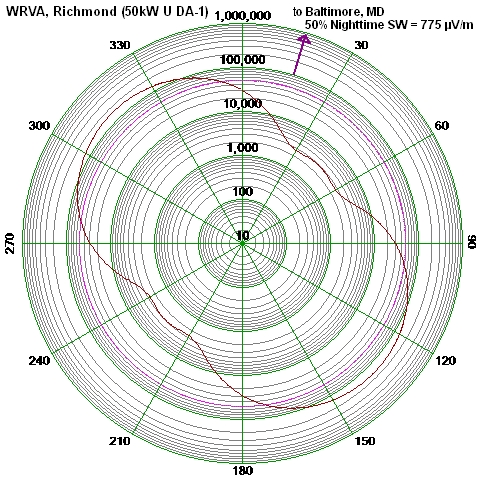
Nobody has mentioned WRVA Richmond. Does that nighttime signal skip over Baltimore?

It has a null towards DC and Baltimore. The protection requirement is for 1140 in Nova Sotia, Canada. It also protects Monterrey, Mexico. So the pattern is NW/SE.


It has a null towards DC and Baltimore. The protection requirement is for 1140 in Nova Sotia, Canada. It also protects Monterrey, Mexico. So the pattern is NW/SE.

Interesting. I remember hearing Richmond Braves games on WRVA as a teen in suburban Boston. The signal wasn't as strong as skywave blowtorches like WBAL, but it was an easy catch, more like WWVA. You'd think a null protecting Nova Scotia would have made reception more difficult in New England, wouldn't you?


If you consider that all the 1-A and 1-B clears were being created roughly between the creation of the FRC in 1927 and the early part of the 30's, that means we have to analyze the population of the cities in the South at that time. And we also have to consider that the building of a clear channel station would have to take place in the midst of the Great Depression.
.

Southern cities were much smaller, both in population and in area, in those days. Houston, where I live, was the first southern city to appear in the top 10 by population and that was in the 1960 census. The metro population in 1930 was less than a half a million vs. 7 million today. Atlanta's population was about the same as Houston's in 1930. Back then, you didn't need that much power to cover the heavily populated areas.
 
The group mentioned taking "Moonlight..." to WERC, David. They said they wanted to wait until Spring. But as you know, that's just 5 kW DA-N, to the South. As I told Jesse Champion, right before he left for WBRC/WERC, the only Birmingham station I had heard in SE Michigan was WVOK, right before Sign Off.

Bob Seger, John Landecker, and I think Chris Erik Stevens, among others, always mentioned WLAC as something they listened to at Night for R & B, and of course WLS and WCFL for Top 40. As most daytimers were above 1240 kHz, their memories are often of of hearing WLAC after daytimers signed off. Someone in both Flint and Grand Rapids mentioned sign offs opening up WLAC. But since their daytimers now all operate at Night, except WERX/WYGR 1530, they can still hear WLAC. But on those little transistor radios, the radios just needed a little bump to get to WLAC.

It looks like in Baltimore, the best time to hear WLAC would be after sunset in Baltimore, and before sunset in Nashville. Or did WLAC run omni until KGA sunset?
 
Last edited:
Well, "Barefoot" wasn't a hit. The group never had anything remotely as popular as "incense." "Barefoot" did better than "Sit With the Guru," but that's not saying much. Neither follow-up hung around radio for more than a few weeks or got out of lighter rotation while on those playlists. Only oldies geeks (like you and me) would remember them 50-plus years later.

I'm an Oldies geek and "Incense" was one of my all time favorites but I had never heard of the other songs by SAC until this thread.
 
I'm an Oldies geek and "Incense" was one of my all time favorites but I had never heard of the other songs by SAC until this thread.

None of their other single releases did much commercially other than the iconic "Incense And Peppermints."

Bob
 
When Moonlight Feels Right was a hit on the radio, I too wondered if 'I'll play the radio on southern stations' was a reference to AM DXing.

Could the next line right after it 'Cause southern belles are hell at night' be a reference to how strong some of the big 50 kw stations in the south come booming in at night up north?

It's always been one of my favorite songs.
 
I assume that Starbuck was talking about Top 40/AC stations in "Moonlight Feels Right".

The writer of that song, Bruce Blackman, is from Mississippi. In fact he was recently inducted into the Mississippi Musicians Hall of Fame. So it was likely a station in Mississippi. Bruce was writer/producer/lead singer of Starbuck. From what I see, he still tours.
 
Southern cities were much smaller, both in population and in area, in those days. Houston, where I live, was the first southern city to appear in the top 10 by population and that was in the 1960 census. The metro population in 1930 was less than a half a million vs. 7 million today. Atlanta's population was about the same as Houston's in 1930. Back then, you didn't need that much power to cover the heavily populated areas.

And in the 1930 census, New Orleans was the largest city south of the Ohio River, but only #16 nationwide. It got WWL. Next was Houston at #26, then Atlanta at #32 (WSB), Dallas at #33 (WWL), Memphis at #36, and San Antonio at #38.

So why did Nashville (#51) get WSM but the larger Memphis got only a regional channel? Most likely because they had a corporate sponsor (National Life) who was interested in taking WSM to 50kW in the early 30s.
 
Well, the newer geomagnetic model does predict that the lower the geomagnetic latitude, the stronger the skywave. But it seems that since the sunspot activity has been erratically low, the model is less accurate. I've noticed that the Class As further North are resurging. How many Class As are left in the US? We've lost WOWO and KGA. That still grinds me. I think they should have preserved part of their protected skywave, at least. Any others? What is that, 55? Well, there are the "Neo Clears", the high Night power Class IIIs. I can remember people referring to 5 kW Class III-As as Clear Channels, because the cochannels signed off, like WHK and WING and WAKR. So many of those are crowded out by "new Bs" and PSSA/Class Ds.
 
Last edited:
"Incense and Peppermints" was produced by Frank Slay, previously known mainly for collaborations with Bob Crewe. By the end of the song, you travel back from a brief experiment with Psychedelia to "Sha-La-La, Sha-La-La". The group reportedly didn't care for the commercialization of the recording. Wonder why there wasn't a true Stereo Mix.
 
Nobody has mentioned WRVA Richmond. Does that nighttime signal skip over Baltimore?

Below is a plot of the WRVA ERP and its nighttime, 50% skywave in/near Baltimore.


WRVA-ERP.jpg
 
Status
This thread has been closed due to inactivity. You can create a new thread to discuss this topic.


Back
Top Bottom