
According to another board here it appears 91.9 WMKL is for sale. Haven't seen any chatter here... Any prospective buyers interested in a non commercial FM?

-
Get involved.
We want your input!
Apply for Membership and join the conversations about everything related to broadcasting.
After we receive your registration, a moderator will review it. After your registration is approved, you will be permitted to post.
If you use a disposable or false email address, your registration will be rejected.
After your membership is approved, please take a minute to tell us a little bit about yourself.
https://www.radiodiscussions.com/forums/introduce-yourself.1088/
Thanks in advance and have fun!
RadioDiscussions Administrators
You are using an out of date browser. It may not display this or other websites correctly.
You should upgrade or use an alternative browser.
You should upgrade or use an alternative browser.
WMKL-FM for sale
- Thread starter Mike Sheridan
- Start date
According to their website they'll be shifting to online only at some point. As it is the majority of their signal covers largely unpopulated areas of Miami-Dade and barely makes into the western reaches Kendall, Countrywalk and Doral. I don't know if there would be a great deal of interest in a station that essentially serves the Everglades.
G
Groove1670
Guest
Big signal with no pop count.

Big signal with no pop count.
What are you smoking? Theres lots of people within the 50dbu contour which is plenty for someone to do something with this signal!

What are you smoking? Theres lots of people within the 50dbu contour which is plenty for someone to do something with this signal!
In a ZIP code analysis of major markets (including Miami) done back when the diary specified home, work and car listening it could be seen that 80% of reported listening at home and at work was within the 70dbu contour. 95% was inside the 65 dbu contour. Nothing was reported outside the 60 dbu.
There are less than 5,000 persons in the 65 dbu contour of that station.
There are about 450,000 in the 60 dbu, but that's not where most listening happens...
The signal covers the far central west suburbs of Dade... those bordering Krome Avenue. Anyone commuting from one of those areas would lose the signal before they got to work.
I saw a station sold for $75 million based on the 60 dbu coverage. Unfortunately, the target audience was all outside the 65 dbu contour, and the station has never even gotten a 1 share in its market.
They have a CP on file to increase the HAAT 492 feet. That may help some,
SomeRadioGuy is exactly right. In reality the actual WMKL coverage is outstanding.
SomeRadioGuy is exactly right. In reality the actual WMKL coverage is outstanding. I may be a bit impartial (I am the president and GM of Call Radio which owns WMKL). The FCC propagation models used to generate coverage contours don’t do the actual WMKL coverage area justice. The WMKL antenna is located due west of Miami on US-41/SW 8th Street which is essentially the “50-yard line” of the Miami area. Between the antenna and the edge of the urbanized area is water and flat everglades with very little signal attenuation. Car radio coverage is great throughout Miami-Dade and much of Broward County. The maximum range north on a car radio is west Boca Raton and the maximum range south is well into Key Largo. We regularly have listeners that call in from Fort Lauderdale and Miami Beach. Indoor reception (even with IBOC) occurs all the way to the coast including Pinecrest and Cutler Bay (where I live and can listen on my late 80’s clock radio).
Most radio listening, at least in South Florida occurs in cars and commute times are very long in South Florida. Nationally, half of all people under the age of 35 live in households without a radio (Edison Research). Unlike myself, most people do not consume ‘radio’ via an FM radio indoors at home or at work.
We have filed an application to upgrade WMKL to full Class C2 facilities which would require an increase in the antenna height. At full Class C2, WMKL’s 60 dBu F(50,50) coverage would increase to 1,203,060 persons (Census 2010) and the 45 dBu coverage to 4,074,456 persons (recently the FCC recognized that FM stations normally have listeners within the 45 dBu contour to be protected from encroaching translator interference). WMKL reaches a lot of people “as is” and potentially 3 times as many. Here is a map of proposed coverage: https://cdn.website-editor.net/8f1697e0bfb04e0db2e9a902d902480e/files/uploaded/WMKL_C2.pdf
However, our organization has decided to pursue all digital platforms going forward to more effectively reach our target audience of teens and young adults. We are currently seeking a new qualified, nonprofit owner for WMKL. Please reach out to me directly if you would like more information: [email protected]
Rob Robbins
President and GM
Call Communications Group
SomeRadioGuy is exactly right. In reality the actual WMKL coverage is outstanding. I may be a bit impartial (I am the president and GM of Call Radio which owns WMKL). The FCC propagation models used to generate coverage contours don’t do the actual WMKL coverage area justice. The WMKL antenna is located due west of Miami on US-41/SW 8th Street which is essentially the “50-yard line” of the Miami area. Between the antenna and the edge of the urbanized area is water and flat everglades with very little signal attenuation. Car radio coverage is great throughout Miami-Dade and much of Broward County. The maximum range north on a car radio is west Boca Raton and the maximum range south is well into Key Largo. We regularly have listeners that call in from Fort Lauderdale and Miami Beach. Indoor reception (even with IBOC) occurs all the way to the coast including Pinecrest and Cutler Bay (where I live and can listen on my late 80’s clock radio).
Most radio listening, at least in South Florida occurs in cars and commute times are very long in South Florida. Nationally, half of all people under the age of 35 live in households without a radio (Edison Research). Unlike myself, most people do not consume ‘radio’ via an FM radio indoors at home or at work.
We have filed an application to upgrade WMKL to full Class C2 facilities which would require an increase in the antenna height. At full Class C2, WMKL’s 60 dBu F(50,50) coverage would increase to 1,203,060 persons (Census 2010) and the 45 dBu coverage to 4,074,456 persons (recently the FCC recognized that FM stations normally have listeners within the 45 dBu contour to be protected from encroaching translator interference). WMKL reaches a lot of people “as is” and potentially 3 times as many. Here is a map of proposed coverage: https://cdn.website-editor.net/8f1697e0bfb04e0db2e9a902d902480e/files/uploaded/WMKL_C2.pdf
However, our organization has decided to pursue all digital platforms going forward to more effectively reach our target audience of teens and young adults. We are currently seeking a new qualified, nonprofit owner for WMKL. Please reach out to me directly if you would like more information: [email protected]
Rob Robbins
President and GM
Call Communications Group
Rob,
I appreciate your comments here and I am not surprised that WMKL does better than the published FCC curves. They are estimates and not exact. Radio itself is an inexact science. In my career I have seen stations that do everything top notch only to end up with a signal that sucks. The reverse has been true too, sometimes you just get lucky be it terrain or whatever. Best of luck with your station sale. Sadly I believe you may have the right idea by moving to an on line digital platform.
I appreciate your comments here and I am not surprised that WMKL does better than the published FCC curves. They are estimates and not exact. Radio itself is an inexact science. In my career I have seen stations that do everything top notch only to end up with a signal that sucks. The reverse has been true too, sometimes you just get lucky be it terrain or whatever. Best of luck with your station sale. Sadly I believe you may have the right idea by moving to an on line digital platform.

Wioll this mean that 90.7 in Palm Beach is for sale?
90.7 in Palm Beach County is unrelated to WMKL in Miami-Dade. 90.7 is WFLV and is owned by Education Media Foundation. WMKL 91.9 FM is owned by Call Communications Group.

Most radio listening, at least in South Florida occurs in cars and commute times are very long in South Florida. Nationally, half of all people under the age of 35 live in households without a radio (Edison Research). Unlike myself, most people do not consume ‘radio’ via an FM radio indoors at home or at work.
Actually, a majority amount of listening in South Florida (specifically the Miami MSA) is at home and at work.
While the percentage of in-car listening is increasing, listening times in the care are limited by the length of the trip, while home and work listening is not constrained in this manner. And in-home listening is pretty much limited by the laws of physics to the area inside the 65 dbu.
The average commute times in the Miami metro survey area are around 28 minutes... the same as LA and a minute less than Houston and two minutes less than Chicago. All big metros have long commute averages because, well, they are big.
I have programmed, managed and consulted Miami stations over the last 50 years and done many research projects there as well. While Miami is different in that it is fundamentally a Latin American city and has a different cultural feel, it's also not that different in infrastructure from any other major US metro.
As a class C of any kind, you are only protected from interference to the 60 dbu contour. While there have been cases of stations opposing LPFM and translator operations farther away, the FCC is changing its criteria on interference complaints. That change is intended to prevent the "single listener" complaints such as the one that affected a translator in Lexington, KY which "interferred" with a Hazard, KY station more than 100 miles away.
And any A or C of any class that wants to move or improve only has to protect your 60 dbu, not the 45.
Last edited:
Increasing the station's height by forty-four meters will help it almost as much as movig WBGF a few kilometers closer to twentymile bend helped it...NOT!
And it has to reduce its radiation on the 90° radial even further.... that is the one that points down The Trail towards Miami.
Actually that's incorrect...
David, check the FCC data on this application on the LMS. There's NO reduction at all in the current relative field values anywhere near 90 degrees, nor in the proposed modification. The ERP is 100% in both cases at 90 degrees and coverage obviously increases substantially in the proposed modified facility. Here is the direct link: https://enterpriseefiling.fcc.gov/d...&id=25076ff36efa9460016efc37411a01ee&goBack=N Specifically see the heading "Directional Antenna Relative Field Value." Wherever you see the value "1.0" that is 100%. If you square the relative field value and multiply it by the maximum ERP (50 kW in this case) the product is the actual ERP which is 50kW. So clearly there is no reduction in ERP anywhere over the urban area.
The 60 dBu population more than doubles based on the FCC models and Census 2010 data.
Rob
And it has to reduce its radiation on the 90° radial even further.... that is the one that points down The Trail towards Miami.
David, check the FCC data on this application on the LMS. There's NO reduction at all in the current relative field values anywhere near 90 degrees, nor in the proposed modification. The ERP is 100% in both cases at 90 degrees and coverage obviously increases substantially in the proposed modified facility. Here is the direct link: https://enterpriseefiling.fcc.gov/d...&id=25076ff36efa9460016efc37411a01ee&goBack=N Specifically see the heading "Directional Antenna Relative Field Value." Wherever you see the value "1.0" that is 100%. If you square the relative field value and multiply it by the maximum ERP (50 kW in this case) the product is the actual ERP which is 50kW. So clearly there is no reduction in ERP anywhere over the urban area.
The 60 dBu population more than doubles based on the FCC models and Census 2010 data.
Rob
Last edited:
David, check the FCC data on this application on the LMS. There's NO reduction at all in the current relative field values anywhere near 90 degrees, nor in the proposed modification. The ERP is 100% in both cases at 90 degrees and coverage obviously increases substantially in the proposed modified facility. Here is the direct link: https://enterpriseefiling.fcc.gov/d...&id=25076ff36efa9460016efc37411a01ee&goBack=N Specifically see the heading "Directional Antenna Relative Field Value." Wherever you see the value "1.0" that is 100%. If you square the relative field value and multiply it by the maximum ERP (50 kW in this case) the product is the actual ERP which is 50kW. So clearly there is no reduction in ERP anywhere over the urban area.
The 60 dBu population more than doubles based on the FCC models and Census 2010 data.
Rob
I just looked and the 90° radial on the pending application is .436, down to .347 at 100° and so on. The deepest null is at 150°, roughly towards the area of Goulds and Homestead. It is 1.0 from about 210° up to the 80° point, but has a null from Hialeah and NMB across downtown and towards all the southern suburbs.
This is LMS Application LMS Application ID: 25076FF36EFA9460016EFC37411A01EE
https://transition.fcc.gov/fcc-bin/...&slat2=&NS=N&dlon2=&mlon2=&slon2=&EW=W&size=9
The strange thing is that the calculated pattern is roughly non-directional, but the antenna data shows about a third of the full radius being severely restricted.
Last edited:
LMS/CDBS database errors
David,
Now I understand! The data that you are looking at isn't being validly displayed. The FCC switched FM and AM stations over to the new LMS database around September 26, 2019 and there are horrendous errors in many of the FCC applications. Those patterns that you are seeing are not correctly displayed on the older transition site you are looking at.
Here is the link to the new LMS database search: https://enterpriseefiling.fcc.gov/dataentry/public/tv/publicSearchLanding.html
You can search by Facility (insert call letters) or by Application (also insert call letters) and pull up applications, and click on Technical Information. It will provide a plot of the 60 dBu F(50,50) contours on a better map that can also be displayed with a satellite image base map layer.
The Commission has been working to resolve the errors. There are many, especially in the way that data is displayed and rendered. For instance, there are LPFM stations like WGGM-LP in Fort Myers that have 60 dBu coverage with a 25 mile + radius with only 43 watts ERP! The underlying data is correct, but it isn't being translated correctly on the website.
This is the best information for WMKL's proposed facility on the new LMS database: https://enterpriseefiling.fcc.gov/d...&id=25076ff36efa9460016efc37411a01ee&goBack=N
Rob
David,
Now I understand! The data that you are looking at isn't being validly displayed. The FCC switched FM and AM stations over to the new LMS database around September 26, 2019 and there are horrendous errors in many of the FCC applications. Those patterns that you are seeing are not correctly displayed on the older transition site you are looking at.
Here is the link to the new LMS database search: https://enterpriseefiling.fcc.gov/dataentry/public/tv/publicSearchLanding.html
You can search by Facility (insert call letters) or by Application (also insert call letters) and pull up applications, and click on Technical Information. It will provide a plot of the 60 dBu F(50,50) contours on a better map that can also be displayed with a satellite image base map layer.
The Commission has been working to resolve the errors. There are many, especially in the way that data is displayed and rendered. For instance, there are LPFM stations like WGGM-LP in Fort Myers that have 60 dBu coverage with a 25 mile + radius with only 43 watts ERP! The underlying data is correct, but it isn't being translated correctly on the website.
This is the best information for WMKL's proposed facility on the new LMS database: https://enterpriseefiling.fcc.gov/d...&id=25076ff36efa9460016efc37411a01ee&goBack=N
Rob
Last night while in the parking lot at Dadeland Mall, I was scanning through the radio dial when I stumbled on 91.9 and heard their rather lengthy announcement about terrestrial radio not reaching enough of their desired demographic, and their impending move to digital platforms. I found their comments interesting and well stated, but at the same time sad, considering my lifelong love of radio broadcasting. Hopefully they'll find an owner who'll be a good steward of that station. While I didn't continue listening once they resumed programming, again, WMKL came in clear for me in South Miami, and strong enough that my radio stopped on it when scanning.
Their full comments and reasons for ceasing their broadcasts on terrestrial radio can be found on their homepage. The other link below (FM stations) shows the supposed coverage area of WMKL and it appears all the stations and translators that carry their signal?
https://www.callfm.com/
https://www.callfm.com/fm-stations
Their full comments and reasons for ceasing their broadcasts on terrestrial radio can be found on their homepage. The other link below (FM stations) shows the supposed coverage area of WMKL and it appears all the stations and translators that carry their signal?
https://www.callfm.com/
https://www.callfm.com/fm-stations
WMKL, Call Radio
Mike,
Thanks for posting about this. I completely agree. In a way it is a sad decision to make, especially since I really love FM broadcasting as well. FM is a great technology, it sounds the best, and nothing beats that "real" over-the-air connection from a listener's vantage point. From a broadcaster's vantage point, nothing compares to putting all of the components together to making the connection, from getting the FCC construction permit approved, raising funds for a project, ordering the and unpacking new equipment, watching the tower crew install it on a tower, putting it all together, pressing the "on" button, and then interacting with listeners and getting phone calls, emails, and mail from listeners in numerous over several counties, promoting events, etc. For our target audience, the "tipping point" away from FM radio started after 2008 with iPhones, smartphones, 3G, 4G, WiFi, Bluetooth, and now 5G. So we made the decision about 18 months ago to divest our FM assets and invest in new digital platforms including streaming and podcasting and redirecting resources currently going to tower rents, insurance, electricity, license fees, into new staff, programming, and content creation from a new digital production studio on a private high school campus in Miami. We're currently looking for new owners of all of our FM stations. We do plan to continue Call Radio on FM long-term operating WPSF 91.5 FM in Clewiston/Moore Haven/Belle Glade where Call Radio has a mix of community programming, music, and high school football coverage.
Terrestrial radio is facing huge challenges. In the past year, numerous AM radio stations have gone silent as owners have sold the AM tower properties where the real estate values are worth more than the station license values. During the most recent license renewal cycle, numerous LFPM stations across Florida and even a full-power FM station in Key West didn't renew FCC licenses and were subsequently cancelled.
All of the full-power FM and translator signals carry "Call Radio" programming originating from three separate studios located in Palmetto Bay (WMKL Miami/Keys), Clewiston (WPSF), and Naples (WMYE and translators). There is no longer an FCC "main studio" requirement but Call Radio has always operated "old school" by maintaining local programming studios for more diverse programming.
As you pointed out, the coverage of WMKL at 50,000-watts from the west side of Miami-Dade is outstanding reaching as far north as west Boca Raton and South to Key Largo, and west to Everglades City including most of Alligator Alley and Southwest Broward. We're looking forward to what's next!
Rob Robbins, President, Call Radio, [email protected]
Mike,
Thanks for posting about this. I completely agree. In a way it is a sad decision to make, especially since I really love FM broadcasting as well. FM is a great technology, it sounds the best, and nothing beats that "real" over-the-air connection from a listener's vantage point. From a broadcaster's vantage point, nothing compares to putting all of the components together to making the connection, from getting the FCC construction permit approved, raising funds for a project, ordering the and unpacking new equipment, watching the tower crew install it on a tower, putting it all together, pressing the "on" button, and then interacting with listeners and getting phone calls, emails, and mail from listeners in numerous over several counties, promoting events, etc. For our target audience, the "tipping point" away from FM radio started after 2008 with iPhones, smartphones, 3G, 4G, WiFi, Bluetooth, and now 5G. So we made the decision about 18 months ago to divest our FM assets and invest in new digital platforms including streaming and podcasting and redirecting resources currently going to tower rents, insurance, electricity, license fees, into new staff, programming, and content creation from a new digital production studio on a private high school campus in Miami. We're currently looking for new owners of all of our FM stations. We do plan to continue Call Radio on FM long-term operating WPSF 91.5 FM in Clewiston/Moore Haven/Belle Glade where Call Radio has a mix of community programming, music, and high school football coverage.
Terrestrial radio is facing huge challenges. In the past year, numerous AM radio stations have gone silent as owners have sold the AM tower properties where the real estate values are worth more than the station license values. During the most recent license renewal cycle, numerous LFPM stations across Florida and even a full-power FM station in Key West didn't renew FCC licenses and were subsequently cancelled.
All of the full-power FM and translator signals carry "Call Radio" programming originating from three separate studios located in Palmetto Bay (WMKL Miami/Keys), Clewiston (WPSF), and Naples (WMYE and translators). There is no longer an FCC "main studio" requirement but Call Radio has always operated "old school" by maintaining local programming studios for more diverse programming.
As you pointed out, the coverage of WMKL at 50,000-watts from the west side of Miami-Dade is outstanding reaching as far north as west Boca Raton and South to Key Largo, and west to Everglades City including most of Alligator Alley and Southwest Broward. We're looking forward to what's next!
Rob Robbins, President, Call Radio, [email protected]
Last night while in the parking lot at Dadeland Mall, I was scanning through the radio dial when I stumbled on 91.9 and heard their rather lengthy announcement about terrestrial radio not reaching enough of their desired demographic, and their impending move to digital platforms. I found their comments interesting and well stated, but at the same time sad, considering my lifelong love of radio broadcasting. Hopefully they'll find an owner who'll be a good steward of that station. While I didn't continue listening once they resumed programming, again, WMKL came in clear for me in South Miami, and strong enough that my radio stopped on it when scanning.
Their full comments and reasons for ceasing their broadcasts on terrestrial radio can be found on their homepage. The other link below (FM stations) shows the supposed coverage area of WMKL and it appears all the stations and translators that carry their signal?
https://www.callfm.com/
https://www.callfm.com/fm-stations
Last edited:
As you pointed out, the coverage of WMKL at 50,000-watts from the west side of Miami-Dade is outstanding reaching as far north as west Boca Raton and South to Key Largo, and west to Everglades City including most of Alligator Alley and Southwest Broward. We're looking forward to what's next!
In studies of listening at home and at work (still, in normal times, over half of all listening) 80% occurs in the 70 dbu contour and 95% is inside the 65 dbu contour. The WMKL signal at 65 dbu does not reach much of any populated area. There is a difference between being able to hear a station and it being listenable to the normal listener.
There are less than 500 people in the WMKL 70 dbu coverage area, and just over 4,300 in the 65 dbu coverage area. Even the 60 dub reaches less than 10% of the radio MSA.
You speak elsewhere in the post about some AMs and LPFMs disappearing. The real reason is bifurcated. For AM, it is the combination of most stations not fully covering their markets or being daytimers plus the failure of the low-fidelity, interference prone band to compete with FM and new media. For FM, rimshots, low power stations and the like can't find enough audience to get supporters or revenue.
Last edited:
WMKL, Call Radio population
David,
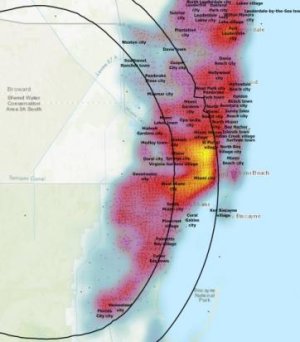
I'm not sure which propagation software package and what version of Census data you use? See the attached coverage map of WMKL, as currently licensed. This shows the 60 dBu and 54 dBu contours plotted with Longley-Rice propagation model and 3 second terrain DEM with the 2017 Census ACS 5-year estimate data. The 60 dBu coverage includes 1,320,158 persons, and the 54 dBu coverage includes 2,689,326 persons. The 65 dBu coverage includes 385,633 persons (If you have other data I'd definitely be interested in seeing how you are coming up with such low numbers). This tabulates 3-year old Census data so actual population numbers are likely higher in reality. With the terrain in South Florida, the actual in-vehicle coverage is well out beyond 50 dBu - there is WMKL reception well into Palm Beach, Collier, and Monroe Counties. There is great WMKL indoor clock and table top radio reception even less than 60 dBu (Cutler Bay, Palmetto Bay on the coast). Where are you listening? Indoors or vehicle?
I don't think it is realistic to assume that the majority of radio listening still happens from home in 2020, at least not in South Florida with lengthy drive-time commute times. The majority of households (ages 18-34) do not have a radio at home. Even if people are consuming audio only, smart phones and smart speakers dominate. See Edison Research's 2020 Infinite Dial: http://www.edisonresearch.com/wp-co...e-Infinite-Dial-2020-U.S.-Edison-Research.pdf. Unfortunately, the trend of AM stations disappearing is inevitable. The FM in Key West (WJIR on-air for at least 35 years) blanketed Key West. The LPFM (WORZ-LP) exclusively served the affluent Ocean Reef Club community in North Key Largo with a local signal. The decline of some FM stations has more to do with other factors than signal or coverage. People are just consuming media differently than they did 10-15 years ago depending on their age and unfortunately that is less audio consumption of terrestrial radio.
Rob
David,
I'm not sure which propagation software package and what version of Census data you use? See the attached coverage map of WMKL, as currently licensed. This shows the 60 dBu and 54 dBu contours plotted with Longley-Rice propagation model and 3 second terrain DEM with the 2017 Census ACS 5-year estimate data. The 60 dBu coverage includes 1,320,158 persons, and the 54 dBu coverage includes 2,689,326 persons. The 65 dBu coverage includes 385,633 persons (If you have other data I'd definitely be interested in seeing how you are coming up with such low numbers). This tabulates 3-year old Census data so actual population numbers are likely higher in reality. With the terrain in South Florida, the actual in-vehicle coverage is well out beyond 50 dBu - there is WMKL reception well into Palm Beach, Collier, and Monroe Counties. There is great WMKL indoor clock and table top radio reception even less than 60 dBu (Cutler Bay, Palmetto Bay on the coast). Where are you listening? Indoors or vehicle?
I don't think it is realistic to assume that the majority of radio listening still happens from home in 2020, at least not in South Florida with lengthy drive-time commute times. The majority of households (ages 18-34) do not have a radio at home. Even if people are consuming audio only, smart phones and smart speakers dominate. See Edison Research's 2020 Infinite Dial: http://www.edisonresearch.com/wp-co...e-Infinite-Dial-2020-U.S.-Edison-Research.pdf. Unfortunately, the trend of AM stations disappearing is inevitable. The FM in Key West (WJIR on-air for at least 35 years) blanketed Key West. The LPFM (WORZ-LP) exclusively served the affluent Ocean Reef Club community in North Key Largo with a local signal. The decline of some FM stations has more to do with other factors than signal or coverage. People are just consuming media differently than they did 10-15 years ago depending on their age and unfortunately that is less audio consumption of terrestrial radio.
Rob
In studies of listening at home and at work (still, in normal times, over half of all listening) 80% occurs in the 70 dbu contour and 95% is inside the 65 dbu contour. The WMKL signal at 65 dbu does not reach much of any populated area. There is a difference between being able to hear a station and it being listenable to the normal listener.
There are less than 500 people in the WMKL 70 dbu coverage area, and just over 4,300 in the 65 dbu coverage area. Even the 60 dub reaches less than 10% of the radio MSA.
You speak elsewhere in the post about some AMs and LPFMs disappearing. The real reason is bifurcated. For AM, it is the combination of most stations not fully covering their markets or being daytimers plus the failure of the low-fidelity, interference prone band to compete with FM and new media. For FM, rimshots, low power stations and the like can't find enough audience to get supporters or revenue.
Attachments
- Status
- This thread has been closed due to inactivity. You can create a new thread to discuss this topic.