• Get involved.
    We want your input!
    Apply for Membership and join the conversations about everything related to broadcasting.

    After we receive your registration, a moderator will review it. After your registration is approved, you will be permitted to post.
    If you use a disposable or false email address, your registration will be rejected.

    After your membership is approved, please take a minute to tell us a little bit about yourself.
    https://www.radiodiscussions.com/forums/introduce-yourself.1088/

    Thanks in advance and have fun!
    RadioDiscussions Administrators

KJR-100 years of continuous broadcasting

Almost all of the early stations used live voice or musical talent, nothing prerecorded. If you go into John Schneider's archives, you'll see examples of early KJR or other stations having a local piano player accompanying local singers etc. Years ago Vincent Kraft told me he didn't have any problems finding talent around the area which wanted to be a part of this new thing, radio. While still 7XC, Kraft pulled off one of the first major radio broadcasts:

"The first big event to be broadcast by our company was the Dempsey-Carpenter fight on July 2, 1920. This was accomplished with a small 10-watt radio telephone transmitter, and we were more than surprised and pleased to receive reports that the broadcasting of this event was received from points as far away as Anacortes."
 
BTW: I uncovered in my vast basement archives, a wrapped tube of original KJR 'Yellow Ball' stickers, vintage the early to mid 70's.
If you'd like one or two, PM-me with your name and mailing address.
 
Hmmm, music played off a Victrola? Don't know where you got that idea. If they tried to play recorded music, they would get sued by either the musicians union or the record labels. The early history of broadcasting is filled with litigation over the attempted use of music on the radio. The famous story had to do with the first broadcast by the NBC radio network in 1926. The president of the network introduced his secretary, who played the piano. That was a live performance, not a recording. Soon afterwards, the musicians union sued because she wasn't in the union. This is why early radio stations had to hire professional musicians to play music. Keep in mind that NBC was owned by the same company that made the Victrola and owned RCA Records. A lot of the technology was being developed by the recording industry and the film industry. Quality microphones were introduced in 1917. Multiple microphone mixing in recording studios came about in 1928. So it's not as dismal as you make it sound. KJR began as an amateur station, most likely on the air for a few hours a day. So playing music off a Victrola was probably not on the schedule.

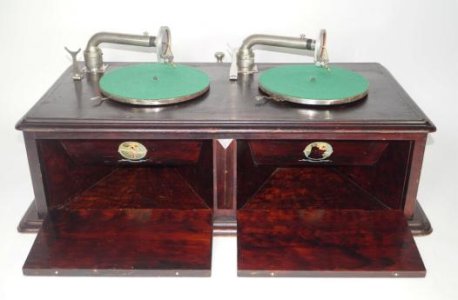
Actually, he may be right on the Victrolas. There were double gramophones in those days.

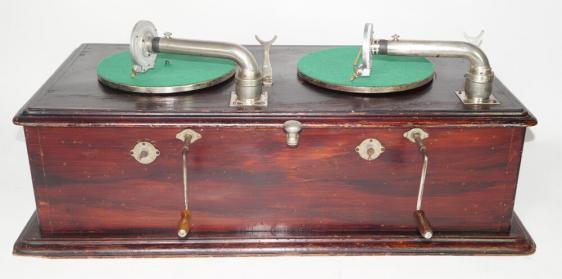
This is The Pathe Duplex Phonograph. It has two soundboxes, as you can see and for the life of me, I can't imagine what other use they could used be for. Victor and Columbia made similar models, but Pathes could play both lateral and vertical cut records by swapping out the reproducers on the tone arms.
 

Attachments

  • Extreme-Rare-Pathe-Duplex-Phonograph-Gramophone-With.jpg
    Extreme-Rare-Pathe-Duplex-Phonograph-Gramophone-With.jpg
    20.7 KB · Views: 27
  • Extreme-Rare-Pathe-Duplex-Phonograph-Gramophone-With-_57.jpg
    Extreme-Rare-Pathe-Duplex-Phonograph-Gramophone-With-_57.jpg
    20.6 KB · Views: 24
Actually, he may be right on the Victrolas. There were double gramophones in those days.

What I was responding to was "music played off a Victrola with a microphone in front of it." As I said, the playing of recorded music on the radio wasn't legal in the 20s. Placing a microphone in an open room in front of an acoustic speaker probably didn't sound very good. You probably picked up as much rumble from the motor as you did music. As for uses for double gramophones: playback in theaters or restaurants.

So far I haven't seen a photo of a gramophone in a radio studio. Although by the early 1930s, the networks had the ability to record and playback on transcription discs, and I've seen pictures of those devices. I actually own some of those recordings with the radio station labels on them.
 
I have a couple of those old carbon microphones from that era. The audio quality picked-up by today's standards are slightly one step above two cans and a string. Trying to mic a Victrola with one of those mics would make the transmitted audio unintelligible.
 
As for uses for double gramophones: playback in theaters or restaurants.

If that's the case, then it's quite possible the nightclub DJ predates radio.
 
Status
This thread has been closed due to inactivity. You can create a new thread to discuss this topic.


Back
Top Bottom