• Get involved.
    We want your input!
    Apply for Membership and join the conversations about everything related to broadcasting.

    After we receive your registration, a moderator will review it. After your registration is approved, you will be permitted to post.
    If you use a disposable or false email address, your registration will be rejected.

    After your membership is approved, please take a minute to tell us a little bit about yourself.
    https://www.radiodiscussions.com/forums/introduce-yourself.1088/

    Thanks in advance and have fun!
    RadioDiscussions Administrators

Stations that covered the most states

While looking at the Services Edition of the 1979 Television Factbook, which includes what local stations were carried on almost every CATV system in the country at this time, I noticed that there were quite a few stations that covered at least parts of a handful of states.

Some examples include:
WBBJ (7) Jackson, TN (AL, AR, KY, MO, MS, TN) [6 states]
WLOS (13) Asheville, NC (GA, KY, NC, SC, TN, VA) [6 states]
WGAL (8) Lancaster, PA (DE, MD, PA, VA, WV) [5 states]
WFSB (3) Hartford, CT (CT, MA, NH, NY, RI, VT) [6 states]
KELO (11) Sioux Falls, SD/KDLO (3) Florence, SD/KPLO (6) Reliance, SD (IA, MN, ND, NE, SD) [5 states]
KOTA (3) Rapid City, SD/KDUH (4) Hay Springs, NE/KHSD (11) Lead, SD (CO, MT, ND, NE, SD, WY) [6 states]
The Salt Lake City stations were carried as far away as Williston, North Dakota
 
WMTW on Mount Washington NH (COL Poland Spring ME) had cable carriage in Maine, NH, Vermont and parts of northern NY, not to mention across wide swaths of Ontario and Quebec. And you could watch it over the air in all of those places - and even in some corners of Massachusetts when conditions were good.
 
When KELO added KCLO Rapid City, it could serve a sliver of eastern WY as well (like the Sundance area). So six states.
When the Denver stations went to C-Band in the late '80s, cable providers all over the Mountain time zone carried them. Montana, Wyoming, even in parts of Oregon. Burns OR was able to get KMGH and I think one other Denver station all the way to 2010 or so. Wonder if any cable providers in CT or ET w/o a nearby ABC, NBC, CBS or PBS carried a Denver network station off Satcom F1R/C1? Some in WY and parts of CO already had them from microwave relays prior to C-Band.
 
I think some rural parts of Texas (Central Time) carried at least some of the Denver Six. I think there might be areas of west central Texas that still get KRMA to this day, especially in the Abilene and San Angelo markets.

KUED from Salt Lake City was carried in most of central and eastern Montana before KUSM came on the air. KSPS covered western Montana. I think KSPS still has a translator in Missoula, even though it's been bumped off cable there

Alturas, CA (in far northeast California and a white area for OTA TV) had KCNC on cable for years.

Also, it seems like every little municipality in Pennsylvania had its own cable system.
 
Some other interesting tidbits from the 1979 TV Factbook:
- WMBB (Panama City, FL) was trying to also serve Dothan and Tallahassee (neither of which had their own NBC affiliates at this time; WMBB's stick was in Calhoun County, which put a borderline Grade A signal into Tallahassee and a Grade B signal into Dothan)
- WBOY (Clarksburg, WV) had a fairly short-lived primary ABC affiliation in the late 1970s as WDTV had an ad mentioning CBS and NBC airing on that station
 
I believe the fringes of Boston signals reach all six New England states.
More than just the fringes. The Boston TV market includes most of New Hampshire and a small chunk of southeastern Vermont around Brattleboro. WCVB, in particular, still has cable carriage in eastern Connecticut and a few towns in southern Maine. And while it's not on cable, the WCVB broadcast signal is easily received in much of Rhode Island.
 
More than just the fringes. The Boston TV market includes most of New Hampshire and a small chunk of southeastern Vermont around Brattleboro. WCVB, in particular, still has cable carriage in eastern Connecticut and a few towns in southern Maine. And while it's not on cable, the WCVB broadcast signal is easily received in much of Rhode Island.

WGBH and WGBX are on cable in all of Rhode Island: https://www.cox.com/wcm/cl/Rhode-Island-Area.pdf
 
More than just the fringes. The Boston TV market includes most of New Hampshire and a small chunk of southeastern Vermont around Brattleboro. WCVB, in particular, still has cable carriage in eastern Connecticut and a few towns in southern Maine. And while it's not on cable, the WCVB broadcast signal is easily received in much of Rhode Island.
It's important to note that radio markets are principally defined by the coverage and usage of over the air radio signals. Television markets are defined by the use of TV stations whether received off the air, by cable or other non-broadcast distribution method.

Many TV markets extend well beyond the reach of the stations that are in the main city of the market. A radio market is confined to the reach of enough over the air signals with enough audience to be dominant.
 
Many TV markets extend well beyond the reach of the stations that are in the main city of the market.

That is very true-- I have an old 1997 San Bernardino County Sun Sunday paper, and the TV guide within has the main L.A. stations and a few more, IIRC.

Also, I have the San Jose Mercury News for New Year's Day 1989, and the TV guide within that one has San Jose, San Francisco, Sacramento, and even one or two Monterey stations.
 
That is very true-- I have an old 1997 San Bernardino County Sun Sunday paper, and the TV guide within has the main L.A. stations and a few more, IIRC.

Also, I have the San Jose Mercury News for New Year's Day 1989, and the TV guide within that one has San Jose, San Francisco, Sacramento, and even one or two Monterey stations.
I remember that the Kansas City Star used to offer TV listings for the Topeka, KS TV stations along with the Kansas City, MO\KS TV stations. For some reason, though, KQTV in St. Joseph, MO, was not listed in the Kansas City edition.
 
I remember that the Kansas City Star used to offer TV listings for the Topeka, KS TV stations along with the Kansas City, MO\KS TV stations. For some reason, though, KQTV in St. Joseph, MO, was not listed in the Kansas City edition.
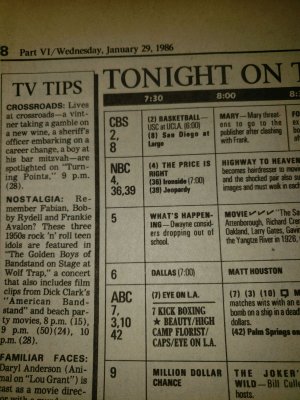
And the L.A. Times had not just KCBS, KNBC and KABC (the L.A. O&Os on 2, 4 and 7), but also KFMB, KCST (now KNSD) and KGTV from San Diego (channels 8, 39 and 10). Here's part of the TV page for Wed. Jan. 29, 1986 (Page 8 of the Calendar section [Part VI]), showing that the Times had not just L.A. and San Diego stations, but also the ABC station for Santa Barbara (KEYT Channel 3), and NBC and ABC stations for Palm Springs (KMIR Channel 36 and KESQ Channel 42).

latimesjeopardy1986-2.jpg
 
That is very true-- I have an old 1997 San Bernardino County Sun Sunday paper, and the TV guide within has the main L.A. stations and a few more, IIRC.
San Bernardino County... at least most of the populated areas... get about as good a signal from the LA Mt Wilson stations as, let's say, Northridge or San Clemente do.

The real case of "reach but not cover" is where OTA signals are not generally receivable but stations are carried on cable.
 
And the L.A. Times had not just KCBS, KNBC and KABC (the L.A. O&Os on 2, 4 and 7), but also KFMB, KCST (now KNSD) and KGTV from San Diego (channels 8, 39 and 10). Here's part of the TV page for Wed. Jan. 29, 1986 (Page 8 of the Calendar section [Part VI]), showing that the Times had not just L.A. and San Diego stations, but also the ABC station for Santa Barbara (KEYT Channel 3), and NBC and ABC stations for Palm Springs (KMIR Channel 36 and KESQ Channel 42).

View attachment 1641
Of course, that is the reverse of station service either over the air or by cable; newspapers that circulated in wide areas would put the TV schedules of other cities as they wanted to sell papers there.

I recall in the early 60's that the Detroit Free Press even printed an addition for part of the NE Lower Peninsula that had the Traverse City and Cadillac TV station schedules. And they did not include the Detroit stations!
 
I remember Directv in the 2000's used to issue Los Angeles TV (O&O) stations in states where their local market was not available yet or not issued as all. It notably had KABC, KTTV, KCBS and KNBC. Does this count as stations that cover most states.

Also there was a story that KTVU Fox 2 prior to having a Fox affiliation under the previous owners Cox Media used to have a superstation status in the early 1980's and they were supposed to be a competitor for Superstation WTBS (Now known as WPCH-TV for Atlanta only Viewers) and TBS for national audiences.

WGN Chicago was a superstation now under Nexstar ownership is converting WGN America as News Nation.

KTLA Los Angeles under Golden West and Tribune Management was also at one point a superstation and was also the default WB affiliate in some areas that didn't have a local WB affiliate yet at the time or at all.
 
Last edited:
Of course, that is the reverse of station service either over the air or by cable; newspapers that circulated in wide areas would put the TV schedules of other cities as they wanted to sell papers there.

I recall in the early 60's that the Detroit Free Press even printed an addition for part of the NE Lower Peninsula that had the Traverse City and Cadillac TV station schedules. And they did not include the Detroit stations!

Even into the 2000s, I remember one of the Detroit papers having a statewide TV guide that included most of the stations from Detroit, Grand Rapids/Kalamazoo/Battle Creek, Flint/Saginaw/Bay City, Toledo, Lansing/Jackson, Traverse City/Cadillac, Marquette, and Alpena, as well as CBC (CBET and CJIC) and CTV (CKCO and CHBX). The only stations that served parts of MI that weren't included were South Bend (serving far SW Michigan, which likely had more readership of the Chicago papers than the Detroit papers) and Green Bay (however, WFRV was included as it had a satellite in the Yoop [WJMN, which is all but a separate station nowadays])
 
I remember Directv in the 2000's used to issue Los Angeles TV (O&O) stations in states where their local market was not available yet or not issued as all. It notably had KABC, KTTV, KCBS and KNBC. Does this count as stations that cover most states.

Also there was a story that KTVU Fox 2 prior to having a Fox affiliation under the previous owners Cox Media used to have a superstation status in the early 1980's and they were supposed to be a competitor for Superstation WTBS (Now known as WPCH-TV for Atlanta only Viewers) and TBS for national audiences.

WGN Chicago was a superstation now under Nexstar ownership is converting WGN America as News Nation.

KTLA Los Angeles under Golden West and Tribune Management was also at one point a superstation and was also the default WB affiliate in some areas that didn't have a local WB affiliate yet at the time or at all.
Way before we called it "Cable" we had CATV. Community Antenna TeleVision started with a community group putting antennas "up on the hill" and then sending the received OTA signals to homes. Rugged area of PA and WV were prime locations. As the tech got better, the antennas were picking up stations a hundred, two hundred miles away. Or getting relays from another hilltop. So places in ID, MT, the Dakotas, WY and the like that were far, far away from a TV station were suddenly part of those station's collective market. Thus, even if there was no signal and no local station, many far-away towns became part of the SLC or Denver or PHX markets, to name a few.

And that is how the TV Areas of Dominant Influence or market areas were established.
 
I remember Directv in the 2000's used to issue Los Angeles TV (O&O) stations in states where their local market was not available yet or not issued as all. It notably had KABC, KTTV, KCBS and KNBC. Does this count as stations that cover most states.

Also there was a story that KTVU Fox 2 prior to having a Fox affiliation under the previous owners Cox Media used to have a superstation status in the early 1980's and they were supposed to be a competitor for Superstation WTBS (Now known as WPCH-TV for Atlanta only Viewers) and TBS for national audiences.

WGN Chicago was a superstation now under Nexstar ownership is converting WGN America as News Nation.

KTLA Los Angeles under Golden West and Tribune Management was also at one point a superstation and was also the default WB affiliate in some areas that didn't have a local WB affiliate yet at the time or at all.
But, while those were all local stations in their OTA licensed markets, they were also cable channels that had really nothing to do with the local VHF channel.

I am not sure of this data, but I was told that the Superstations used a sort of loophole in program licensing contracts before cable on a national basis became big; program providers depended on selling to local stations in a hundred or more markets and did not really want to just have one customer. So the local stations you named became "superstations" until the licensing caught up. In the meantime, we got "A Team" reruns on cable.
 
Way before we called it "Cable" we had CATV. Community Antenna TeleVision started with a community group putting antennas "up on the hill" and then sending the received OTA signals to homes. Rugged area of PA and WV were prime locations. As the tech got better, the antennas were picking up stations a hundred, two hundred miles away. Or getting relays from another hilltop. So places in ID, MT, the Dakotas, WY and the like that were far, far away from a TV station were suddenly part of those station's collective market. Thus, even if there was no signal and no local station, many far-away towns became part of the SLC or Denver or PHX markets, to name a few.

And that is how the TV Areas of Dominant Influence or market areas were established.
And in some cases, at least for Denver channels, the uplink to C-Band really helped. Cable providers all over the rural west were picking up one or more Denver stations from the late '80s onward.
 
And in some cases, at least for Denver channels, the uplink to C-Band really helped. Cable providers all over the rural west were picking up one or more Denver stations from the late '80s onward.
Remember, though, that CATV began in the late 40's to provide "shadowed" markets with service from "nearby" TV stations. That was long before satellites... even before we sat in our school classrooms and heard Sputnik beeping from the sky.

 
Status
This thread has been closed due to inactivity. You can create a new thread to discuss this topic.


Back
Top Bottom