• Get involved.
    We want your input!
    Apply for Membership and join the conversations about everything related to broadcasting.

    After we receive your registration, a moderator will review it. After your registration is approved, you will be permitted to post.
    If you use a disposable or false email address, your registration will be rejected.

    After your membership is approved, please take a minute to tell us a little bit about yourself.
    https://www.radiodiscussions.com/forums/introduce-yourself.1088/

    Thanks in advance and have fun!
    RadioDiscussions Administrators

Daytimer on at night - 890

Last night (2/24) 9:30pm CST/0330 GMT, I was on the Dixon, IL SDR and heard a very weak, but audible signal on 890 under WLS. Matching what I was hearing to an online srream, I was able to determine what I was hearing was Catholic radio from KMVG in suburban Kansas City. KMVG is a 960-watt daytimer with a deep null protecting WLS.. Radio-Locator indicates that they have a CP to move their transmitter location a short distance away from where they are now, and increase power slightly to 1kw with a similar DA pattern.

I'm not sure what's going on, but I'm wondering if KMVG being on has to do with the move to a new transmitter site. Perhaps they're running without the DA and/or at lower power for whatever reason (on top of "forgetting" to turn off the transmitter). That null would theoretically keep the signal away from Illinois ...including The Dixon SDR site, which is about 100 miles west of Chicago.

Anyway, some of you guys may have a shot for a new catch on 890.
 
Interesting! This is a local station for me in Overland Park, Kansas. I am aware of their CP to move their transmitter site. They are owned by the Catholic Radio Network that also owns KDMR here on 1190 kHz. KDMR is a 5 kW non-directional day, 500 w 4-tower directional night. I suspect that KMVG and KDMR will share the same transmission facility once this move is completed.

Usually, WLS "booms" in here once KMVG signs off. WLS is the most reliable of the 50 kW non-directional signals from Chicago at my location.

Bob
 
I was driving between Waukegan and Kenosha about Midnight (2/25) doing my usual quick bandscan. WLS was getting absolutely trashed by something I didn't have time to ID.

WLS has always been the weakest Chigago 50K on this side of the Metro, but I have never heard anything bury them like last night.
 
If the receive site is far enough from the tx site then nighttime skywave dominates the received field. For the last few weeks, the skip has been "long" for MW broadcast stations. I live in west central Illinois, and normally get WBBM's nighttime skywave here with almost no co- or adjacent-channel interference from other stations.

But for the last few weeks WBBM has been almost too noisy to listen to here at night, while WJR, Detroit and other more distant Class A AMs were solid copy here with signals 10-15 dB higher than WBBM.

An hour or so ago I checked, and WBBM was back on par with the other Class As.
 
At 6:45am this morning here in Overland Park, Kansas I tuned in 890 kHz on my car radio on the way to a client meeting. This is before local KMVG on this frequency signs on. To my surprise, WLS was totally missing which is highly unusual at this time of day. The only signal was some Spanish music programming that I did not have time to ID since I had a 7:00am meeting. I quickly checked the other Chicago 50 kW frequencies and all were missing. Skip conditions were not good anywhere on the AM band here early this morning between 6:30-7:00am. Most unusual since local sunrise is now 6:57am.

Bob
 
Last edited:
I checked 890 before dawn this morning, and it was all WLS. Nothing at all underneath it. My location is about 53 miles from the WLS transmitter site.

I was wondering about KDMR's relationship with KMVG. It seems pretty safe to assume that KDMR has been something less than compliant with nighttime broadcasting regulations on occasion during recent weeks. So perhaps if KMVG "forgot" to turn off its transmitter the other night, it's not all that surprising.
 
Spanish music programming that I did not have time to ID
A while back when WLS was still a good station, signal had a big problem overcoming Cuban National Radio. Particularly in the summer, it wasn't unusual to hear the Cuban anthem being sung on 890. I don't know if that's the origin of Spanish music being heard now but then it was almost like Cuba was wiping out WLS on East Coast.
 
I checked 890 before dawn this morning, and it was all WLS. Nothing at all underneath it. My location is about 53 miles from the WLS transmitter site.

I was wondering about KDMR's relationship with KMVG. It seems pretty safe to assume that KDMR has been something less than compliant with nighttime broadcasting regulations on occasion during recent weeks. So perhaps if KMVG "forgot" to turn off its transmitter the other night, it's not all that surprising.

Owned by the same folks, obviously.
 
I checked 890 before dawn this morning, and it was all WLS. Nothing at all underneath it. My location is about 53 miles from the WLS transmitter site.

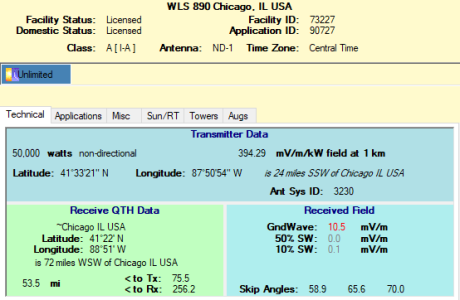
It looks like receive sites that are ~53 miles from the WLS transmitter site are too close to receive a day/night, interfering skywave signal from them (see the Received Field section of the graphic below).

Assuming there is no huge source of local r-f noisemakers at a receive site and that the receiver is not located in a steel-frame structure, WLS' ground wave should be solid 24/7, and free of self-interference at that distance downrange.

WLS, ~53-mile GW Path.png
 
A while back when WLS was still a good station, signal had a big problem overcoming Cuban National Radio. Particularly in the summer, it wasn't unusual to hear the Cuban anthem being sung on 890. I don't know if that's the origin of Spanish music being heard now but then it was almost like Cuba was wiping out WLS on East Coast.
Cuba , years ago , ruined 710 WOR at night here in suburban Philadelphia.
 
A while back when WLS was still a good station, signal had a big problem overcoming Cuban National Radio. Particularly in the summer, it wasn't unusual to hear the Cuban anthem being sung on 890. I don't know if that's the origin of Spanish music being heard now but then it was almost like Cuba was wiping out WLS on East Coast.
There is no such thing as "Cuban National Radio" (which would be "Radio Nacional de Cuba" or "Radio Nacional Cubana"). 710 has numerous "Radio Rebelde" outlets, though. There are 8 listed in last year's World Radio Handbook, the largest with 300 kw. Those signals are intended to block Radio Martí from Miami.

Cuba has a whole bunch of national networks, including Rebelde, Progreso, Enciclopedia, Reloj, Musical Nacional and Taino.
 
"Radio Habana" is Cuban national radio. Arnie Coro was on shortwave for years. But the same on the hour anthem, was on frequency at 890 often in the summer (on Progreso) that was also played on Radio Habana.
Radio Progreso (the domestic service formerly heard in Havana on 690) can be heard on 890 (where it often overrides WLS). Programming consists mostly of popular music, with children’s programs in the early evening. It's domestic, all of this programming is in Spanish. Phil Galasso
 
I hear Radio Progresso, drifting in and out, over WLS every night here in Atlanta. Its been that way for several years now.
When it gets so bad that I can't understand Mark Levin I switch over to WHAS (840).
Speaking of Arnie Corro, I heard on Glen Hauser that he is suffering from Alzheimers.
 
Last edited by a moderator:
"Radio Habana" is Cuban national radio. Arnie Coro was on shortwave for years. But the same on the hour anthem, was on frequency at 890 often in the summer (on Progreso) that was also played on Radio Habana.
Radio Habana Cuba is Cuba's international service, not intended for the local audience.

Some of the AMs that had high power ran that service overnight because those signals could be heard all around the Caribbean Basin, from Yucatán to Venezuela. But that was back when they had the Czech transmitters; everything now is from China.
 
Radio Habana Cuba is Cuba's international service, not intended for the local audience.
Although the English shortwave service does promote that you can hear RHC on 102.5 FM in the Havana area.
But that was back when they had the Czech transmitters
Ah, yes, the other Tesla: Tesla (Czechoslovak company) - Wikipedia

Actually the Tesla transmitters used by Radio Prague on SW back in the day had very good audio quality, probably the best of all the eastern European broadcasters.
everything now is from China.
And the RHC Chinese-made SW transmitters (presumably BBEF units) have deteriorated badly since their installation in the early 00's. Horrible audio and spurring on several frequencies.
 
Although the English shortwave service does promote that you can hear RHC on 102.5 FM in the Havana area.

Ah, yes, the other Tesla: Tesla (Czechoslovak company) - Wikipedia
But those Teslas don't have wheels.

Back in the 60's, I was visted by a sales rep from the Czech company to try to sell me their 30 kw, 60 kw and 120 kw AM transmitters. What was amusing is that the salesman arrived with a "silent partner"... a guy in the classic "bad suit" and unfriendly attitude. You knew they were KGB or something similar, making sure that the salesperson did not defect or say something negative.

The transmitters were cheap, but they used tubes made in Russia only and that made me doubly nervous. And they had no data on the transmitters running at 10,000 feet AMSL so I thanked them and sent the seller and the secret agent man on their way. They never sold a single rig in Ecuador.
Actually the Tesla transmitters used by Radio Prague on SW back in the day had very good audio quality, probably the best of all the eastern European broadcasters.

And the RHC Chinese-made SW transmitters (presumably BBEF units) have deteriorated badly since their installation in the early 00's. Horrible audio and spurring on several frequencies.
The AM system was redone in very recent years; lots of diplexed, triplexed and beyond AM sites. I suspect that SW is now considered almost dead, so I doubt they are spending on improvements.
 
It looks like receive sites that are ~53 miles from the WLS transmitter site are too close to receive a day/night, interfering skywave signal from them (see the Received Field section of the graphic below).

Assuming there is no huge source of local r-f noisemakers at a receive site and that the receiver is not located in a steel-frame structure, WLS' ground wave should be solid 24/7, and free of self-interference at that distance downrange.
Thanks for the info and the illustration, Rich. Unlike when I was a teenager, I don't spend a lot of time listening to WLS, My own real world experience at my home location is different. Albeit only very slightly, on three counts....

First, I have heard nighttime skywave cancellation on WLS, but only in recent years...and very rare. Off the top of my head, I'd, say the first time was maybe 2-3 years ago. Frankly, I was shocked, but my thought then...as now...was that perhaps they weren't runnuing their full 50kw. Secondly, I've also heard Spanish under WLS. Again, very rare and very faint. I haven't been able to ID it, but i suspect Cuba (R, Progreso). Third, This morning, about an hour and a half before sunrise, I nulled WLS, and heard a faint, but unidentiable, "fluttering" signal on the channel. Rotating the radio to remove the null, WLS was again all alone.

I'm not here to argue with someone whom I greatly respect, and consider a treasure-trove of information and insights for all of us on this board. We're fortunate to have you. And indeed, WLS signal is robust here 24/7. But not totally immune from intrusion. I chalk it up to the reality of more transmitters on just about every channel, and less stringent enforcement of some of the rules. Combined with newer residential and commercial development around the 73-year old WLS transmitter site, which may have slightly degraded the signal.

As always, I stand to be corrected.
 
Last edited:
... And indeed, WLS signal is robust here 24/7. But not totally immune from intrusion. I chalk it up to the reality of more transmitters on just about every channel, and less stringent enforcement of some of the rules. Combined with newer residential and commercial development around the 73-year old WLS transmitter site, which may have slightly degraded the signal.
All of those observations are totally valid.

Below is a graphic showing the potential co-channel interfering sources to WLS these days.

PS: Thanks for your good words.

890-k-Hz-Day-Night-AM-Stns-Contours[1].jpg
 
For what it's worth, one of the recent additions to 890 in the west has dropped to nominal D level, KJME Fountain/Colorado Springs. CP has night power at 11 watts, non-D. Don't know their current power, but it's not usable beyond a few miles from its current site.
 
Status
This thread has been closed due to inactivity. You can create a new thread to discuss this topic.


Back
Top Bottom