• Get involved.
    We want your input!
    Apply for Membership and join the conversations about everything related to broadcasting.

    After we receive your registration, a moderator will review it. After your registration is approved, you will be permitted to post.
    If you use a disposable or false email address, your registration will be rejected.

    After your membership is approved, please take a minute to tell us a little bit about yourself.
    https://www.radiodiscussions.com/forums/introduce-yourself.1088/

    Thanks in advance and have fun!
    RadioDiscussions Administrators

Series AM towers

I wonder why there are so many series AM towers? One would think that the extra expense of insulators plus some form of an Austin ring transformer if the tower has to have lighting, would cost more than a simple grounded tower with a shunt feed.

No one saw this decades ago but If a station can use it’s tower for a FM translator or other uses like cell service there is the expense of an isolator if series feed.
 
One rather big reason is that series-fed monopoles have more predictable radiation patterns in the vertical plane, which make their nighttime skywave, co-channel interference performance more predictable by the FCC (for allocation purposes).
 
Thanks

I never thought about nighttime service and that makes since, but there seems to have been a bunch of upper band (1300+) 1KW or lower day-timers set up in series too. I question how many AM stations have under used towers, especially near airports and in residential neighbor hoods where any tall structure could face NIMBY opposition. One has to wonder did CC now iHeart really made a good deal with American tower?
 
I wonder why there are so many series AM towers? One would think that the extra expense of insulators plus some form of an Austin ring transformer if the tower has to have lighting, would cost more than a simple grounded tower with a shunt feed.

Not including the price of land, a self-supporting tower usually costs more than its guyed equivalent. Mechanically a tall guyed tower needs a fulcrum point at its bottom. This is provided by the high strength ceramics that are also able to RF isolate the structure.
 
I wonder why there are so many series AM towers? One would think that the extra expense of insulators plus some form of an Austin ring transformer if the tower has to have lighting, would cost more than a simple grounded tower with a shunt feed.

No one saw this decades ago but If a station can use it’s tower for a FM translator or other uses like cell service there is the expense of an isolator if series feed.
Shunt feeds are seldom used. More often, when using a grounded tower, an AM station will install an insulated "skirt" on the tower. The skirt becomes the transmitting antenna. On a series-fed tower, the wires for the tower lighting can be wound on an insulator and fashioned into an RF choke This provides not only electrical power for the tower lights, but also acts as a static drain choke to reduce static buildup on the tower.
 
I have never seen the ac lighting feed wound on an insulator. I have seen "Austin ring transformers" used in directional arrays. that require lighting. The AM towers I had to deal with had FM antennas, used a form of "folded unipole" and had Nott LTD documentation or did not require lighting. and had the glass insulator at the base and glass insulators on the guy wires.

 
I have never seen the ac lighting feed wound on an insulator. I have seen "Austin ring transformers" used in directional arrays. that require lighting. The AM towers I had to deal with had FM antennas, used a form of "folded unipole" and had Nott LTD documentation or did not require lighting. and had the glass insulator at the base and glass insulators on the guy wires.


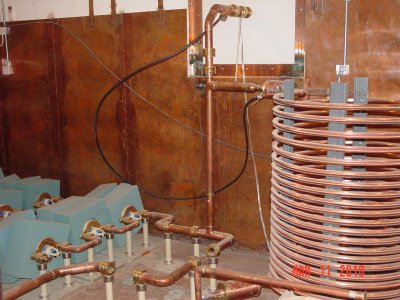
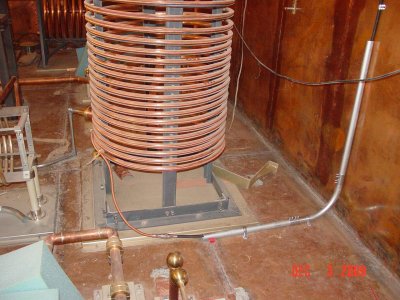
The solenoid style AC lighting feed tended to be rather common at the lower power MW transmitter operations, using something
like what you see in the upper left of page 29 in this Gates catalog from years ago:


Sometimes even used at rather high powers. Below are two different views of an isolation coil used for both an RF sampling line and AC power for the tower lights.
 

Attachments

  • Sampling Line CTH 3.jpg
    Sampling Line CTH 3.jpg
    590.4 KB · Views: 4
  • Center Tower Sampling Line.jpg
    Center Tower Sampling Line.jpg
    592.2 KB · Views: 4
Status
This thread has been closed due to inactivity. You can create a new thread to discuss this topic.


Back
Top Bottom