
• Get involved.
    We want your input!
    Apply for Membership and join the conversations about everything related to broadcasting.

    After we receive your registration, a moderator will review it. After your registration is approved, you will be permitted to post.
    If you use a disposable or false email address, your registration will be rejected.

    After your membership is approved, please take a minute to tell us a little bit about yourself.
    https://www.radiodiscussions.com/forums/introduce-yourself.1088/

    Thanks in advance and have fun!
    RadioDiscussions Administrators

Unusual Histories for Salem's KRLA and KKLA

In a separate LA thread, we were discussing whether Salem should flip KKLA and KRLA, talk on FM and religion on AM? It got me thinking about the odd histories both stations have.

KRLA 870 was, for most of its history, a daytimer, with the call sign KIEV. By the 1970s it was broadcasting at 5,000 watts but it had to sign off at sunset. It was protecting Class I-A WWL New Orleans. But am I remembering it also had to protect a station in Hawaii? Salem bought that station and took it off the air to give 870 nighttime power?

And in the 1990s, the FCC relaxed restrictions on co-channel stations on the clear channel frequencies. Glendale and New Orleans are more than 2,000 miles apart, so KIEV really wasn't going to cause much of a problem for WWL. Eventually KIEV got the boost to 50,000 watts days, 3,000 watts nights, using a directional antenna around the clock.

KKLA 99.5 was a religious station for its entire history. Back when nobody valued FM licenses, an LA church got the frequency and put a religious station on the air. In the 1970s, televangelist and nutty character Gene Scott (look at his TV show videos on You Tube) acquired the church and FM station. FMs were still undervalued. But by then, some people had FM radios in their homes and vehicles. Scott used the station to broadcast the audio of his TV shows 24/7.

Eventually Scott's craziness got him in trouble with the IRS. Due to his legal and tax problems, his FM station was taken off the air for several years. I guess Salem saw an opportunity to get it and eventually the FCC awarded Salem the license? There are few full power religious stations on FM frequencies in large markets. KKLA, according to Wikipedia, claims it has the largest audience of any Christian radio station in the U.S. I suppose that's true, since Salem's NYC station is a 5,000 watt AM outlet, likely not getting the same level of listeners as a full power Los Angeles FM signal.
 
KRLA 870 was, for most of its history, a daytimer, with the call sign KIEV. By the 1970s it was broadcasting at 5,000 watts but it had to sign off at sunset. It was protecting Class I-A WWL New Orleans. But am I remembering it also had to protect a station in Hawaii? Salem bought that station and took it off the air to give 870 nighttime power?
It moved the Honolulu station to an adjacent frequency, clearing 870.
 
Didn’t the 870 in Honolulu run 50KW from a Directional antenna on Molokai? I read the electricity cost was astronomical. Moving the 870 frequency in Honolulu to 880 (with a significant power reduction and back to Oahu) saved a lot of money and allowed the 870 upgrade in Southern California. A win/win situation for Salem.
 
In a separate LA thread, we were discussing whether Salem should flip KKLA and KRLA, talk on FM and religion on AM? It got me thinking about the odd histories both stations have.

KRLA 870 was, for most of its history, a daytimer, with the call sign KIEV. By the 1970s it was broadcasting at 5,000 watts but it had to sign off at sunset. It was protecting Class I-A WWL New Orleans. But am I remembering it also had to protect a station in Hawaii? Salem bought that station and took it off the air to give 870 nighttime power?

And in the 1990s, the FCC relaxed restrictions on co-channel stations on the clear channel frequencies. Glendale and New Orleans are more than 2,000 miles apart, so KIEV really wasn't going to cause much of a problem for WWL. Eventually KIEV got the boost to 50,000 watts days, 3,000 watts nights, using a directional antenna around the clock.

KKLA 99.5 was a religious station for its entire history. Back when nobody valued FM licenses, an LA church got the frequency and put a religious station on the air. In the 1970s, televangelist and nutty character Gene Scott (look at his TV show videos on You Tube) acquired the church and FM station. FMs were still undervalued. But by then, some people had FM radios in their homes and vehicles. Scott used the station to broadcast the audio of his TV shows 24/7.

Eventually Scott's craziness got him in trouble with the IRS. Due to his legal and tax problems, his FM station was taken off the air for several years. I guess Salem saw an opportunity to get it and eventually the FCC awarded Salem the license? There are few full power religious stations on FM frequencies in large markets. KKLA, according to Wikipedia, claims it has the largest audience of any Christian radio station in the U.S. I suppose that's true, since Salem's NYC station is a 5,000 watt AM outlet, likely not getting the same level of listeners as a full power Los Angeles FM signal.
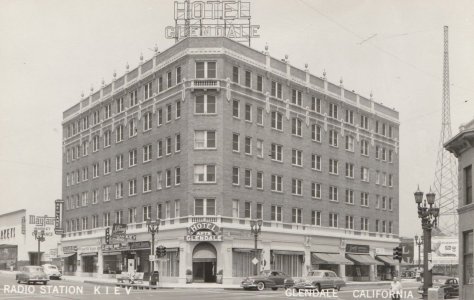
I think the original call letters were KFSG (meaning Four Square Gospel Church) which simulcast on 1150. The call letters were later changed to KRKD which eventually would become KIIS(AM). Also I think in the early days of Gene Scott's programming and possibly before, whatever was on 99.5 was also simulcast on 99.1 in Riverside.

On another note, it certainly was fun to drive by the Glendale Hotel and and see the KIEV antenna on the roof. If you weren't aware that it was KIEV you might think it was a 10 meter beam type Ham antenna. Back in the 60's thay got a "tremendous" power increase from 250 to 500 watts using the same antenna. After they got authorization for 5kw and moved the xmitter to Eagle Rock, I think it was little KGFJ 1230 that would remain one of the few stations in the country still using a roof mounted top-loaded wire antenna, and that station only recently began di-plexing on the 1580 towers.
 
On another note, it certainly was fun to drive by the Glendale Hotel and and see the KIEV antenna on the roof. If you weren't aware that it was KIEV you might think it was a 10 meter beam type Ham antenna. Back in the 60's thay got a "tremendous" power increase from 250 to 500 watts using the same antenna. After they got authorization for 5kw and moved the xmitter to Eagle Rock, I think it was little KGFJ 1230 that would remain one of the few stations in the country still using a roof mounted top-loaded wire antenna, and that station only recently began di-plexing on the 1580 towers.
1621376979202.jpeg
 
Another unusual aspect of 99.5: under previous ownership (the Dr. Gene Scott years), they had one of L.A.'s strongest transmitters (100kw), but relatively low elevation (antenna was on the 870-AM tower in Eagle Rock).
 
I think the original call letters were KFSG (meaning Four Square Gospel Church) which simulcast on 1150. The call letters were later changed to KRKD which eventually would become KIIS(AM). Also I think in the early days of Gene Scott's programming and possibly before, whatever was on 99.5 was also simulcast on 99.1 in Riverside.
That is a little off per my data:

1. 870 was KIEV from the start (February 1933) until Salem changed the calls to KRLA in 2001.
2. KFSG-FM was on 96.3 (today's KXOL) and never on 99.5. 96.3 started off as KRKD-FM. 1150 was a share-time between KRKD and KFSG, and in 1970 Foursquare traded their AM license to KRKD's owners for the FM license.
3. The reason KKLA ended up with the same facilities as KHOF-FM is that because the license was stripped from Gene Scott, applications were allowed for the exact same facilities. In other words, at least as I see it, the grandfathered facilities were allowed to continue.
4. 4. 99.5 was never simulcast on 99.1 Riverside. As KBBL, the latter was a religious station, but had no connection to Faith Center.
 
Last edited:
Gene Scott would play the song or a part of the song "I Wanna Know" by The Statesman Quartet about every fifteen minutes.
 
That is a little off per my data:

1. 870 was KIEV from the start (February 1933) until Salem changed the calls to KRLA in 2001.
2. KFSG-FM was on 96.3 (today's KXOL) and never on 99.5. 96.3 started off as KRKD-FM. 1150 was a share-time between KRKD and KFSG, and in 1970 Foursquare traded their AM license to KRKD's owners for the FM license.
3. The reason KKLA ended up with the same facilities as KHOF-FM is that because the license was stripped from Gene Scott, applications were allowed for the exact same facilities. In other words, at least as I see it, the grandfathered facilities were allowed to continue.
4. 4. 99.5 was never simulcast on 99.1 Riverside. As KBBL, the latter was a religious station, but had no connection to Faith Center.
Thank you David for clearing all this up. But I still think that probably long before Gene Scott I remember hearing the same programming on 99.1 and 99.5. I suppose it could be that a given ministry could simply have purchased the same time period on each station.
 
In a separate LA thread, we were discussing whether Salem should flip KKLA and KRLA, talk on FM and religion on AM? It got me thinking about the odd histories both stations have.

KRLA 870 was, for most of its history, a daytimer, with the call sign KIEV. By the 1970s it was broadcasting at 5,000 watts but it had to sign off at sunset. It was protecting Class I-A WWL New Orleans. But am I remembering it also had to protect a station in Hawaii? Salem bought that station and took it off the air to give 870 nighttime power?

And in the 1990s, the FCC relaxed restrictions on co-channel stations on the clear channel frequencies. Glendale and New Orleans are more than 2,000 miles apart, so KIEV really wasn't going to cause much of a problem for WWL. Eventually KIEV got the boost to 50,000 watts days, 3,000 watts nights, using a directional antenna around the clock.

KKLA 99.5 was a religious station for its entire history. Back when nobody valued FM licenses, an LA church got the frequency and put a religious station on the air. In the 1970s, televangelist and nutty character Gene Scott (look at his TV show videos on You Tube) acquired the church and FM station. FMs were still undervalued. But by then, some people had FM radios in their homes and vehicles. Scott used the station to broadcast the audio of his TV shows 24/7.

Eventually Scott's craziness got him in trouble with the IRS. Due to his legal and tax problems, his FM station was taken off the air for several years. I guess Salem saw an opportunity to get it and eventually the FCC awarded Salem the license? There are few full power religious stations on FM frequencies in large markets. KKLA, according to Wikipedia, claims it has the largest audience of any Christian radio station in the U.S. I suppose that's true, since Salem's NYC station is a 5,000 watt AM outlet, likely not getting the same level of listeners as a full power Los Angeles FM signal.
I've heard the question of whether Salem should put its Talk format on its best signals many times. Salem has stated that Religion is the most important format to the company, that it's the company's mission. There are several examples of this. In New York, Religion is on WMCA, which has a much better signal than WNYM despite 970 having 10 times the wattage during daytime hours.

Great picture, David.
 
I've heard the question of whether Salem should put its Talk format on its best signals many times. Salem has stated that Religion is the most important format to the company, that it's the company's mission. There are several examples of this. In New York, Religion is on WMCA, which has a much better signal than WNYM despite 970 having 10 times the wattage during daytime hours.

Great picture, David.
If you listen Salem's investor conference calls or presentations or hear their executives talk about the business, they always refer to the "religious" stations as their "foundational Christian teaching and talk" format. The foundational part being the foundation of their business/company. They are deeply committed this format as a mission of the company and as a solid business. The founders operated a variation of this format (typically with some music) in a few markets prior to Salem even being a thing. The other formats they operate like "The Answer" news/talk are really just complimentary to this core format.

In almost every market, that foundational format is on their best signal. LA, NYC, Denver, SF, Seattle, DC, etc. There are a few markets where they operate music on a better FM signal like Atlanta. The only market I can think of where the Christian Teaching and Talk was demoted to an inferior signal is Dallas. They bought the Cedar Hill Class C on 94.9 and launched The Word. Not long after they also bought the Christian Music station KLTY which was then on rimshot 100.7 (before that KLTY was on another Cedar Hill Class C on 94.1 for many years). They wisely chose to swap those two signals. KLTY was long established in the market and The Word was basically a start up. Had KLTY not had that history of success, I doubt even that change would have been made.
 
Status
This thread has been closed due to inactivity. You can create a new thread to discuss this topic.


Back
Top Bottom