• Get involved.
    We want your input!
    Apply for Membership and join the conversations about everything related to broadcasting.

    After we receive your registration, a moderator will review it. After your registration is approved, you will be permitted to post.
    If you use a disposable or false email address, your registration will be rejected.

    After your membership is approved, please take a minute to tell us a little bit about yourself.
    https://www.radiodiscussions.com/forums/introduce-yourself.1088/

    Thanks in advance and have fun!
    RadioDiscussions Administrators

When Something Goes Wrong On Shortwave...

Back on Monday June 14th, something went wrong with the feed for the VOA Portuguese programming on Botswana shortwave transmitter. The first half hour of the broadcast on 12080kHz went fine but something went wrong at news time. I caught the problem as it happened while Dxing and recording it from Alaska.

At 1730UTC, a pop song faded out and then some news jingle background music played in it's entirety with no news person, then there was some dead air followed by more news music. Then for 25 minutes, they played a 40 second VOA jingle music bed over and over and over.... and over till the VOA Portuguese feed suddenly reappeared.

Here's the audio:
https://drive.google.com/file/d/1nhxnmy9axAV3j_nYDArHvTlF_msFQMIu/view?usp=sharing

I'm told that if it were an issue in the studio, a live operator has multiple ways to fill. Another backup system, whatever ARPS, would've defaulted to VOA1 Music Mix. It would seem like this may have been an issue at the transmitter site. I didn't check the other frequency on 17mhz carrying the same programming to see what it was up to.
 
And that is what shortwave is today. Trees falling in the forest and no one around to hear them. Or they were all cut down and logged years ago (ala, Radio Australia, Exterior de Espana, nearly every other European broadcaster, BBC's old service to North America).
Except if you're on the frequencies of 3700-3999khz LSB, 7125-around 7250khz LSB, 14150-14350khz USB or 18100-18150khz USB. Then there's lots of activity from the ham operators. Those bands will be REALLY packed starting at 1800z this coming Saturday for ARRL Field Day.
But I want to cry when I notice all the dead space on 31 meters nowadays. In the mid-2000s this band was packed full at 0200z. In the early 2020s, it is nearly empty at 0200z besides for a Cuban, a couple of wacko religious folks, China, and WWV.
 
SW is dying, or simply dead. Around midnight local time the past couple nights, 6000-6200 khz was virtually empty. 8-9 years ago I would have been hearing at least one Japanese domestic outlet, China would have just started kicking in, and I would have heard at least one Chinese broadcaster beaming to Russia, plus a couple Spanish language stations (including Cuba) -- along with the US domestic outlets, which themselves would have been S4-S5 signals instead of S1-S3.

When Cuba is no longer on the air on 6000, you know something's haywire with SW.

The HF ham bands aren't much better, except during contests.

It's the ionosphere. Unless you have an exceptional antenna (and I was able to DX most of the world with simple wire ones), it's just grainy traces of audio in the static, on the same exact same equipment that yielded much better results in 2015.

The only bright spot is -- for some reason -- I've been able to ID Voz Missionaria out of Brazil... enough to ID the Portuguese and some of the words spoken. Why that is, I don't know.
 
SW is dying, or simply dead. Around midnight local time the past couple nights, 6000-6200 khz was virtually empty. 8-9 years ago I would have been hearing at least one Japanese domestic outlet, China would have just started kicking in, and I would have heard at least one Chinese broadcaster beaming to Russia, plus a couple Spanish language stations (including Cuba) -- along with the US domestic outlets, which themselves would have been S4-S5 signals instead of S1-S3.

When Cuba is no longer on the air on 6000, you know something's haywire with SW.

The HF ham bands aren't much better, except during contests.

It's the ionosphere. Unless you have an exceptional antenna (and I was able to DX most of the world with simple wire ones), it's just grainy traces of audio in the static, on the same exact same equipment that yielded much better results in 2015.

The only bright spot is -- for some reason -- I've been able to ID Voz Missionaria out of Brazil... enough to ID the Portuguese and some of the words spoken. Why that is, I don't know.

cuba is still on 6000khz plenty.

I can hear 5940 La Voz from Brazil from time to time up here.. usually about 0500UTC, 9pm local time
 
The death of shortwave is being prematurely reported here. There's still a lot out there, it's just not aimed at North America anymore. That plus the low sunspot count means hearing exotic signals are difficult for us.

With the advent of remotely accessible SDRs all over the world, you'll find that 31 mb is still pretty crowded — in Asia and Europe, at least. It's mostly China, but also a lot of American-funded stuff like VOA, RFE and R. Free Asia, too.

There's been a small resurgence in music programming on Shortwave in the US, with several shows airing weekly and bringing interesting and otherwise unheard music via WRMI, WBCQ and even WWCR.

And for what it's worth, Spain is still on shortwave, back after an absence of several years. They even have a half hour English service beamed to the US, or did last time I checked in on them.
 
Yeah, that's the only time that 31 and 49m are still packed, around 1200-1500z when Asia is in. I can use CNR-1's 6175khz transmitter to // to CNR1 on AM if the conditions are good towards the Far East. I've done it several times.
But stations like RTE, Radio Australia, Voice of Russia/Radio Moscow, YLE Radio Finland, RAI Italy, BBC service to North America, Channel Africa, Radio Bulgaria, Radio France Internationale (in English), Flanders Radio Belgium and Radio Netherlands will NEVER, EVER, be heard again on shortwave. And nor will English services from Taiwan which were always strong in the Pacific Northwest. I miss them. Netherlands had some of the best programming in the world. And it too left SW, probably some 10 years ago.
Not to mention, Canada is entirely gone from SW, at least the RCI and CBC Quebec services AND 6160 CKZU repeating CBU, which could be heard all day long. Same with 6030 CFVP/CKMX Calgary, in winter. Somehow, I think CFRX is still alive, but for how long?

There's a reason Passport to World Band Radio quit publishing.
 
That's true, a lot of the 'big guns' from the cold war days have left us. I only have vague memories of those times, but I do remember the bands being pretty full, even stuff up in the 21 MHz band (whose meter # escapes me at the moment).

Where you are now, I imagine that RNZI is about the only foreign broadcaster that still has English programming and is strong enough to listen to.
 
That's true, a lot of the 'big guns' from the cold war days have left us. I only have vague memories of those times, but I do remember the bands being pretty full, even stuff up in the 21 MHz band (whose meter # escapes me at the moment).
The 21 MHz broadcast segment (21.45-21.85 MHz) is called 13 meters, while the ham segment (21.00-21.45 MHz) is called 15 meters. Neither are technically correct, but those terms are accepted. 15 meters is 20 MHz, while 13 meters is just above 23 MHz.
Where you are now, I imagine that RNZI is about the only foreign broadcaster that still has English programming and is strong enough to listen to.
RNZI is currently blasting into Phoenix on 13.840 MHz (the only frequency they use at this time) as I write this at just before 0500 UTC. They're due to move to 11.725 MHz in a few minutes.

Now, it's 0500Z, and they're a bit weaker but still solid on 25 meters. This is the best I've heard them in about 3 years.
 
The HF ham bands aren't much better, except during contests.

The ham bands are plenty busy from October through April, when thunderstorm activity is low. Check out 80 and 40 meters, especially, nights and mornings. Summer always sees a slowdown in activity as QRN builds and the operators themselves have other activities occupying their time.

Of course, many of these HF hams are on the older side, which probably means the future isn't bright for this use of the SW spectrum regardless of time of year.
 
The ham bands are plenty busy from October through April, when thunderstorm activity is low. Check out 80 and 40 meters, especially, nights and mornings. Summer always sees a slowdown in activity as QRN builds and the operators themselves have other activities occupying their time.
30 meters and up are getting much more activity, now that the Sun has gotten off its stellar keister and started to produce a few sunspots.
Of course, many of these HF hams are on the older side, which probably means the future isn't bright for this use of the SW spectrum regardless of time of year.
"Older side?!?!?" You call us old one more time, and I'll throw my teeth at you. Now get off my lawn! :LOL:
 
That's true, a lot of the 'big guns' from the cold war days have left us. I only have vague memories of those times, but I do remember the bands being pretty full, even stuff up in the 21 MHz band (whose meter # escapes me at the moment).

Where you are now, I imagine that RNZI is about the only foreign broadcaster that still has English programming and is strong enough to listen to.
BBC and VOA still broadcast in English to Africa, and I think the BBC still broadcasts to parts of Asia in English from Singapore.
 
Solar activity looks like it will go up in time for Field Day. Something like an 80 SFI level expected.
 
That's true, a lot of the 'big guns' from the cold war days have left us. I only have vague memories of those times, but I do remember the bands being pretty full, even stuff up in the 21 MHz band (whose meter # escapes me at the moment).

Where you are now, I imagine that RNZI is about the only foreign broadcaster that still has English programming and is strong enough to listen to.
I believe so. If BBC still isn't doing English to Asia in the early morning. I miss Australia and their weekend Grandstand programming. Could always hear cricket or horse racing on 15.240 late on a Friday or Saturday night, and always at S9 or higher during the summer.
 
Is CFCX (Montreal,QB) still on 6005? They used to simulcast CFCF 600.....and I was a regular listener back in the '60s and '70s.....
My current home location doesn't lend itself to large antennas -- beams OR long-wires --- so I haven't done much with ham or SWL'ing.....2 meters and 450 repeaters are my new "modis operendi"!!;)
 
Been gone for years and years, 1999, in fact. Same with the CKWX relayer on 6080 in Vancouver, and just about everything else in Canada, except for CFRX (I think). Radio Canada International has been off the air for probably 7-8 years now, and about as long for the 9625 khz CBC Northern Quebec Service.
 
The 21 MHz broadcast segment (21.45-21.85 MHz) is called 13 meters, while the ham segment (21.00-21.45 MHz) is called 15 meters. Neither are technically correct, but those terms are accepted. 15 meters is 20 MHz, while 13 meters is just above 23 MHz.

RNZI is currently blasting into Phoenix on 13.840 MHz (the only frequency they use at this time) as I write this at just before 0500 UTC. They're due to move to 11.725 MHz in a few minutes.

Now, it's 0500Z, and they're a bit weaker but still solid on 25 meters. This is the best I've heard them in about 3 years.

Lucky! The 11 & 13 MHz RNZI frequencies are a rough copy in the eastern US. I don't usually get them well until they drop down to their night frequency (7245 right now) and it tends to get hammered by amateurs which makes it unlistenable.

BBC and VOA still broadcast in English to Africa, and I think the BBC still broadcasts to parts of Asia in English from Singapore.

They do, and sometimes those Africa-oriented broadcasts do make it into the US, but even on the east coast it can be a dreadful signal. The Beeb was a big loss when they stopped offering English to North America, but since then they've become available in so many other ways — online, on XM/Sirius, via many HD subchannels of NPR outlets — that I don't miss it quite as much as I do some others like Australia.

I believe so. If BBC still isn't doing English to Asia in the early morning. I miss Australia and their weekend Grandstand programming. Could always hear cricket or horse racing on 15.240 late on a Friday or Saturday night, and always at S9 or higher during the summer.

Australia was a great companion of mine when I was working my first job right out of high school. I had the luxury of basically being an office gopher in a building all to myself, so I'd bring dad's shortwave radio every day and listen to their programming beamed from Sackville. It was a massive signal back then up and down the east coast! (I certainly got the occasional odd look from the other co-workers when they dropped into my building, though.)

Is CFCX (Montreal,QB) still on 6005? They used to simulcast CFCF 600.....and I was a regular listener back in the '60s and '70s.....
My current home location doesn't lend itself to large antennas -- beams OR long-wires --- so I haven't done much with ham or SWL'ing.....2 meters and 450 repeaters are my new "modis operendi"!!;)

As crainbebo noted, they're gone. Only CFRX remains, and its 1 kW signal isn't the easiest to hear right now with conditions being so poor. At least not down here in Alabama. It is still odd to hear it, though, since it's just a typical commercial AM news/talk type station with that broadcast sound that is lacking on shortwave for the most part.

***

It's worth noting that for all the big boys who've abandoned shortwave, there are a few smaller players still surprisingly hanging in there. Radio Nacional Amazonia from Brazil has been back for a while now after a major transmitter plant fire took them off a while back. Normally something like that should spell the end of shortwave transmissions but they're on 6180 and 11780 with a lot of programming. Ditto XEPPM in Mexico City, which still plays a lot of interesting music. They had a transmitter refurb not too long ago, too. The Solomon Islands are still on (at least I think they are?) after China basically gave them a new TX. And a station called Radio Montaña in Colombia recently signed on as well. Like Radio Clube do Para in Brazil, they're kind of a tough catch with less than 5 kW but it's there if you get lucky.

Oh and Argentina, Slovakia and R. Prague are still available via WRMI. I've heard a lot of interesting music from them in the past few years.
 
I believe so. If BBC still isn't doing English to Asia in the early morning. I miss Australia and their weekend Grandstand programming. Could always hear cricket or horse racing on 15.240 late on a Friday or Saturday night, and always at S9 or higher during the summer.
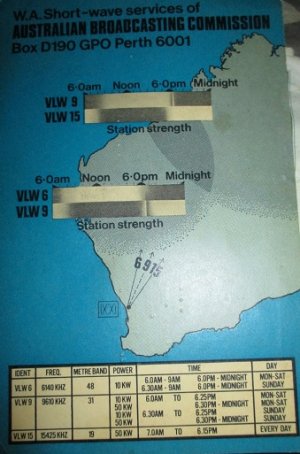
And in the mornings here on the East Coast, we not only got Radio Australia at 9580, but the Perth domestic service on 9610 -- fantastic signal for only 50kw! This QSL is from Jan. 19, 1970.
 

Attachments

  • perth.jpg
    perth.jpg
    76.8 KB · Views: 6
Status
This thread has been closed due to inactivity. You can create a new thread to discuss this topic.


Back
Top Bottom