• Get involved.
    We want your input!
    Apply for Membership and join the conversations about everything related to broadcasting.

    After we receive your registration, a moderator will review it. After your registration is approved, you will be permitted to post.
    If you use a disposable or false email address, your registration will be rejected.

    After your membership is approved, please take a minute to tell us a little bit about yourself.
    https://www.radiodiscussions.com/forums/introduce-yourself.1088/

    Thanks in advance and have fun!
    RadioDiscussions Administrators

AM Frequency of the week: 870

Far northwestern "Chicagoland"......

Day: Usually not much of anything. There used to be TIS from a town just to my southeast (Cary, IL), but last time I checked it was gone. Sometimes in winter, WKAR from Lansing, MI makes it in on daytime skip, I've also heard WQRX from Valley Head, AL around sunset. Not sure whether that was full daytime power of 10kw or 4.7kw CH power

Night: Typically WWL. Usually with a good signal. I have heard R. Reloj from Cuba underneath WWL a few times, but not often.

Other Location. On the beach in the Pensacola area, WWL is a blaster 24/7, Arguably the strongest signal at that location, despite being over 150 miles away. Obviously the salt water path is what makes that possible. But even with that, R. Reloj is usually faintly audible underneath at night,
 
Likewise, CDad. Daytime here it's nothing.

One sunset (and taped) is WHCU Ithaca NY. That place had some good DJ's and newspeople as alumuses.

WWL here at night, along with the ever=popular R. Reloj/

* * * * * * *

Way way back in the Queens NYC DX years, the old logbook looks pretty much the same: WWL, WHCU -- even the sunset WKAR, and a goodie.
That goodie was the faint WHOA San Juan PR. They were in English, a Beautiful Music station. At 3:30 my time, one fine Monday Morning, they played a jingle that sang 'Four-thirty ,,,,, four thirty ,,,, it's half past the hour of foooooouuurrrr....'

I'm guessing that WWL was off the air. And probably, super-local WCBS 880 might've been off, too, hi
 
Chicago by the lakeshore:

Daytime: WKAR in Lansing normally comes in, barely. Closer to sunset it can be quite listenable.

Critical Hours: Often there's a reasonable WKAR before it goes off for the night. One time I heard WTIM in Assumption, IL, before they too went off for the night.

Nighttime: WWL in New Orleans mainly. There's also that clock station in Cuba which occasionally makes an appearance. Neither is particularly strong where I am, and I sometimes hear other station(s). These other signals come in well enough that I might be able to get an ID at some point.
 
East Tennessee (Knoxville-Sevierville): Days: WPWT, "Possum 96.3", Colonial Hts TN (Tri-Cities) fair to middlin'.
Night: WWL with Radio Reloj underneath.

Retro/other: During my brief time in Sarasota, WWL was rock solid day and night over the gulf. I don't remember if there was a Reloj (or other Cuban outlet) on 870 at the time (1980).
Western Ohio: The last breath of WKAR could be heard during the day.
 
In the near north Chicago suburbs: Days it's a weak WKAR. At night all WWL with a very good signal. Sometime I hear Cuba underneath, but WWL usually dominates.
 
I remember the neighborhood amateur, who listened to WKAR 870 and WKAR-FM a lot, telling me that the FCC had done MSU a favor and granted the AM 10000 watts. Didn't know until a few years later they were directional, with 5000 watts IDF equivalent toward CJBC 860, WRFD 880, and WWL 870 during Critical Hours. Mr. Thomas, an assistant engineer, told me that there was about 10000 watts into the slope fed self supporting tower from way back, and about 500 watts in the new guyed tower. He said I could touch the base of the slope fed tower without RF burns. He grabbed a tower leg to demonstrate, I took his word for it. He went on to explain the large difference there was in the radiation resistance in the two towers.

 
Last edited:
East Tennessee (Knoxville-Sevierville): Days: WPWT, "Possum 96.3", Colonial Hts TN (Tri-Cities) fair to middlin'.
Night: WWL with Radio Reloj underneath.

Retro/other: During my brief time in Sarasota, WWL was rock solid day and night over the gulf. I don't remember if there was a Reloj (or other Cuban outlet) on 870 at the time (1980).
Western Ohio: The last breath of WKAR could be heard during the day.
IME, WWL is very listenable on the stretch of I-75 between Fort Meyers and Tampa. But, if memory serves, that was before the Cubans launched a R. Reloj transmitter on 870.

@Steve Green NEPA: I Forgot all about WHCU. I heard WHCU here one evening maybe about 10-15 years ago after sunset when they stayed on for some reason. (Maybe someone forgot to flip a switch). Anyway, on my business trips to Ontario and Quebec, WHCU was just about as easy around sunrise/sunset as it is difficult here for me at my home location!
 
Last edited:
Daytime - Nothing

Nighttime - Often a very weak signal of something on the frequency but almost always not where you can hear actual words.

But sometimes WWL will come in good enough to hear and that's over 4,000 miles!

 
Here in W WA near market 12. Days, splash from local KIXI 880. Nights, a varying, weak but readable KFLD Pasco WA, on rare occasions (maybe once a year, 2-3 X a year on a good DX season) WWL will be audible behind KFLD, and sometimes CKIR Invermere BC (on a different bearing) with their version of the EZ Rock format. I have heard other (unreadable) signals (a suspected KJMP Pierce CO once or twice -- no ID) from time to time but nothing IDed.
 
Orange County, TX it's WWL at about 240 mi all the time.

Retro: who remembers their "King Edward Cigar Time"?
 
From south Overland Park. Kansas:

Day: A weak KAAN, a 930 watt non-directional station in Bethany, Missouri.

KAAN-AM Radio Station Coverage Map

Night: WWL is usually steady and listenable. Occasionally, they fade out completely, however. No other signals logged to date.

Bob
 
Orange County, TX it's WWL at about 240 mi all the time.

Retro: who remembers their "King Edward Cigar Time"?
Me!

......Along with along with "Delta is ready when you are" drop-in ads on WWL.
 
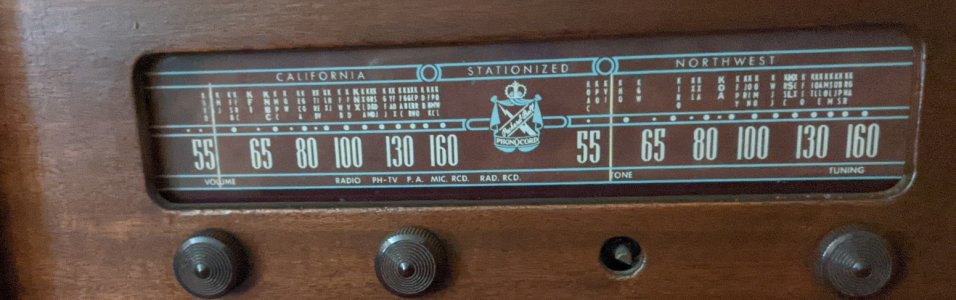
DX'd in the '70's with a Packard Bell Phon0cord console radio. Received WCCO and WCBS from Arizona. hope to start again with a Ccrane EP-pro. (the noise floor is UNBELIEVABLY HIGH!!!) Bob Bartholomew Yuma, Arizona.


phono.jpg
 
That's a neat dial, but the stations are every 10 kHz and the vertical call letters are difficult to read. The Class Is are in bold letters. That's good. I've heard KFI (I-A), KNBR (I-B), KNX (I-B), and KOA (I-B). My Mother In Law had a Detrola that had a round dial and it was easier to read. It had the whole country, though mainly more major markets. Wonder why KGO (I-B) isn't in bold letters.
 
Last edited:
We have WTCG Mount Holly, NC with 5,000 watts here in the Charlotte area preaching to the faithful during the day and WWL at night.
 
Here's a more legible dial. This appears to be from the early to mid 1940s, after the NARBA frequency changes. KPO is shown on this one. KPO became KNBC in 1946, and KNBR in 1962. The above image is then post 1946. The paste on call letters on preset buttons are sometimes a clue to the radio's previous owners.

Vg3116WoP1LKHdnu0LQsvg.jpg
 
Last edited:
South Mississippi:

WWL has strong signal day and night. At night, some music can be heard in the background with WWL nulled.
 
Does anyone have pictures of radios or dial inserts showing other parts of the country? I notice that almost all the stations which were Class III that have upgraded to 50000 watts Day and 10000 or more watts Night are on the dial inserts. KMJ, KJR, KRKD, and KOL. I would imagine that holds for the rest of the country.
 
Last edited:
Status
This thread has been closed due to inactivity. You can create a new thread to discuss this topic.


Back
Top Bottom