• Get involved.
    We want your input!
    Apply for Membership and join the conversations about everything related to broadcasting.

    After we receive your registration, a moderator will review it. After your registration is approved, you will be permitted to post.
    If you use a disposable or false email address, your registration will be rejected.

    After your membership is approved, please take a minute to tell us a little bit about yourself.
    https://www.radiodiscussions.com/forums/introduce-yourself.1088/

    Thanks in advance and have fun!
    RadioDiscussions Administrators

Podcasts as a radio format

I am sure I'm not the first to put forth this idea. But seeing as how podcasts are ridiculously popular, would it work (or is it already being done in some markets) to air podcasts as the format?
I guess, considering the main appeal of them, is that a lot of them aren't FCC friendly, and the running times may vary from episode to episode, but I think podcasts are what radio could have (or should have) been doing a long long time ago. The cookie-cutter programming and imaging is grating for many to listen to. So what do they do? Go on to spotify and put on their favorite podcast.
I guess if I had to program a station that would air nothing but podcasts, I'd try block programming. The morning would be more news-based podcasts, the middays and afternoons would be hardest I think. Perhaps lifestyle? Comedy? True crime? I guess you'd have to pick one general subject and run with it. Overnights would be the more "risque" podcasts of the same general subject matter, though.

I think it's worth a shot, considering Audacy literally makes their own podcasts and seems to advertise the heck out of them. Why not just...air them?
 
iHeart has tried that on a couple of also-ran stations, and even on weekends on stations like WLW. It would be basically sampling podcasts (many that have a limited run).
 
While not podcasts per se, I'd think some of the series a few NPR stations run that take, for instance, 3 or 4 consecutive shows to cover a particular subject in-depth would come close. In one case, I heard an NPR program covering the subject of religious fanatics and cults, and what causes people to follow people like Jim Jones and David Koresh. That program aired on Saturdays, was very interesting with a lot of first-hand interviews and chats with family members of people who've been radicalized, and those who were once indoctrinated into religious cults at one time, then broke free. It aired on a program that played on Saturday afternoons and I think it took them 3 consecutive weeks to fill out the entire story.
 
Ben Shapiro began his on air gig when stations started airing his podcast. That became a hit, and Ben expanded to a full daily show. It helps that a lot of the radio companies are also in the podcasting business, so there is less of a line between platforms.
 

There is an Iheart owned station that rebroadcasts podcasts on FM radio in the Erie area.
Yes it's Ihearts ploy to get more listeners to the Iheart app though from my understanding but then again I can imagine some News/talk stations putting this under consideration. But then that might end up cannibalising their traditional OTA talk operations like Fox Sports talk programming, NBC News Radio affiliation, and BIN affiliation. For now I say keep podcasts on the app given the demos.
 
I am sure I'm not the first to put forth this idea. But seeing as how podcasts are ridiculously popular, would it work (or is it already being done in some markets) to air podcasts as the format?
I guess, considering the main appeal of them, is that a lot of them aren't FCC friendly, and the running times may vary from episode to episode, but I think podcasts are what radio could have (or should have) been doing a long long time ago. The cookie-cutter programming and imaging is grating for many to listen to. So what do they do? Go on to spotify and put on their favorite podcast.
I guess if I had to program a station that would air nothing but podcasts, I'd try block programming. The morning would be more news-based podcasts, the middays and afternoons would be hardest I think. Perhaps lifestyle? Comedy? True crime? I guess you'd have to pick one general subject and run with it. Overnights would be the more "risque" podcasts of the same general subject matter, though.

I think it's worth a shot, considering Audacy literally makes their own podcasts and seems to advertise the heck out of them. Why not just...air them?

1550 in San Francisco tried that.. i think it lasted 2 years?
 
A Podcast format is an interesting idea but there must be some uniformity. Lots of podcasters hope to earn income and get some level of 'fame'. Radio might be a help for both of those. The station has an online list of minimum requirements to be considered. Those who will subscribe to those requirements get the added marketing of said station, exposure and a predetermined fee based on time (length of program). The podcaster will earn some money for the effort. There are a number of excellent podcasters out there and some are making good money doing a consistent weekly show.
 
A Podcast format is an interesting idea but there must be some uniformity.
As usual, Bill is right on.

A format of random podcasts on shuffle won't work. And without some means to make the podcasts time out to a schedule, it's tough to do something other than podcasts on shuffle.

In addition, to uniformity of schedule, broadcast isn't great for serialized stories, which are fairly popular in podcasting, because we know people don't tend to listen to radio for several consecutive hours, or at the same time every day.
 
Thinking further on podcasting as a format, it seems short features would be best. Many years back there was a short lived format that could best be described as motivational radio. The daily format consisted of mostly 3 minute segments with commercials and/or preselling upcoming segments between segments. 40 different segments aired each day. If a listener tuned in for about 20 minutes, they could hear about 5 segments. There was enough consistency for a certain subject to come up at the same time each day. Think the news cycle on radio with various segments at fixed times each half hour. I recall one segment was 5 tips to success. Each day, say at 7:15 for one week you got one of those 5 tips. It seems to me that introducing several segments during a typical listening session gives enough sampling to get listeners to come back. As stated earlier, it cannot be random subjects and a computer randomly playing podcasts but rather blocks of segments where the content is the tie-in. In other words, the next segment needs to retain the interest the listener had in the prior segment.
 
I feel podcasts COULD work, but even though you're just airing pre-recorded shows, PUT SOME EFFORT INTO IT.

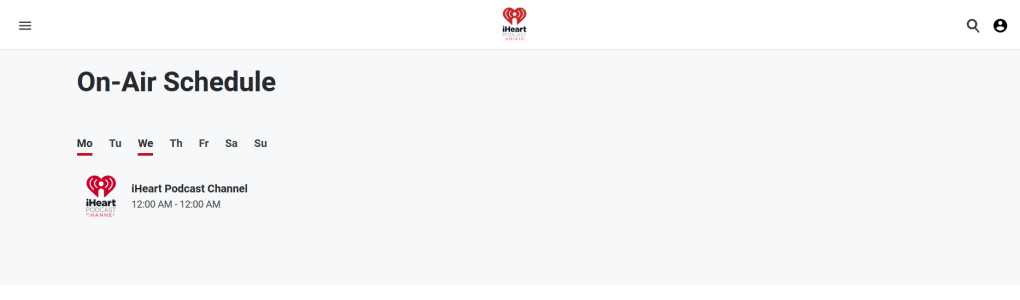
I looked at the iHeartRadio Podcast station webpages for Allentown and Erie. Attached is the on-air schedule.

In the off-chance that someone actually lands on your un-promoted AM station and hears something they like, sure listening to the podcast will hopefully drive people to the iHeartRadio app to stream more episodes.

But how about telling us WHAT is airing WHEN. So maybe folks can tune in again to catch other episodes (if they don't like streaming... spend all day in the car etc.), or so they can actually see what is airing. And take a look at the schedule and say "oh hey! They're airing another episode of this tomorrow at X time. I'll have to tune in then"

This is just... lazy.
podcast.png
 
I feel podcasts COULD work, but even though you're just airing pre-recorded shows, PUT SOME EFFORT INTO IT.
Along that line, there has been discussion in some groups about using 15 minute "sets" of the station talent, rotating, throughout the day. So there would be no morning drive or PM Drive show... just bits by the station talent played all day long, with perhaps four to six shows done in "workparts" and blended with the music so every quarter hour or in every sweep you got new content and personalities all day long.
 
Along that line, there has been discussion in some groups about using 15 minute "sets" of the station talent, rotating, throughout the day. So there would be no morning drive or PM Drive show... just bits by the station talent played all day long, with perhaps four to six shows done in "workparts" and blended with the music so every quarter hour or in every sweep you got new content and personalities all day long.
But how does that make radio any more attractive than listening to an ipod or music streaming service on shuffle, then? The reason many listen to a particular morning show or afternoon drive show is because there's a familiarity and a "relationship" (if that's the proper term) with the regular host.
 
Last edited:
But how does that make radio any more attractive than listening to an ipod or music streaming service on shuffle, then? The reason many listen to a particular morning show or afternoon drive show is because there's a familiarity and a "relationship" (if that's the proper term) with the regular host.
The idea is to hear a variety of podcast-like "bits" plus music... instead of one jock. The attraction is hearing different "acts" during one's use of the radio, not just one over and over. It fits the podcast user's style and preferences.
 
Just offering my opinions here since I listen to several podcasts every day. Part of what's great about podcasts is the freedom: Freedom for the producers and hosts to have whatever guests they want, to choose their own content, to make each episode as long as they want, to not have to worry about saying the f-word, etc. And freedom for the listener to not have to be near an actual radio at a specific time (that is decided by someone else). The listener is free to listen whenever and wherever they like--to the whole episode at once or in small chunks throughout a day, a week, a month, whatever. When the phone rings, the listener can pause, take the call, and come back to the show without having missed anything. The listener is also free to listen to whatever podcasts she wants and to never have to be bothered at all with what someone else thinks they will want to hear. All of this is to say that part of what's great about podcasts is precisely that they are not radio.

I think all the time about topics I could use to start a podcast and who I would want to do the show with me and what guests I would wish for. I would love to have a podcast. I absolutely, positively, definitely do not want a radio show.
 
All of this is to say that part of what's great about podcasts is precisely that they are not radio.
Yeah, you actually did convince me of this. Trying to use podcasts as a life support for radio, a decidedly worse option for audio entertainment, is a bad idea. All of this is to say, to some extent, radio may be its own worst enemy. Or at least those who control most of it, and the rules of censorship for the "bad" words and such.
 
Yeah, you actually did convince me of this. Trying to use podcasts as a life support for radio, a decidedly worse option for audio entertainment, is a bad idea. All of this is to say, to some extent, radio may be its own worst enemy. Or at least those who control most of it, and the rules of censorship for the "bad" words and such.
A lot of the "bad words" are gratuitous and serve no purpose. A guy like marketing guru Gary Vaynerchuk has continuous "f" bombs as part of his schtick.
 
All of this is to say, to some extent, radio may be its own worst enemy.

Maybe. The other way to look at it is that podcasting is radio's new farm system. It's where talent develops its style and an audience in a place that has fewer rules. That's what happened to Ben Shapiro. He was doing this podcast, and then Cumulus offered it to stations to run on the weekends, and then they discovered that he has an audience for what he does that translates to the radio. Then he got an official radio show. There are several other people who've come up this way. Conversely, there are a few on-air hosts who've taken what they do to podcasting and given up on radio. Adam Carolla is a good example. That way he owns it and keeps most of the money.

But when you're in the world of talent and content, you can't see the world as friends or enemies. You just have an open mind and listen for who can attract an audience. That's what you're listening for. It doesn't matter where they come from. It could be a small market, it could be college radio, or it could be a podcast. It doesn't matter. It's all audio. The thing that makes it radio is formatting it with commercials and other radio production techniques. So the podcaster works with a producer who puts the content into a package that fits the medium.
 
Status
This thread has been closed due to inactivity. You can create a new thread to discuss this topic.


Back
Top Bottom