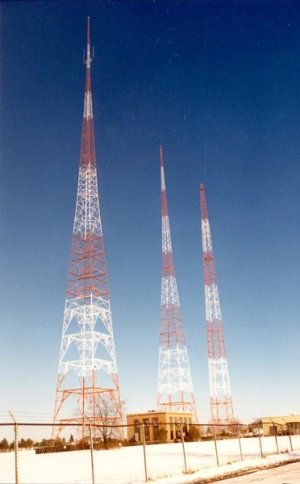
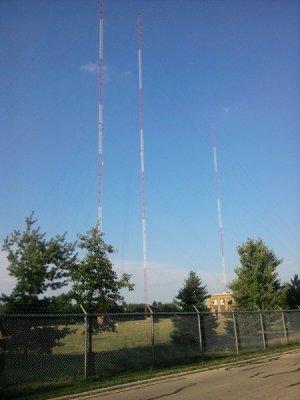
Far northwest suburban Chicago:
Day: Local WMVP. 50kw from 31 miles to my south-southeast. The directional pattern has a shallow null to the west. The result here is a very good signal, but not as good as the Chicago non-directional 50kw blowtorches.
Night: WMVP's pattern tightens, and the result here is a somewhat weaker signal, although still good. As I alluded to last week, that night signal can occasionally be prone to some moderate splatter from CBW. On even more rare occasions XEOY can be audible either underneath or with WMVP nulled. I've also heard KTOK a couple of times.
Other Locations/retro: During my college years in southeast Iowa during the late 60s, then-WCFL was audible day and night, but not comfortably listenable. Daytime the problem was splatter from now-defunct WCAZ (990) from Carthage, IL. At night there would often be a combination of fading and a battle with XEOY. WCFL usually was on top, but XEOY was still a significant pest.
Fast forward to the current situation at our beach vacation location near Pensacola, WMVP is most often in with a fair (and listenable) signal at night. XEOY usually present underneath. There have been a couple of incarnations of a 1kw daytimer on 1kw daytimer operating on 1000 from a location about 30 miles north from where we stay. Ground conductivity in the area is poor, and the result is a signal at the beach has been fair at best.
Day: Local WMVP. 50kw from 31 miles to my south-southeast. The directional pattern has a shallow null to the west. The result here is a very good signal, but not as good as the Chicago non-directional 50kw blowtorches.
Night: WMVP's pattern tightens, and the result here is a somewhat weaker signal, although still good. As I alluded to last week, that night signal can occasionally be prone to some moderate splatter from CBW. On even more rare occasions XEOY can be audible either underneath or with WMVP nulled. I've also heard KTOK a couple of times.
Other Locations/retro: During my college years in southeast Iowa during the late 60s, then-WCFL was audible day and night, but not comfortably listenable. Daytime the problem was splatter from now-defunct WCAZ (990) from Carthage, IL. At night there would often be a combination of fading and a battle with XEOY. WCFL usually was on top, but XEOY was still a significant pest.
Fast forward to the current situation at our beach vacation location near Pensacola, WMVP is most often in with a fair (and listenable) signal at night. XEOY usually present underneath. There have been a couple of incarnations of a 1kw daytimer on 1kw daytimer operating on 1000 from a location about 30 miles north from where we stay. Ground conductivity in the area is poor, and the result is a signal at the beach has been fair at best.