
• Get involved.
    We want your input!
    Apply for Membership and join the conversations about everything related to broadcasting.

    After we receive your registration, a moderator will review it. After your registration is approved, you will be permitted to post.
    If you use a disposable or false email address, your registration will be rejected.

    After your membership is approved, please take a minute to tell us a little bit about yourself.
    https://www.radiodiscussions.com/forums/introduce-yourself.1088/

    Thanks in advance and have fun!
    RadioDiscussions Administrators

My best long distance catch ever

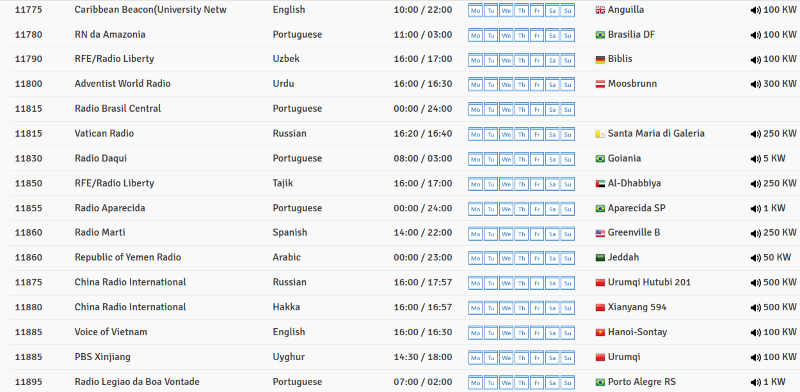
So I was tuning around the shortwave band first thing this morning when I heard a signal on 11.850 MHz and decided to go to ShortwaveSchedule.com where they have real time listing of broadcasts to see what I was hearing.

The station was from the United Arab Emirates.
Screenshot-2021-08-18-6-44-35-AM.png


HFRadio.org also confirmed the location as the only broadcast on that frequency at the time.

Not a bad signal either for a barefoot catch at 8,915 miles.


When I used the distance between locations calculator, the path from there to here went up over the Arctic.

I wonder if that had any way of enhancing the signal propagation.

Also, according to the Day and Night World Map, the signal path from there to here was entirely in complete daylight.
 
It's quite amazing what shortwave can do. When I bought HCSP1 in San Pedro de Amaguaña, Ecuador in 1966 it had both an AM license (595 kHz AM) and an FM one in the 3 mHz tropical band. As I was cleaning out the station's offices (an experience itself as the building had adobe walls and a compacted dirt floor!) I found a batch of reception reports from all over Europe, SE Asia and Oceania as well as North America.

That station had 200 watts, roughly, into an inverted L antenna hung between two big wooden phone poles. Yet the station got reports from all over the world.
 
Since AM radio is pretty much impossible to listen to anymore with all the background noise here, nothing to hear on FM because Hawaii is too far from the mainland, and only being able to hear but not be heard on CB radio, I thought it was time for another shortwave radio.

I'm very impressed with it.
 
Since AM radio is pretty much impossible to listen to anymore with all the background noise here, nothing to hear on FM because Hawaii is too far from the mainland, and only being able to hear but not be heard on CB radio, I thought it was time for another shortwave radio.

I'm very impressed with it.
Good--enjoy!
 
Polar routes often degrade the signal, rather than enhance it, as the auroral zone comes into play.

According to at least one Great Circle Map I found, the signal path for the station you heard dodged some of the polar / auroral zone, and that may be why you had really good reception. Also, the signal path is aligned with the station's beam -- it was aimed towards Tajikistan, and also your part of the world, which helps.

Good catch, though. It's always cool to hear stations from that part of the world.
 
Nicely done, Gar. Congratulations on those catches as well as on your new radio.

During the year of high school I spent in Honolulu, shortwave could be a bit problematic at times because a lot of the mid-north pacific was not usually a target for the larger international broadcasters. You could hear some of them, but I was surprised at how empty the SW bands usually were compared to back home in the Chicago area.

One thing I did hear lots of, however was hams on the 15 and 20 meter bands from the west coast of North America.

Back home in the Chicago area, I'd have to say that may longest-distance catches were pretty easy. Australia and New Zealand. Usually on 31 meters.
 
Nicely done, Gar. Congratulations on those catches as well as on your new radio.

During the year of high school I spent in Honolulu, shortwave could be a bit problematic at times because a lot of the mid-north pacific was not usually a target for the larger international broadcasters. You could hear some of them, but I was surprised at how empty the SW bands usually were compared to back home in the Chicago area.

One thing I did hear lots of, however was hams on the 15 and 20 meter bands from the west coast of North America.

Back home in the Chicago area, I'd have to say that may longest-distance catches were pretty easy. Australia and New Zealand. Usually on 31 meters.
Radio Australia signed off the for the last time 3 or 4 years ago, but Radio New Zealand still puts a good signal into North America at certain times of the day.
 
There's quite a difference between what I can hear on shortwave now compared to when I had my Grundig G8 10 years ago in Florida.

Back then, most all of what I could hear was at night, especially between 7 and 8 MHz, mostly from Europe and but there wasn't very much to hear in the daytime on 10 MHz and above.

Now in Hawaii, it's the opposite where most of what I can get is during the day and there's not very much at night unless I stay up late to hear Asia.
 
Check out 41 meters and 49 meters in the mornings, Gar, and also check out the 40 meter ham band in the mornings. You should be able to hear quite a bit of Asian and SE Asian SW and ham activity. Here in the PNW any time between 4-5 a.m. and 9-10 a.m. (during the Fall and Winter) brings in Asia, and even when prop is down usually I can hear the Chinese blasters. In Hawaii it would probably be relatively the same... only two hours later.

FWIW my best SW catches probably were India (AIR Chennai in the 31 meter band), and the USIA's broadcasts in Dari and Pushto into Afghanistan, as it's on the opposite side of the world from the PNW. Those catches were with my DX440 and a 100 ft wire.

My best catch off a whip antenna was China broadcasting to Europe from Kashgar, and Vividh Bharati (India), both in the 31 meter band, and both on my Grundig G2, which does really well off the whip. But those catches were a year or so before the propagation went south in 2016-2017.

The farthest point on the globe from here is near Kerguelen Island in the S Indian Ocean, but there aren't any SW stations even close. Anything near the Indian Ocean I consider a best SW catch.

Decades ago I heard an American ham in Qatar talking to a couple other hams, and before long there was a massive pileup, as I guess Qatar was a rare country. That was probably my best HF ham catch, aside from KC4AAA, the ham station in the South Pole. Those catches were on my FRG-7 using a 80 ft wire.
 
Last edited:
Status
This thread has been closed due to inactivity. You can create a new thread to discuss this topic.


Back
Top Bottom