• Get involved.
    We want your input!
    Apply for Membership and join the conversations about everything related to broadcasting.

    After we receive your registration, a moderator will review it. After your registration is approved, you will be permitted to post.
    If you use a disposable or false email address, your registration will be rejected.

    After your membership is approved, please take a minute to tell us a little bit about yourself.
    https://www.radiodiscussions.com/forums/introduce-yourself.1088/

    Thanks in advance and have fun!
    RadioDiscussions Administrators

How Class A AMs Protected Each Other

Historical insight questions.

Back when the Class A (I-B) AM assignments were being given out, how did two stations given construction permits at the same time protect each other. For example did someone take a map and draw a line halfway between them and each station protected the territory beyond that line?

Could (Did) AM stations select ground system radial lengths and geometry to help achieve directional patterns?
 
Historical insight questions.

Back when the Class A (I-B) AM assignments were being given out, how did two stations given construction permits at the same time protect each other. For example did someone take a map and draw a line halfway between them and each station protected the territory beyond that line?

Could (Did) AM stations select ground system radial lengths and geometry to help achieve directional patterns?
In the early days of radio (the wild west, if you will, of the 1920s), stations might timeshare, but in general it was a stew.
In the modern day, Three pairs of stations come to mind here...
1000 KOMO and WMVP both directionalize their signals, KOMO to the South, and WMVP to the East.
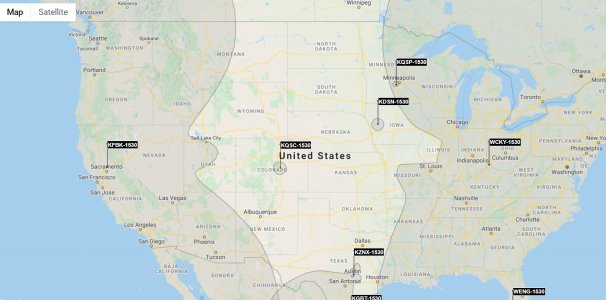
1530 WCKY is allowed to be full power several hours after dark before it goes directional to protect KFBK Sacramento, which is also directional at night.
1030 KTWO is directional to protect WBZ.
 
Historical insight questions.

Back when the Class A (I-B) AM assignments were being given out, how did two stations given construction permits at the same time protect each other. For example did someone take a map and draw a line halfway between them and each station protected the territory beyond that line?

Could (Did) AM stations select ground system radial lengths and geometry to help achieve directional patterns?
Stations are required to meet certain antenna radiation efficiencies. The normal ground system consists of 120 radials. Reducing the number or length of radials does not provide reliable control of coverage area. Directional antenna arrays are the only acceptable method of coverage control. There are many factors which the FCC considers when granting CPs for new construction.
It's not a simple matter of drawing a line halfway between the two competing applications. It's a complex process which requires the help of a qualified consulting engineer to calculate the predicted coverage area.
 
<...>Back when the Class A (I-B) AM assignments were being given out, how did two stations given construction permits at the same time protect each other.<...>

<...>It's a complex process which requires the help of a qualified consulting engineer to calculate the predicted coverage area.

I'm not certain the OP's question was answered.


"Most former Class I-Bs are directional at night, although a few are also directional during days."
 
Back when the Class A (I-B) AM assignments were being given out, how did two stations given construction permits at the same time protect each other.

That's why the FRC and later the FCC was created. Prior to that, radio stations existed with no limits, so they interfered with each other. Plus you had a bunch of amateur radio operators sharing the same band with professionals such as Westinghouse. If it had been left to the big corporations, there would have been no rules, and the most powerful transmitter would win. In fact, even after the FCC was created and set up rules, radio owners like Sarnoff and Crosley sought to exceed the government limits.

My favorite example was the religious broadcaster Aimee Semple McPhearson who ran a station out of her church in California. On any given day, the station might be at one of several frequencies. When the FCC told her she had to stay on one frequency, she wrote a letter to the Secretary of Commerce, saying "PLEASE ORDER YOUR MINIONS OF SATAN TO LEAVE MY STATION ALONE. YOU CANNOT EXPECT THE ALMIGHTY TO ABIDE YOUR WAVELENGTH NONSENSE."
 
KTWO was not a Class A. It was a Class II-A, now it's a Class B.

There are quite a few pairs of Class As, or were. WOWO was downgraded to Class B. Now KGA is also in the process of downgrading to Class B.

Most of the pairs protect each other with three tower in line or dogleg arrays at Night.
 
I was not thinking about WBZ-KTWO mentioned above. WBZ was the dominant station and had been around for a long time as Class A (formerly I-A). Then the allocation KTWO got was subordinate (Class B, which does not have skywave protection). WBZ's nighttime skywave contour was already known to KTWO for protection.

KOMO-WMVP would be a better example. Consider two stations that were applying at about the same time to obtain clear channel assignments. Let's say they could both get co-channel allocations as Class A (1-B). Since both were also applying for power increases, neither had an existing formal skywave contour for the other to protect. So the question is, how was the territory between them divvied up? Come to think of it, each station's proposed contour would have to have been engineered sooner in order to be spec'ed out in the other's construction permit.
 
Last edited:
KGA has been a class B for a while. Just this spring further reduced the night-time power and has gone non-directional.
"1530 WCKY is allowed to be full power several hours after dark before it goes directional to protect KFBK Sacramento, which is also directional at night." KFBK is directional day & night different patterns with the daytime looking like a peanut. KFBK also can operate with their day pattern starting when WCKY's goes to their non-directional daytime mode.
1530 night-time:
1530.JPG
 
Historical insight questions.

Back when the Class A (I-B) AM assignments were being given out, how did two stations given construction permits at the same time protect each other. For example did someone take a map and draw a line halfway between them and each station protected the territory beyond that line?

Could (Did) AM stations select ground system radial lengths and geometry to help achieve directional patterns?
Assignments on AM weren't typically "given out" as much as a station wanting to apply to operate on a frequency had to make their best engineering case to the FCC (FRC) that the station would fit, not cause interference, and serve the public interest. FM worked differently in that there was a table of allocations that assigned frequencies and classes to potential stations nationwide.
 
Assignments on AM weren't typically "given out" as much as a station wanting to apply to operate on a frequency had to make their best engineering case to the FCC (FRC) that the station would fit, not cause interference, and serve the public interest. FM worked differently in that there was a table of allocations that assigned frequencies and classes to potential stations nationwide.
i know that LPFM's are assigned frequencies since a resident complained about a local one blocking out a full-power signal, and the LP actually came back and explained that it was the FCC's choice, but I didn't realize AMs could pick what frequency they want!
 
My favorite example was the religious broadcaster Aimee Semple McPhearson who ran a station out of her church in California. On any given day, the station might be at one of several frequencies. When the FCC told her she had to stay on one frequency, she wrote a letter to the Secretary of Commerce, saying "PLEASE ORDER YOUR MINIONS OF SATAN TO LEAVE MY STATION ALONE. YOU CANNOT EXPECT THE ALMIGHTY TO ABIDE YOUR WAVELENGTH NONSENSE."
So this kind of religious cray cray existed even back then? This sounds like a modern day religious organization's response to the FCC, or most any secular rule or law they don't like or agree with or wish to abide by!
 
In the early days of radio (the wild west, if you will, of the 1920s), stations might timeshare, but in general it was a stew.
In the modern day, Three pairs of stations come to mind here...
1000 KOMO and WMVP both directionalize their signals, KOMO to the South, and WMVP to the East.
1530 WCKY is allowed to be full power several hours after dark before it goes directional to protect KFBK Sacramento, which is also directional at night.
1030 KTWO is directional to protect WBZ.
Incase anyone missed the memo, frequencies beyond 1490 were not part of the original AM band and were not included in the 25 Class 1-A clear channels. Think of them as a very early "expanded band".
 
Incase anyone missed the memo, frequencies beyond 1490 were not part of the original AM band and were not included in the 25 Class 1-A clear channels. Think of them as a very early "expanded band".
Yes they were! I wonder what it would be like to listen to radio (or Dx for that matter) at a time when the only options were 833 khz and 619?
 
Yes they were! I wonder what it would be like to listen to radio (or Dx for that matter) at a time when the only options were 833 khz and 619?
I can't find when the band was expanded to 1600 but I did find this:
According to Thomas H. White, in his Internet article "Building the Broadcast Band," the number of stations authorized to operate on 360 meters reached 524 by March, 1923. Once again, the Commerce Department acted to expand the broadcast band, this time assigning all of the space from 550 to 1350 kHz for AM broadcasting. In 1927 the Federal Radio Commission (FRC) was formed to be a "traffic cop" for the burgeoning radio broadcasting industry. The standard broadcast band was expanded again, this time from 550 to 1500 kHz.
 
For the high-powered stations that today are called "Class A," the FCC originally had two classifications, Class I-A and Class I-B. All were 50,000 watts except when noted below.

Class I-A: These were the 37 top stations, the Cream of the Crop, with no other stations on their frequencies within 1,000 miles or more at night. (WOAI San Antonio had no other U.S. station, NONE, on 1200 kHz, day or night.) They all were non-directional except WWL and WBZ, which wanted directional antennas to put a stronger signal over New Orleans and Boston.

540 CBK Regina and XEWA San Luis Potosí (150 kw)
This was the only frequency with two Class I-A stations
640 KFI Los Angeles
650 WSM Nashville
660 WNBC New York (now WFAN)
670 WMAQ Chicago (now WSCR)
690 CBF Montreal (now CKGM)
700 WLW Cincinnati
720 WGN Chicago
730 XEX Mexico City (100 kw days/50 kw nights)
740 CBL Toronto (now CFZM)
750 WSB Atlanta
760 WJR Detroit
770 WABC New York
780 WBBM Chicago
800 XEROK Ciudad Juarez (150 kw)
820 WBAP Fort Worth
830 WCCO Minneapolis
840 WHAS Louisville
860 CJBC Toronto
870 WWL New Orleans
880 WCBS New York
890 WLS Chicago
900 XEW Mexico City (250 kw - the highest power station in North America until a few years ago)
990 CBW Winnipeg
1020 KDKA Pittsburgh
1030 WBZ Boston
1040 WHO Des Moines
1050 XEG Monterrey (150 kw)
1100 WWWE Cleveland (now WTAM)
1120 KMOX St. Louis
1160 KSL Salt Lake City
1180 WHAM Rochester
1200 WOAI San Antonio
1210 WCAU Philadelphia (now WPHT)
1220 XEB Mexico City (100 kw)
1570 XERF Ciudad Acuña, Coahuila (100 kw)
1580 CBJ Chicoutimi, Quebec (10 kw until going 50 kw in the 1990s, now silent)

======

Class I-B stations usually had two or three other high-powered stations on their frequencies but at least 1,000 miles away. With a few exceptions, they used directional antennas to protect the other Class I-B stations on their frequency. They operate with 50,000 watts fulltime unless otherwise noted.

--680 KNBR San Francisco (It's non-directional, even though it's a Class I-B)
--810 WGY Schenectady and KGO San Francisco (WGY is non-directional, KGO only slightly directional)
--850 KOA Denver (non-directional Class I-B)
--940 CBM Montreal and XEQ Mexico City (150 kw D/50 kw N - both stations were so distant that XEQ was non-directional and CBM only slightly directional)
--1000 WCFL Chicago, KOMO Seattle and XEOY Mexico City (50 kw D/20 kw N)
--1010 CFRB Toronto and CBR Calgary
--1060 KYW Philadelphia and XEEP Mexico City (100 kw D/20 kw N)
--1070 KNX Los Angeles and CBA Moncton (both stations were so distant that they both used non-directional antenna - CBA is now silent)
--1080 WTIC Hartford and KRLD Dallas
--1090 WBAL Baltimore, KAAY Little Rock and XEPRS Tijuana
--1110 WBT Charlotte and KFAB Omaha
--1130 WNEW New York, KWKH Shreveport and CKWX Vancouver
--1140 WRVA Richmond and XEMR Monterrey
--1170 WWVA Wheeling and KVOO Tulsa
--1190 KEX Portland, WOWO Fort Wayne and XEWK Guadalajara (50 kw D/10 kw N)
--1500 WTOP Washington and KSTP St. Paul
--1510 WLAC Nashville and KGA Spokane
--1520 WKBW Buffalo and KOMA Oklahoma City
--1530 WCKY Cincinnati and KFRK Sacramento
--1540 KXEL Waterloo, Iowa and ZNS-1 Nassau, Bahamas (10 kw)
--1550 CBW Windsor, Ontario (10 kw), KGAR Vancouver, Washington (10 kw) and XERUV Xalapa, Veracruz (10 kw)
--1560 WQXR New York and KPMC Bakersfield (10 kw)

 
Last edited:
1580 CBJ Chicoutimi, Quebec (10 kw until going 50 kw in the 1990s, now silent)
1580 also had Hermosillo, Sonora, 50 kw non-D day and night. It was another shared channel with non-directionals in both CA and MEX.
 
What about KOB/KKOB, 770kHz, 50kW non DA day, DA night?
That's a long long story.
 
Status
This thread has been closed due to inactivity. You can create a new thread to discuss this topic.


Back
Top Bottom