• Get involved.
    We want your input!
    Apply for Membership and join the conversations about everything related to broadcasting.

    After we receive your registration, a moderator will review it. After your registration is approved, you will be permitted to post.
    If you use a disposable or false email address, your registration will be rejected.

    After your membership is approved, please take a minute to tell us a little bit about yourself.
    https://www.radiodiscussions.com/forums/introduce-yourself.1088/

    Thanks in advance and have fun!
    RadioDiscussions Administrators

Over-saturation

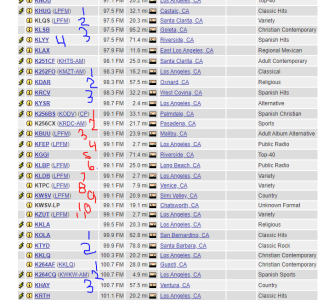
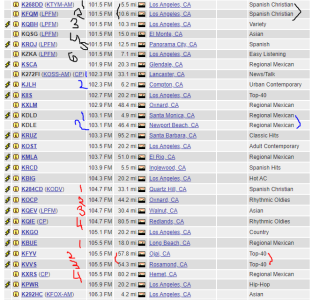
Someone on the internet had posted that they were interested in building a station in Los Angeles; my more or less automatic response to him was basically that the market is just too jam packed to find a truly clean frequency. But then, I had to go see for myself, and I found this hilarious nonsense. Wow does Los Angeles need an expanded band or just start from scratch!Los Angeles Overload Part 1.PNGLos Angeles Overload Part 2.PNG
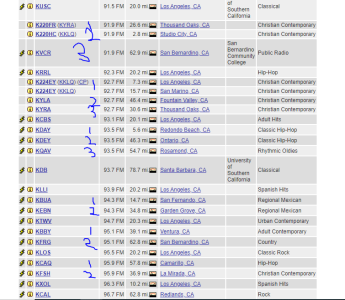
 
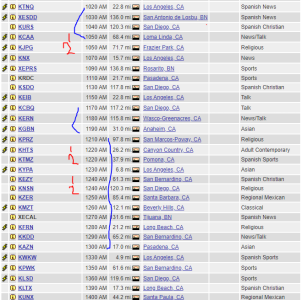
And then there's more...LAO Part 3.PNGLAO AM Edition.PNG
In other words, what solutions would YOU propose to give everyone a fair chance in LA? I vote for an expansion of the FM band of 60-100 Mhz, while skipping the specialty devices at 72Mhz as well as Channel 5.
 
And then there's more...View attachment 2294View attachment 2295
In other words, what solutions would YOU propose to give everyone a fair chance in LA? I vote for an expansion of the FM band of 60-100 Mhz, while skipping the specialty devices at 72Mhz as well as Channel 5.
Oof at this point streaming only via TuneIn, Iheart and Audacy. I know some of the frequencies you show here are occupied by more than one group because of the LPFM status. I'm just not sure what else you can do with the FM band at this point.


Maybe expand to 76 mHz for FM? If that's even possible.
 
Oof at this point streaming only via TuneIn, Iheart and Audacy. I know some of the frequencies you show here are occupied by more than one group because of the LPFM status. I'm just not sure what else you can do with the FM band at this point.


Maybe expand to 76 mHz for FM? If that's even possible.
I'd bet most LA residents already stream their stations anyways, but I do like your idea of a 76-108 Mhz FM band, and it shouldn't be too hard to implement, right? It looks like LA did designate 99.1, 101.5, and 107.9 as LP only frequencies, which is nice for small-time broadcasters, but a drag for anyone trying to listen to anything on those channels. Hey...what if we make SiriusXM free for LA County residents only, and they must prove their registration every other year?
 
I'd bet most LA residents already stream their stations anyways, but I do like your idea of a 76-108 Mhz FM band, and it shouldn't be too hard to implement, right? It looks like LA did designate 99.1, 101.5, and 107.9 as LP only frequencies, which is nice for small-time broadcasters, but a drag for anyone trying to listen to anything on those channels. Hey...what if we make SiriusXM free for LA County residents only, and they must prove their registration every other year?

Thats the stupidest thing ive heard today.. they didnt designate "99.1, 101.5 and 107.9" as LP only frequencies.. its just where they happen to fit with all the other full powers

The other thing youre neglecting to mention with 2 or 3 stations on the same frequency, los angeles is really big and the stations with 2 or 3 on the same channel are much smaller Class A's usually spread 30-40 miles apart and the base setting when searching on radio locator is distant signals, not locals, but not fringe.. which makes a difference
 
Thats the stupidest thing ive heard today.. they didnt designate "99.1, 101.5 and 107.9" as LP only frequencies.. its just where they happen to fit with all the other full powers

The other thing youre neglecting to mention with 2 or 3 stations on the same frequency, los angeles is really big and the stations with 2 or 3 on the same channel are much smaller Class A's usually spread 30-40 miles apart and the base setting when searching on radio locator is distant signals, not locals, but not fringe.. which makes a difference
True that some of the distant and fringe signals probably don't come in the best, and that the city is so big that it can handle more LP's, however I think my point still remains that there is not enough space on the dial so stations had to double up, sacrificing some coverage in the city.

They didn't specifically designate them? Now that's a shocker.
 
True that some of the distant and fringe signals probably don't come in the best, and that the city is so big that it can handle more LP's, however I think my point still remains that there is not enough space on the dial so stations had to double up, sacrificing some coverage in the city.

They didn't specifically designate them? Now that's a shocker.

No, they didnt designate them.. you can put a translator anywhere it fits

And back in the day, some of these places were a bit more seperate then one big LA glob it is now and many times, a commercial allocaton just isnt gonna cover the whole market based upon other stations, among some factors
 
I'd bet most LA residents already stream their stations anyways,
No, in September 84.2% of the 25-54 persons (the prime ad target for which we program) listened to local area radio stations. Of that number, 0.6% was from streams.
but I do like your idea of a 76-108 Mhz FM band, and it shouldn't be too hard to implement, right? It looks like LA did designate 99.1, 101.5, and 107.9 as LP only frequencies, which is nice for small-time broadcasters, but a drag for anyone trying to listen to anything on those channels. Hey...what if we make SiriusXM free for LA County residents only, and they must prove their registration every other year?
107.9 is in use in the LA metro by KWVW KWVE, which is 530 watts at 5300 feet HAAT. 99.1 has two translators and 101.5 has one of them, all in the radio metro area.

LPFMs are not designated and not on the table of assignments. I've never spent any time looking at LPFM licensing procedures, so for further data I defer to those familiar with how they are applied for and granted.
 
Last edited:
No, they didnt designate them.. you can put a translator anywhere it fits

And back in the day, some of these places were a bit more seperate then one big LA glob it is now and many times, a commercial allocaton just isnt gonna cover the whole market based upon other stations, among some factors
Yeah, you might want to make LA and San Bernardino their own separate markets, and then repeat for the north side in that case. I forgot to mention that most stations have HD to boot, and in the videos I've seen, you can get stations from San Diego while in LA. All of that adds up to a full band in my book. And station contours, unlike AM, do not always follow clear cut boundaries.
 
No, in September 84.2% of the 25-54 persons (the prime ad target for which we program) listened to local area radio stations. Of that number, 0.6% was from streams.

107.9 is in use in the LA metro by KWVW, which is 530 watts at 5300 feet HAAT. 99.1 has two translators and 101.5 has one of them, all in the radio metro area.
Good to know they still like radio, and that it is being used well, apparently!
 
And back in the day, some of these places were a bit more seperate then one big LA glob it is now and many times, a commercial allocaton just isnt gonna cover the whole market based upon other stations, among some factors
Good observation.

As the biggest example, the Lancaster-Palmdale area "over the hill" from LA and its close suburbs is part of the LA radio metro survey area. But, other than KFI, none of the LA AMs have a decent fulltime signal there, and more than half of the FMs "home" to the market are totally shadowed... with the remaining ones not particularly consistent in covering that sub-metro with a 2021 population of 504,000 persons.
 
Yeah, you might want to make LA and San Bernardino their own separate markets, and then repeat for the north side in that case. I forgot to mention that most stations have HD to boot, and in the videos I've seen, you can get stations from San Diego while in LA. All of that adds up to a full band in my book. And station contours, unlike AM, do not always follow clear cut boundaries.

Riverside/San Bernardino are their own market.. and am nor fm follow boundries.. especially when right along the coast
 
Good observation.

As the biggest example, the Lancaster-Palmdale area "over the hill" from LA and its close suburbs is part of the LA radio metro survey area. But, other than KFI, none of the LA AMs have a decent fulltime signal there, and more than half of the FMs "home" to the market are totally shadowed... with the remaining ones not particularly consistent in covering that sub-metro with a 2021 population of 504,000 persons.
Weird, not even KNX would be considered a "good" signal in Lancaster?
 
Yeah, you might want to make LA and San Bernardino their own separate markets,
They are separate radio survey markets. They have never been combined.

Look at the most recent "Market Map" from Nielsen at https://worldradiohistory.com/Arbitron-Market_Maps.htm. The maps are PDFs and can be expanded for great detail.
and then repeat for the north side in that case. I forgot to mention that most stations have HD to boot, and in the videos I've seen, you can get stations from San Diego while in LA.
"LA" for radio is the totality of Los Angeles and Orange counties. Of course there will be some "leakage" of San Diego stations, particularly in southern Orange and along the flat, coastal areas.

Note: TV markets are, generally, quite different from radio markets for ratings because TV markets include areas where stations are carried on cable, not jut over the air reception. In radio, the "MSA" means "Metro Survey Area" while in the government it means "Metropolitan Statistical Area" and they can be very different also.
All of that adds up to a full band in my book. And station contours, unlike AM, do not always follow clear cut boundaries.
The band is "full" to the FCC based on the protected contours of each station and its class. While many stations nationally cover outside their protected contours, there is a possibility that new or moved or improved stations elsewhere can reduce that unprotected coverage.
 
No, in September 84.2% of the 25-54 persons (the prime ad target for which we program) listened to local area radio stations. Of that number, 0.6% was from streams.

107.9 is in use in the LA metro by KWVW, which is 530 watts at 5300 feet HAAT. 99.1 has two translators and 101.5 has one of them, all in the radio metro area.

LPFMs are not designated and not on the table of assignments. I've never spent any time looking at LPFM licensing procedures, so for further data I defer to those familiar with how they are applied for and granted.
You mean KWVE?
 
One country did expand their FM band using reclaimed spectrum from TV channels 5 and 6: Brazil. It's only recently begun, so there aren't a lot of stations or receivers for the 76-88 MHz portion yet.
Love it, Good for them, reclaiming unused space! Here in the US, there are still a good chunk of stations on channel 5 and 6 (looking at you. WMC Memphis and WPVI Philly) and the FCC repack that certainly makes space tight. Maybe one day, in the ATSC 3.0 era, we can finally move away from the VHF band.
 
Weird, not even KNX would be considered a "good" signal in Lancaster?
It's not a very consistently good signal at night out there. Marginal at best. Similarly, it is pretty inconsistent at night by the time you get to Redlands or Moreno Valley in the Riverside/San Bernardino market.
 
One country did expand their FM band using reclaimed spectrum from TV channels 5 and 6: Brazil. It's only recently begun, so there aren't a lot of stations or receivers for the 76-88 MHz portion yet.
And the broadcasters are not strongly supporting this as they realize that people will not buy new radios in the era of streaming.
 
Status
This thread has been closed due to inactivity. You can create a new thread to discuss this topic.


Back
Top Bottom