• Get involved.
    We want your input!
    Apply for Membership and join the conversations about everything related to broadcasting.

    After we receive your registration, a moderator will review it. After your registration is approved, you will be permitted to post.
    If you use a disposable or false email address, your registration will be rejected.

    After your membership is approved, please take a minute to tell us a little bit about yourself.
    https://www.radiodiscussions.com/forums/introduce-yourself.1088/

    Thanks in advance and have fun!
    RadioDiscussions Administrators

Changing Technology: A British Perspective.

I also would like to know. I haven't seen too many cell towers up close and personally, but haven't noticed any large diesel engine generator boxes nearby the ones I have seen up close and personally.

I also neglected to add that although the power and cell service was out for those 40 hours a couple years back, the wireline phone still worked....100 year old tech (sort of -- most wireline phone service is computer-controlled at the central switch) still working.
 
I also would like to know. I haven't seen too many cell towers up close and personally, but haven't noticed any large diesel engine generator boxes nearby the ones I have seen up close and personally.
The gear is not so energy hungry that you'd need a big diesel rig. More likely either propane from tanks or from the city gas service.

My 23 kw generator, rated at continuous duty, is about the size of an old fashioned steamer trunk. And that is a lot bigger than what a cell would need for just one provider.
I also neglected to add that although the power and cell service was out for those 40 hours a couple years back, the wireline phone still worked....100 year old tech (sort of -- most wireline phone service is computer-controlled at the central switch) still working.
Unless you have some idiot who can't read signs with a backhoe, wire is pretty durable.
 
I also neglected to add that although the power and cell service was out for those 40 hours a couple years back, the wireline phone still worked....100 year old tech (sort of -- most wireline phone service is computer-controlled at the central switch) still working.
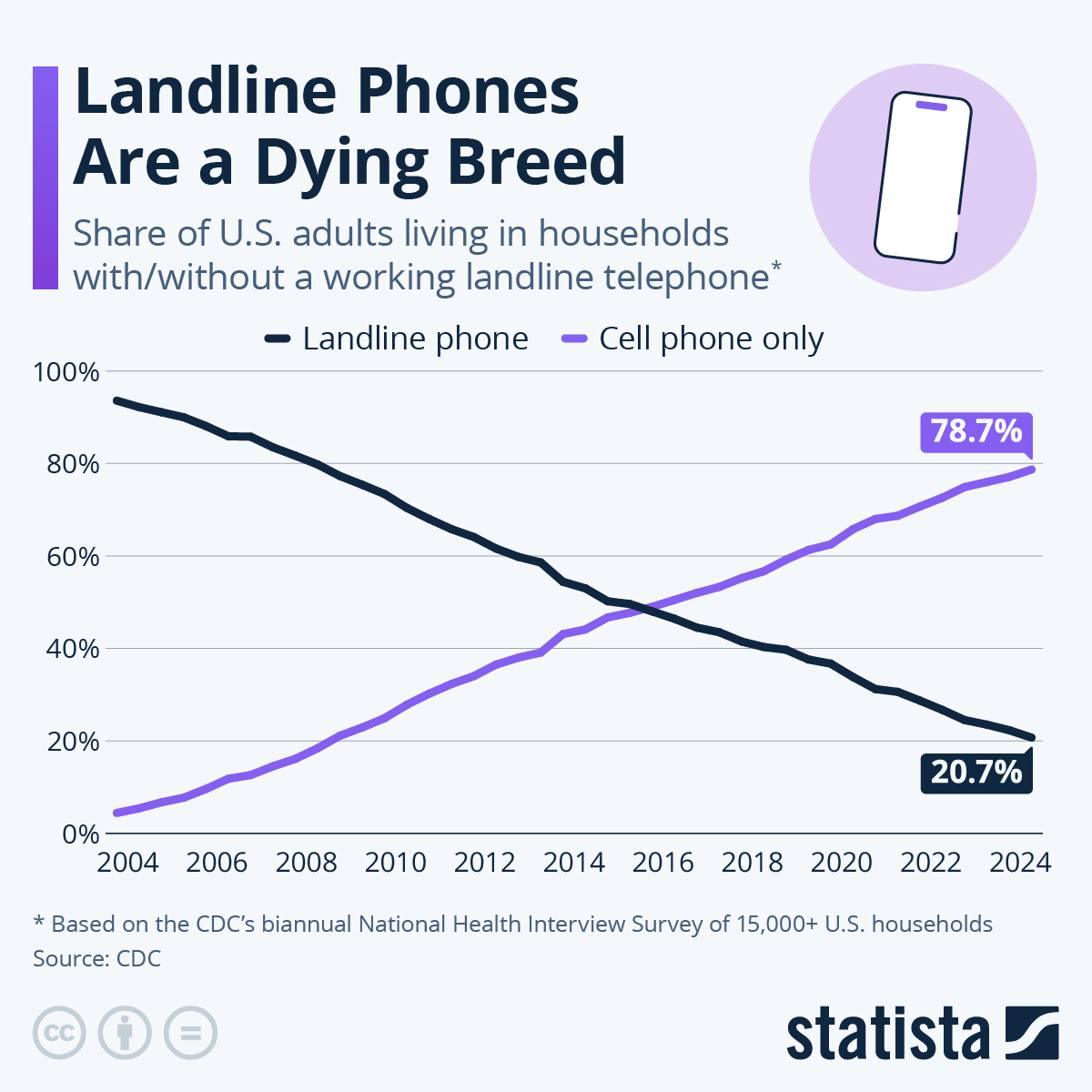
You're correct, but according to some statistics, fewer than 40% of households have a "landline" phone.

Also, and most importantly, many who have a landline "home phone", may no longer have hard-wired "POTS" copper lines that will work in cases of power failure. When my parents signed up for a plan to get internet and home phone under 1 package, AT&T went to their place and installed a modem which now feeds their home phone service as well as their internet. This meant they no longer had "hard wired" phone service that would work during a power outage. When they called the phone company to complain, they were told that reconnecting their POTS service was not possible. When they explained they needed phone service in cases of power outages, the phone company provided them a UPS unit to supply power to their phone/internet modem for a few hours. See below from AT&T's website:
The biggest difference is that fiber optic cables can’t carry electrical current like copper wires, so the new fiber optic equipment located in your home needs your electrical power to work. We’ll install an initial 8-hour backup battery for your new fiber optic equipment, so your phone service will continue to work during a power outage. However, it’s important to know that if the backup battery becomes depleted, your telephone service won’t work during a power outage. You’ll be responsible for the maintenance of the backup battery and subsequent replacement batteries.
 
Last edited:
I;m reminded of a story from a Twilight Zone book where people's lights were turning on and off -- sometimes entire blocks -- and chaos ensued. Aliens watching from a hill were causiing it, almost as an experiment.
Naturally it was fiction. But iIrc the book was from the 60's. Conelrad days.

The reason I bring up the matter is that with all the hacking recently (Barclay's Bank in the UK perhaps being the latest) I'm uncomfortable with a system so vast and important and vulnerable seemingly 'just asking for it'.
 
Perhaps Kelly can give us an estimate of what percentage of cell sites have standby battery power and how many actually have a genny. I defer exponentially to his knowledge of tech matters
I don't have any statistics, mainly because nothing like that is published. A couple years ago a good friend of mine from TMobile, mentioned that around 30% of their sites had generators at the site. All cell/PCS sites run off of batteries charged by utility power. Most, if not all, have spigots to plug in a portable generator (hopefully) before the batteries run out typically between 24 and 36 hours. I've heard most carriers have a plan to dispatch generators on trailers to certain 'priority' cell sites within 12 hours prior to the batteries going dead. Priority sites are ones that cover the most population within a metro region.
 
I don't have any statistics, mainly because nothing like that is published. A couple years ago a good friend of mine from TMobile, mentioned that around 30% of their sites had generators at the site. All cell/PCS sites run off of batteries charged by utility power. Most, if not all, have spigots to plug in a portable generator (hopefully) before the batteries run out typically between 24 and 36 hours. I've heard most carriers have a plan to dispatch generators on trailers to certain 'priority' cell sites within 12 hours prior to the batteries going dead. Priority sites are ones that cover the most population within a metro region.
Of course, in the case of a disaster like a flood, hurricane, forest fire or the like, the trucks would not get through. This is more to maintain service with the objective of retaining customers than being ready for catastrophic emergencies.

Thanks for give us a picture of how those sites work.

I wonder how many of the generator sites store fuel, and how many depend on the gas company as, simply, an alternative fuel.
 
While generators running on natural gas can be a savior during power outages, I’ve wondered this: If every house had a generator operating at the same time, could the resulting extremely heavy demand for natural gas crash the distribution system? There is also an assumption that the gas supply will always be there…here in Texas during “The Big Freeze” we were advised to reduce natural gas usage as distribution systems were frozen and offline (which resulted in power failures as major electric generating plants couldn’t be fueled.)

Also in earthquake zones, I would think that natural gas would be intentionally cut off due to the possibility of fire and explosions from broken lines.

We should also note that some political jurisdictions (hello California) are trying to end the use of natural gas for environmental reasons.

Not trying to be negative about natural gas generators, but there are some gotchas that need to be considered.
 
I don't have any statistics, mainly because nothing like that is published. A couple years ago a good friend of mine from TMobile, mentioned that around 30% of their sites had generators at the site. All cell/PCS sites run off of batteries charged by utility power. Most, if not all, have spigots to plug in a portable generator (hopefully) before the batteries run out typically between 24 and 36 hours. I've heard most carriers have a plan to dispatch generators on trailers to certain 'priority' cell sites within 12 hours prior to the batteries going dead. Priority sites are ones that cover the most population within a metro region.
We had a big storm that started Sunday night here in Silicon Valley and I noticed on Tuesday, driving by a Verizon cell site, there was a portable generator outside. That's the first time I ever saw one. Our power is pretty reliable but the recent storm was huge, leaving nearly 148,000 households and businesses without power and prompting evacuation orders in San Mateo and Santa Cruz counties..
 
While generators running on natural gas can be a savior during power outages, I’ve wondered this: If every house had a generator operating at the same time, could the resulting extremely heavy demand for natural gas crash the distribution system? There is also an assumption that the gas supply will always be there…here in Texas during “The Big Freeze” we were advised to reduce natural gas usage as distribution systems were frozen and offline (which resulted in power failures as major electric generating plants couldn’t be fueled.)
Many whole-home generators are fueled by propane. The 25kW Kohler backing up my home is connected to a 1,000 gallon propane tank. But, that said, I don't live in an area with natural gas from a utility either. Typical ultilty power outages in my area last as short as ten hours, or as long as two weeks.
 
Last edited:
Unlike the USA, the UK has good radio. The dial is not clogged by boring automated corporate cookie cutter stations.

New community stations have come on the air in the UK and they are popular.

The former Audio Division Chief at the FCC told me, "More people would listen to American radio if they played something good."
 
Unlike the USA, the UK has good radio. The dial is not clogged by boring automated corporate cookie cutter stations.
That's assuming you prefer government-run stations with lots of news interview shows or pop stations run by government officials.
The former Audio Division Chief at the FCC told me, "More people would listen to American radio if they played something good."
That's a personal opinion because the FCC doesn't regulate programming, or taste.
 
People in the UK have a good reason to still be listening to radio because their radio is good. Americans have a good reason to get an Alexa.

I would like to see a more progressive FCC under Biden reverse some of the bad rules made during the Trump years. Most of the FM translators for AM's were given to broadcasters who already had plenty FM signals. And, they got the FM frequencies without having to face competition for the frequencies like everyone else.

Just more crap on the air.
 
Last edited by a moderator:
People in the UK have a good reason to still be listening to radio because their radio is good. Americans have a good reason to get an Alexa.

I would like to see a more progressive FCC under Biden reverse some of the bad rules made during the Trump years. Most of the FM translators for AM's were given to broadcasters who already had plenty FM signals. And, they got the FM frequencies without having to face competition for the frequencies like everyone else.

Just more crap on the air.
How is taking FM channels used for translators away from their AM stations considered "progressive"? Seems like the other way around to me.
 
Unlike the USA, the UK has good radio. The dial is not clogged by boring automated corporate cookie cutter stations.
Nearly all then non-government stations are national networks, with lots of transmitter plugged into the London studio feed. There are very few local stations, and those are mostly low power. The rest is the BBC with its "we're the government and we are here to help you" attitude.
New community stations have come on the air in the UK and they are popular.
Very few, and if you look at the ratings, they are not "very popular".
The former Audio Division Chief at the FCC told me, "More people would listen to American radio if they played something good."
This is like Newton Minow and his "vast wasteland" comment; there are elite folks who think even PBS is too common and vulgar. But actually the most successful stations are ones that survey listeners and give them exactly what they want... not some bureaucrat telling us how to think.
 
Last edited:
I would like to see a more progressive FCC under Biden reverse some of the bad rules made during the Trump years. Most of the FM translators for AM's were given to broadcasters who already had plenty FM signals. And, they got the FM frequencies without having to face competition for the frequencies like everyone else.
The decision to make translators available came well before anyone even envisioned Trump as more than a done-and-over-with TV star.
 
American Radio is owned mostly by dorks and crooks.
I've worked in radio for 60 years, and met a dork or two, but no crooks. Like every business, some operators are better than others... but that goes for restaurants or gas stations or supermarkets, too.
 
Status
This thread has been closed due to inactivity. You can create a new thread to discuss this topic.


Back
Top Bottom