
From Jim Duncan's "American Radio" here are the ratings from 45 years ago!
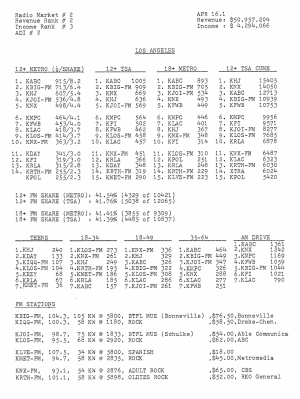
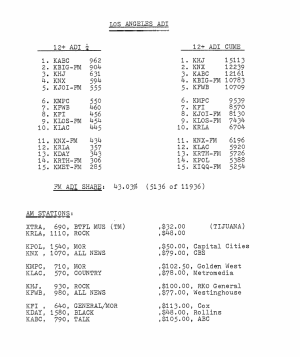

KABC had its biggest numbers in AM drive. And looking at the Fall book, post season, the had even better numbers. Baseball was about the revenue, not the ratings.KABC was number 1 due to Dodgers and an afternoon block of sports talk. Remember, Dodger home games were not on TV, you had to listen To Vinny, Jerry and Ross to get your Dodgers fix.
Yes, they did very well mornings. I think it was Ken and Bob back then. But a lot of those radios were tuned into them because they were still on KABC from the previous night's Dodger game. I witnessed this in my own circle of family and friends.KABC had its biggest numbers in AM drive. And looking at the Fall book, post season, the had even better numbers. Baseball was about the revenue, not the ratings.
Moderate, Intelligent talk moved somewhere else this time on KPCC and KCRW in the LA Radio Market.--The #2 station for 18-34 and #1 for 18-49 is Soft Rock KNX-FM. James Taylor, Linda Ronstadt, The Eagles, Carole King.
--The #1 station, KABC, is well rounded talk. Some slightly liberal, some moderate, some slightly conservative, some psychiatric (Dr. Toni Grant), some historic (Ira Fistel). It's not own the libs, everything Republicans do is right, everything Democrats do is evil.
Moderate, intelligent talk is #1, All-News is #5 and #7. Soft, instrumental music is #2 and #4. Over the last 45 years, did humans lose half their brain cells?
KFI went Top 40 in 1977. The AC format Jhani Kaye devised for KOST in 1982 had nothing in common with KFI’s approach to AC. In fact, Jhani re-invented Adult Contemporary, making it more music-intensive and with a much bigger appeal to adult females.KFI was AC in 1976 prior to being the talk station we know today. KFI's AC format was later moved to KOST-FM. Note KFI and KOST were then owned by Cox Media in the 1970's.
Tom’s involvement with KMET lasted only a few months of 1968. Shadoe Stevens was PD from 1974-75 and was replaced by Sam Bellamy.This is one year after the death of Tom Donohue, who was running The Mighty Met KMET with his wife. She took over programming duties after his death. He was only 45 at the time of his death, but was overweight and died of a heart attack.
You can see how much of an impact the station had with young listeners, with the sweet spot being young adults in their 20s. By this point, most of the Metromedia FMs were rock, with WNEW NY, KSAN SF, WMMR Philly, and WMMS Cleveland.
I have always been told... including when management wanted me to put the Dodgers on KTNQ when it was talk... that baseball in any language lost audience in LA. Again, management liked it due to the revenue; even if shared with the team, it was non-ratings-driven money and very good.Yes, they did very well mornings. I think it was Ken and Bob back then. But a lot of those radios were tuned into them because they were still on KABC from the previous night's Dodger game. I witnessed this in my own circle of family and friends.
I'm not saying they wouldn't have done well on their own, they were the only talk station in town too (back in the day when you could actually hear the station), but the Dodgers "lead-in" so to speak was very helpful.
I did a lot of nighttime listening to KFI while I was living in West Texas during the late 70s and early 80s. Really enjoyed the music mix and presentation, and they would also sprinkle in some gold amongst the Top 40 hits. I do recall the jocks would occasionally acknowledge some of the distant listeners that had called in.KFI went Top 40 in 1977.
MetroMedia sold off MMS in 1972 to Malrite. Ironically that station truly thrived with rock after the sale.This is one year after the death of Tom Donohue, who was running The Mighty Met KMET with his wife. She took over programming duties after his death. He was only 45 at the time of his death, but was overweight and died of a heart attack.
You can see how much of an impact the station had with young listeners, with the sweet spot being young adults in their 20s. By this point, most of the Metromedia FMs were rock, with WNEW NY, KSAN SF, WMMR Philly, and WMMS Cleveland.
KABC suffered less in terms of normal audience tune-out with the Dodgers than KFI because it wasn’t interrupting music.I have always been told... including when management wanted me to put the Dodgers on KTNQ when it was talk... that baseball in any language lost audience in LA. Again, management liked it due to the revenue; even if shared with the team, it was non-ratings-driven money and very good.
I’ve seen L.A. ratings back to fall of 1966. KFI was never number one, and in the late 60s and early 70s, they often weren’t even top ten.For a big market 50,000 watt non-directional AM station in the mid 70’s, KFI wasn’t doing so hot in the ratings losing out to smaller and weaker AM stations. The format was “General / MOR” so does that mean it was playing “middle of the road” music back then? No wonder they later flipped formats!
The PD was John Rook of WLS, Chicago, who knew how to do Top 40 on a big signal.I did a lot of nighttime listening to KFI while I was living in West Texas during the late 70s and early 80s. Really enjoyed the music mix and presentation, and they would also sprinkle in some gold amongst the Top 40 hits. I do recall the jocks would occasionally acknowledge some of the distant listeners that had called in.
It was music radio on AM at a time FM was taking over, but was nice to have a big city alternative to the often mediocre local options I had at the time.
True. KDAY was top five in the fall ‘74 and fall ‘75 books, and got within 8/10th of a point of KHJ in ‘75.The original KDAY-AM had a good sized audience back then with a Motown/Soul/R&B playlist.
I suppose not many would care accept me, but it shouid be noted that the antenna elevations listed for the FM stations on the list are feet above sea level===not height above average terrain (HAAT) which is what the FCC uses to determine appropriate/approved ERP and channel spacing. HAAT is determined by the height of the antenna at the center of radiation between 2 and 10 miles from the antenna. Although Mt. Wilson is a mile high in the San Gabriels, less than 10 miles behind it to the North there's an 8000 ft mountain range which knocks Wilson's HAAT down to about 3000 ft. This explains why you can't hear LA FM stations in Palmdale. The powers listed were grandfathered in when the FCC stopped authorising Class "C" FM stations in California. Max Class C power is about 50 kW at about 3000 ft HAAT (based on the 100 kW at 2000 ft rule). As KBIG and KPFK were authorised before the rules were finalised both operate with over 100 kw. Same for KRUZ in Santa Barbara which has its antenna on the KEYT Channel 3 tower overlooking the Pacific at over 4000 ft. That station can be heard (providing no local interference) from San Diego to near Monterey and Salinas.From Jim Duncan's "American Radio" here are the ratings from 45 years ago!
View attachment 2345
View attachment 2346


