• Get involved.
    We want your input!
    Apply for Membership and join the conversations about everything related to broadcasting.

    After we receive your registration, a moderator will review it. After your registration is approved, you will be permitted to post.
    If you use a disposable or false email address, your registration will be rejected.

    After your membership is approved, please take a minute to tell us a little bit about yourself.
    https://www.radiodiscussions.com/forums/introduce-yourself.1088/

    Thanks in advance and have fun!
    RadioDiscussions Administrators

C.Crane Part 15 FM Transmitter 2

Does anyone know if this C. Crane transmitter has a decent range, compared to many others that have been disappointing?

It has some interesting features, like 50 kHz steps to try to find a clear dial spot, nearly full FM Band Coverage, and an overmodulation indicator and audio gain control But some say it's very limited in range, especially through walls. Anyone here know anything about it?

 
Last edited:
Here's the link to the C. Crane website: Digital FM Transmitter 2 for Sending Near Broadcast Quality

Its range is about 45 feet, which sounds appropriate for a legal Part 15 transmitter. That should cover an average-sized yard unless one has a lot of acreage. It only can transmit between 88.3 and 107.7 MHz, so they're not taking any chances with going out of band on either side.
 
It only can transmit between 88.3 and 107.7 MHz, so they're not taking any chances with going out of band on either side.

This concept goes way back. The Remco Caravelle only transmitted from about 600 kHz to about 1550 kHz. Any wire you added to the circa 3 foot whip antenna DECREASED the range, and lowered the maximum frequency transmitted.
 
This concept goes way back. The Remco Caravelle only transmitted from about 600 kHz to about 1550 kHz. Any wire you added to the circa 3 foot whip antenna DECREASED the range, and lowered the maximum frequency transmitted.
I had something similar when I was a kid, but not that unit. If it lowered the frequency, it was adding inductance to the tuned circuit. That, in turn, caused more of a mismatch between the antenna and the oscillator, decreasing its power output and possibly damaging the transistor.
 
Several years back we had -- iIrc correctly -- a Ramsey 10 (?) FM xmtr. It supposedly had some sort of processing, too. A little thing. maybe 4" X 5" on a project board.
It went the required / legal distance on the car radio or on my bike -- three or so houses DX.
Once, from my living room -- 1530 feet ASL -- I had it attached to old rabbit ears, inside the house, and with a weak battery. I picked it up about 1/2 mile away on the next hill, in a shopping mall parking lot. I mean, no one else would've been likely to play three Chris Rea songs in a row.
That CCrane things looks interesting! Where should I search for a dealer who sells them? Or is there only one left, as the link reads? It'd be fun having fun again.
 
As posted previously. I have a Whole House FM transmitter. It tunes the entire FM band, has automatic gain control, good audio, and as a practical matter, the range is about a half a block. I also have a couple of older models that only cover 106.1 to 107.9 and no AGC. I use those as spares, but my brother in law has one that's about 12 years old and still uses it just about every day. I think these transmitters retail for about $129 on Amazon. But there may be discounts available on the Whole House FM Transmitter FB page. I think I paid $89 for mine about six years ago, and I'm very happy with it. I normally use it on 92.1 and get perfectly clear reception throughout the house and backyard.
 
This concept goes way back. The Remco Caravelle only transmitted from about 600 kHz to about 1550 kHz. Any wire you added to the circa 3 foot whip antenna DECREASED the range, and lowered the maximum frequency transmitted.
Way way back, I had an Allied Radio Knight Kit transmitter. The frequency range was about the same on AM as you mentioned. The difference was the more wire you added to the antenna terminal the farther it transmitted. Mine covered as much as 3 blocks
in the neighborhood.
 
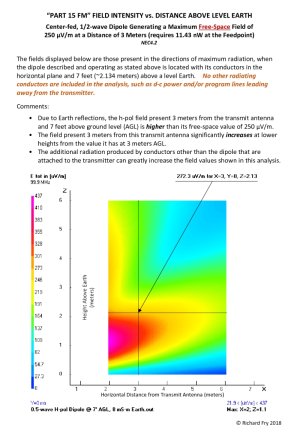
The FCC authorizes the unlicensed use of the FM broadcast band in the U.S. for systems meeting the definitions in 47 CFR §15.239, per the following clip:

\\ § 15.239 Operation in the band 88-108 MHz.

(a) Emissions from the intentional radiator shall be confined within a band 200 kHz wide centered on the operating frequency. The 200 kHz band shall lie wholly within the frequency range of 88-108 MHz.

(b) The field strength of any emissions within the permitted 200 kHz band shall not exceed 250 microvolts/meter at 3 meters. The emission limit in this paragraph is based on measurement instrumentation employing an average detector. The provisions in § 15.35 for limiting peak emissions apply.

(c) The field strength of any emissions radiated on any frequency outside of the specified 200 kHz band shall not exceed the general radiated emission limits in § 15.209. //


The graphic below shows some of the considerations and results — for those wanting to operate an FCC-compliant setup.
Pt15 FM Fld vs Elev AGL.jpg
 
A lot of enhancements that people try remind me of when people made Aluminum Foil "flags" to put on TV Rabbit Ears to improve reception. They did, but depending on exact length of the fully extended telescoping whips, usually only helped on Channel 2. The elements tended to be a little bit short of the resonant length for Channel 2. So it acted like top loading.
 
My C.Crane transmitter had a range of only a few feet until I opened it up and turned up the RF output pot to the maximum. I don't know if they all come set that weak, or someone was just having a bad day at the factory when they made mine.

But even with the C.Crane's RF output set to the maximum, the Whole House FM Transmitter 3 still has much better coverage than it.
 
Compare this to the inverse field you get from 100 mW into a half wave dipole, which would be 138*SQRT(.0001)=1.38 mV/m@1 mile. 100 mW into a quarter wave monopole typical of AM BC stations, 192*SQRT(.0001)=1.92 mV/m@1 mile. Obviously not permitted under Part 15, but when people hear "100 milliwatts", that's what they think.

I had a client a few years who was a lawyer who had been a radio DJ in Ohio before getting her BA and JD. While she was in school, in a mountainous area out West, she "drove a very low power unlicensed signal" out to 25 miles or so, obviously in a terrain enhanced direction, with some associates from a "campus limited" station of some description. They weren't discovered by the FCC. She obviously knew a lot about the radio business, and had a lot of enthusiasm for it, and I asked her why she didn't go into Broadcasting/Communications Law practice. I told her several times that she should. She said she felt she was disqualified because she had been associated with a pirate station. I told her that if that disqualified people from a career associated with broadcasting, there would be very few people in such careers. I know of several broadcast station owners, and more engineers, who confessed to such activity when they were very young. One radio owner operated a TV pirate station within 20 miles of an FCC Monitoring and Field Office, with huge Log Periodics and other antennas on the roof!
 
Last edited:
I bought one several years ago and it stopped working after a week or two. I would not recommend. It's not the only time C Crane sold me a faulty product.
 
While there are strict limits on Part 15 FM transmitters, there are no restrictions as to what kind of receiving setup is used to hear them. So I've always wondered how far a Part 15 would go with an optimized receiver and signal path.

In such a scenario, you would have a Part 15 transmitter on the roof of a multistory building. Then some distance away have a sensitive, quality FM receiver using a high-gain yagi antenna (cut for 3 meters) pointed right at the transmitter. I suspect you might get a detectable signal over a mile away, perhaps two miles away, assuming you could find a clear frequency (good luck with that in most places.)

Same sort of deal with one of those toy walkie-talkies operating on 49.860 MHz. Find a 6-meter (50-54 MHz) ham operator with a good yagi antenna, and have them tune down and listen on the walkie-talkie's frequency. Start walking away from the receive antenna in the direction it's pointed, and see how far away you can transmit with the walkie-talkie before the signal disappears from the ham receiver. Might be surprising how far you can get.

Shortwave enthusiasts have already been doing this sort of thing with the HIFER beacons, which use extremely slow morse code CW. Although running only a couple of milliwatts, such transmitters have been detected thousands of miles away.
 
rfry, would it be legal in your opinion to put a reflector behind the device antenna to create a directional antenna, where the field would exceed 250 uV/m at 3 meters in some directions, if the 250 uV/m contour was entirely on one's own property? That would improve things by allowing more freedom of locating the transmitter in the house.
 
The FCC is the only source for a reliable answer to that question. In my opinion, they would not approve of it.
For obvious reasons, virtually unenforceable though. I can think of terrain situations where real interference to FM stations is caused from other stations, but they comply with all regulations.
 
These C.Crane FM transmitters use a DSP-based SiLabs chip for everything from stereo MPX generation, to modulation. While I don't have much experience with them myself, it would appear that the SiLabs chips have less than ideal audio and RF performance. This is to be expected when producing $0.25 chips that do everything in the Digital Domain.

Every test I've seen of this C.Crane FM transmitter puts it just below other certified Part 15 transmitters, such as the Whole House previously mentioned in this thread. The C.Crane isn't bad - just, not the best.

The Whole House FM transmitter is, as mentioned a few times in this thread, a better choice over the C.Crane, albeit more expensive. Anything from Broadcastvision is also good. Especially their older transmitters, which are very over-built for Part 15 transmitters and feature a discrete RF stage.
 
I have tested the range of the C Crane FM Transmitter 2 unmodified with how it comes out of the box and the range can be pretty good if you put it in the right conditions. I have operated the C Crane FM Transmitter on the roof of my house, plugged into an IPHONE by a long auxiliary cord and transmitted some music and online radio stations from various sources with some pretty good results. When I put the transmitter on my roof, I have been able to get a pretty clear signal in about a 1/2 mile radius around my house. Nothing illegal about it at all as long as you operate the Part 15 transmitter unmodified as it comes from the manufacturer. From there, it’s just optimizing the basic laws of FM transmitting and receiving: the higher you put the FM transmitter (like on a roof or up in a tree), the further out the signal will go. If you happen to live on a hill, even better!

I bet you could get the C Crane FM Transmitter 2 to go out close to a mile under the most ideal topographic conditions. This is, of course, my experience with the CCrane FM Transmitter 2 and not the Whole Home Transmitter, but if I had one of those, I bet the signal could go out even further under ideal setup and conditions.
 
So what would you guys recommend? The C.Crane Digital FM Transmitter 2 or something else?
 
Status
This thread has been closed due to inactivity. You can create a new thread to discuss this topic.


Back
Top Bottom