As we all know, Nielsen ratings are widely bandied about to gauge the popularity of shows and even entire sports and networks. But in the age of continued viewer fragmentation and heavy movement to streaming how important are the actually to the movers and shakers? Do advertisers primarily still use for national and local buys, and if they don't what do they use? How important are Nielsen ratings to how decisions over whether shows get cancelled or stay on?

-
Get involved.
We want your input!
Apply for Membership and join the conversations about everything related to broadcasting.
After we receive your registration, a moderator will review it. After your registration is approved, you will be permitted to post.
If you use a disposable or false email address, your registration will be rejected.
After your membership is approved, please take a minute to tell us a little bit about yourself.
https://www.radiodiscussions.com/forums/introduce-yourself.1088/
Thanks in advance and have fun!
RadioDiscussions Administrators
You are using an out of date browser. It may not display this or other websites correctly.
You should upgrade or use an alternative browser.
You should upgrade or use an alternative browser.
How important are ratings in 2021?
- Thread starter installLSC
- Start date

Another reason to wonder if ratings really matter. Checking out last season's ratings, with the exception of NFL games all shows rated 2.0 or lower! Since even the best opinion polls give you a 2% margin of error, virtually every show on TV has a rounding error for a rating.The better question is how accurate are the ratings.
Do advertisers primarily still use for national and local buys, and if they don't what do they use? How important are Nielsen ratings to how decisions over whether shows get cancelled or stay on?
A lot of TV is subscription-based, (such as Netflix or AppleTV) so ratings don't matter there. In radio, ratings don't matter for Sirius, Spotify, or other streaming services. So advertisers know what they're buying, which is access to an audience that uses ad-supported media. Ratings are a tool, not the only tool. Knowing what's the most-popular in a category is only important if you want to reach that category. If not, then you're open to other pitches.

This is not an accurate criticism. Many of the variables in opinion/political polling do not apply to Nielsen. For one, opinion polling is usually asking predictive questions which leave some room for the respondent to insert their own values.Since even the best opinion polls give you a 2% margin of error, virtually every show on TV has a rounding error for a rating.
That's not to say Nielsen data is perfect. But it is always asking a concrete question ... what show did you watch at 8pm on Tuesday?

And, in the major markets that are used for overnights, they don't even ask questions. A microcomputer reads data and feeds it regularly to "home".This is not an accurate criticism. Many of the variables in opinion/political polling do not apply to Nielsen. For one, opinion polling is usually asking predictive questions which leave some room for the respondent to insert their own values.
That's not to say Nielsen data is perfect. But it is always asking a concrete question ... what show did you watch at 8pm on Tuesday?
The margins of error in Nielsen, thus, are based on the precision of the sample mirroring the universe. There is no distortion caused by things like "interviewer bias" (example: a young person with a nose ring interviewing a senior), social differentiation (persons of a different race interviewing and being interviewed), etc.
Accurate enough for advertisers to use them as a measurement for over $70 billion dollars in TV advertising...The better question is how accurate are the ratings.
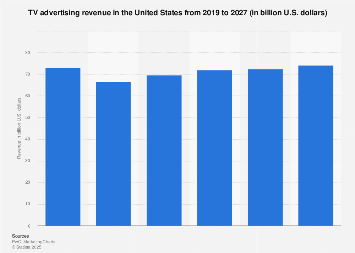
TV advertising revenue in the U.S. 2027| Statista
The projection was that TV ad revenue in the United States would increase from 72.4 billion U.S. dollars in 2023 to 74.1 billion by 2027.
 www.statista.com
... and well over $10 billion in radio advertising this year.
Polls generally ask only a couple of questions and they ask them to everyone.Another reason to wonder if ratings really matter. Checking out last season's ratings, with the exception of NFL games all shows rated 2.0 or lower! Since even the best opinion polls give you a 2% margin of error, virtually every show on TV has a rounding error for a rating.
Ratings measure the use of over a thousand TV shows each week, so the ones that are viewed by very few people have a larger margin of error than the ones a large percentage watch.
A cooking show on a cable channel will have fewer viewers than the Super Bowl. The rating for the football game is going to be nearly without any error. But the tiny cooking show number could be off, in rating points, by factors approaching 50% or more.
Buyers know this. That's why they buy many different channels and shows and dayparts. The error levels out, and ratings are accurate enough so that other things like how good the creative is and how attractive the product is are vastly more important. And, of course, many buys are made to match the "fit" of a show with the product being advertised.
What is the ratio 1000 to 1. Each Neilson household equals 1000 TV's. And those are only counting 1 TV. per house. So are they counting a family of 5 each watching something different?Accurate enough for advertisers to use them as a measurement for over $70 billion dollars in TV advertising...
TV advertising revenue in the U.S. 2027| Statista
The projection was that TV ad revenue in the United States would increase from 72.4 billion U.S. dollars in 2023 to 74.1 billion by 2027.
... and well over $10 billion in radio advertising this year.
Yes. In the diary markets, they send a book for each TV set in the household. I'm not certain what the mechanism is in the metered markets, but they account for each TV and household member.So are they counting a family of 5 each watching something different?
While Nielsen isn't perfect, they aren't morons.
How many Neilson households are there per market. Let's say per town in each market.Yes. In the diary markets, they send a book for each TV set in the household. I'm not certain what the mechanism is in the metered markets, but they account for each TV and household member.
While Nielsen isn't perfect, they aren't morons.
- Status
- This thread has been closed due to inactivity. You can create a new thread to discuss this topic.