• Get involved.
    We want your input!
    Apply for Membership and join the conversations about everything related to broadcasting.

    After we receive your registration, a moderator will review it. After your registration is approved, you will be permitted to post.
    If you use a disposable or false email address, your registration will be rejected.

    After your membership is approved, please take a minute to tell us a little bit about yourself.
    https://www.radiodiscussions.com/forums/introduce-yourself.1088/

    Thanks in advance and have fun!
    RadioDiscussions Administrators

Dec Trends 2022

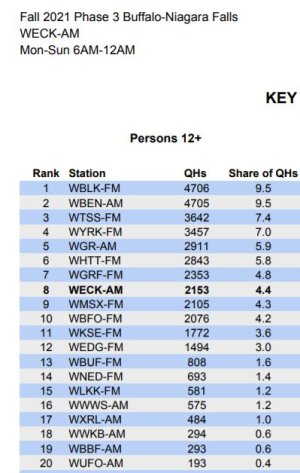
David, you always seem to be the level headed one who can explain things well when it comes to ratings. I just received these AQH ratings an hourago


David, I just received these AQH Ratings an hour ago from Dec . Can you please explain why these never look this way when the actual ratings come out in a few days?


Capture.JPG
 
David, you always seem to be the level headed one who can explain things well when it comes to ratings. I just received these AQH ratings an hourago


David, I just received these AQH Ratings an hour ago from Dec . Can you please explain why these never look this way when the actual ratings come out in a few days?


View attachment 2484
I believe he has answered you before. If you posted the "Unweighted" numbers, that will explain the difference.

WBUF and WLKK are really quite pathetic. Time for a Fire Sale on those signals...
 
Let's try to keep this simple. Let's say you have the following five age groups that you want to know listening habits for. Each group represents 20% of the audience. Ideally, you get 20 people to represent each age group. No those are not the actual numbers. Hopefully it might be 200 people for each age group. 20 samples is just to make it easy to understand:

12-24 20
25-34 20
35-44 20
45-54 20
55-64 20
100 = 100% of the audience

You send out a bunch of diaries knowing that not all of them will be returned, or that the members of households you send books to may have several age groups represented. The number of books returned from your sample audience look like this:

12-24 15
25-34 17
35-44 18
45-54 22
55-64 28
100 = 100% of the audience

As you can see, some of the age groups are under-represented. Some of the age groups are over-represented. So you take the actual number of books returned and weight them numerically to reach the target percentage. In other words:

For 12-24, 15 books need to represent 20% of the audience.
For 25-34, 16 books need to represent 20% of the audience.
For 35-44, 18 books need to represent 20% of the audience.
For 45-54, 22 books need to represent 20% of the audience.
For 55-64, 28 books need to represent 20% of the audience.

More older people returned books, skewing the ratings for all of the stations. When you weight the actual number of books returned for each audience group to achieve the correct percentage you get a more accurate representation of actual listening. That's why the raw numbers look different. The 12+ numbers are weighted to correct for differences between the number of diaries returned in an age group and the percentage of people they represent.

How do they weight books? Let's take the 55-64 age group. 28 diaries are returned. They represent 20% of the audience, so:

28X=20%
X=20%/28
X=0.714%
The results of each book are multiplied by 0.714%. Each book counts but weighting adjusts the results to represent the actual audience.

For the 12-24 age group you only have 15 books returned. They also represent 20% of the audience:

15x=20%
X=20%/15
X=1.333%
The results of each book are multiplied by 1.333% in order to correctly represent the audience.

This is a very simplified version intended to represent a small part of how ratings are calculated. The 12+ numbers, even correctly weighted, are nearly meaningless for sales purposes. That's why they're publicly available. Raw, unweighted numbers are even more meaningless for sales purposes, which is why they're not publicly available.
 
They have not been meaningless for me and my staff! We have more local agency buys than ever because of the ratings. So when you say they are meaningless for sales purposes, that is not correct at all. Advertisers, especially agencies use them heavily.

I was told that these numbers represent the hours people listen in a 15 min span.

I like your analogy. It is helpful, but you prefaced it by saying "Ideally" things would look this way, which to me says there is no exact science.

Ratings when published come out as average quarter hour share. That is what we are looking at in this illustration.

You are saying that because older people return diaries more, we get punished.

But isn't that unfair to us? We can't control how many people feel like filling these things out.

So basically, ratings are out of our control.

Why should BLK get weighted more and WECK get weighted less? It should be, whoever sends them in, sends them in.

BLK is getting all of these quarter hours because Nielson "Thinks", not Knows, that they were under sampled

What a great system.

All I know is WECK is always #9-#6 in these quarter hour ratings, with as high as a 5.7 share not long ago, but when the actual ratings come out, we get boned with these 3.2 , 3.3, 3.8 numbers.
 
You are saying that because older people return diaries more, we get punished.
Not at all.

Example. If 25% of the population is over 55, and there are 1000 diaries, they should get back 250 diaries from those over 55. But if they get 500, they have double what they should have to fairly represent that age group. So each diary is weighted by 0.5. And if the 24-54 diaries under represent the actual population, they weigh them up to make the group representative.
But isn't that unfair to us? We can't control how many people feel like filling these things out.
Nor can Nielsen down to the exact percentages. So the sample is balance by age, gender, income, ethnicity, etc. using weighting.
So basically, ratings are out of our control.
No, they are perfectly controlled given the actual sample size.
Why should BLK get weighted more and WECK get weighted less? It should be, whoever sends them in, sends them in.
Stations are not weighted. Demographic cells are. That makes the sample match, mathematically, the precise population of the market.
BLK is getting all of these quarter hours because Nielson "Thinks", not Knows, that they were under sampled
Again, WBLK was neither under nor over sampled. But if the age group that listens to that station was undersampled, they weigh it up to achieve perfect balance.
What a great system.
It is. There is no better system to measure a small group and project it into a larger one.
All I know is WECK is always #9-#6 in these quarter hour ratings, with as high as a 5.7 share not long ago, but when the actual ratings come out, we get boned with these 3.2 , 3.3, 3.8 numbers.
Weighted vs. unweighted. The unweighted sample is obviously to high in your target age group, so it it is weighted down to make it match the percentage of actual population.

Sir Roxalot gave you a perfect example of how it is done. That makes the sample match the population.
 
Let's try to keep this simple. Let's say you have the following five age groups that you want to know listening habits for. Each group represents 20% of the audience. Ideally, you get 20 people to represent each age group. No those are not the actual numbers. Hopefully it might be 200 people for each age group. 20 samples is just to make it easy to understand:

12-24 20
25-34 20
35-44 20
45-54 20
55-64 20
100 = 100% of the audience

You send out a bunch of diaries knowing that not all of them will be returned, or that the members of households you send books to may have several age groups represented. The number of books returned from your sample audience look like this:

12-24 15
25-34 17
35-44 18
45-54 22
55-64 28
100 = 100% of the audience

As you can see, some of the age groups are under-represented. Some of the age groups are over-represented. So you take the actual number of books returned and weight them numerically to reach the target percentage. In other words:

For 12-24, 15 books need to represent 20% of the audience.
For 25-34, 16 books need to represent 20% of the audience.
For 35-44, 18 books need to represent 20% of the audience.
For 45-54, 22 books need to represent 20% of the audience.
For 55-64, 28 books need to represent 20% of the audience.

More older people returned books, skewing the ratings for all of the stations. When you weight the actual number of books returned for each audience group to achieve the correct percentage you get a more accurate representation of actual listening. That's why the raw numbers look different. The 12+ numbers are weighted to correct for differences between the number of diaries returned in an age group and the percentage of people they represent.
The five age groups you used (at 20 percent) each, left out the 64 + crowd. They may be dead to ad agencies, but many 64-90 year olds probably use Radio. WECK's audience certainly must be heavily 64+. I would wager that more than half of WECK's audience is over 64.

You just needed to expand the age range in your 5 groups. Nielsen is not trying to cheat WECK as Buddy suggested. His station just has a lot of older listeners...
 
Last edited:
The five age groups you used (at 20 percent) each, left out the 64 + crowd. They may be dead to ad agencies, but many 64-90 year olds probably use Radio. WECK's audience certainly must be heavily 64+. I would wager that more than half of WECK's audience is over 64.

You just needed to expand the age range in your 5 groups. Nielsen is not trying to cheat WECK as Buddy suggested. His station just has a lot of older listeners...
Did you read the first paragraph of the post? The illustration was meant to make it easy to understand the methodology, not as a representation of actual demographics or numbers. The actual demographics are a lot more complex. For illustration purposes I chose 5 groups because 100% is easy to divide by 5. Or 4. 6? Not so much.

Buddy still seems to miss the point that diaries represent actual people listening, but diary returns are variable. The part of the ratings methodology that's "flawed" is that the number of diaries returned to represent a very specific demographic can be so small that the results can be skewed badly. If there are only 5 diaries from 12-24 females and two of them write down that they listen to Kiss 12 hours per day the results will be good for Kiss, but not so accurate. Ditto if 5 people over 65 write down that they "listen" to WECK 16 hours a day - virtually every waking moment wherever they are. Are they really listening? Or is it just on in the background. Numbers like that are why background music stations often do well in the ratings but results for advertisers aren't as good as response to stations that generate more "listening" than "hearing."

Agencies generally don't buy 12+, and they do understand the difference between raw numbers and weighted numbers. If you're trying to sell the raw numbers to clients, you're doing them a disservice because they're simply not an accurate representation of the listening audience.
 
Are they really listening? Or is it just on in the background. Numbers like that are why background music stations often do well in the ratings but results for advertisers aren't as good as response to stations that generate more "listening" than "hearing."

So why do "listen at work" stations bill as well as they do? Seems to me that everyone in the office is merely "hearing" those stations, paying attention where it needs to be paid: their work. Oldies stations like WECK have a disproportionate number of retirees in their audiences. They're interested in the music and the personalities who present it, but advertisers don't buy geezer radio. So what music formats that appeal to more advertiser-friendly demographics have listeners like that?
 
So why do "listen at work" stations bill as well as they do? Seems to me that everyone in the office is merely "hearing" those stations, paying attention where it needs to be paid: their work.
People's attention comes and goes. But if a listener is really exposed to the station 30+ hours per week, chances they will "hear" some of the advertising is very high.
 
So why do "listen at work" stations bill as well as they do? Seems to me that everyone in the office is merely "hearing" those stations, paying attention where it needs to be paid: their work. Oldies stations like WECK have a disproportionate number of retirees in their audiences. They're interested in the music and the personalities who present it, but advertisers don't buy geezer radio. So what music formats that appeal to more advertiser-friendly demographics have listeners like that?
Very few. The product is so generic that nobody cares. Unique formats could be attempted, but that requires expertise and effort.

The Pandemic has changed the game. More people working at home means no commute. That means less listening during morning and afternoon "Drive". If people aren't driving to work, they're not using the radio. They might just have the TV on if they're working from home now.

The "at work" stations only bill well if they are Top 3 in their demos. They get the agency buys. Whether the client gets any return on the investment is another matter. As you said, older retired listeners have leisure time. They may actually "hear" the message instead of just background noise. WECK has filled one niche ignored by the Corporate groups. They have managed to find clients who will buy "Geezer Radio"...
 
Snapshot, nothing more than one person's one-time recent experience. The scene is a doctor's office waiting room. Because of Covid-19 protocols, individuals in the waiting room are properly socially distanced. Five people sit, masked, waiting to be called. The youngest is about 30, the oldest is 65+. There is a small well cared for, countertop radio in the waiting room. It is tuned to The Breeze, just audible and not intrusive. Each of the four individuals waiting to see his/her doctor has a smart phone in hand, eyes on the screen and they read and scroll, seemingly oblivious to the radio.
 
You are saying that because older people return diaries more, we get punished.

Here's an analogy you might like. Back in the 90s, George Jones complained that radio wasn't playing him. The fact was they WERE, but not to the degree as other younger artists in the chart. But the question is: Why does a member of the Hall of Fame need to compete against artists half his age? It makes no sense.

You should be looking at the data you're getting about your audience. That's what John Sebastian is doing in Phoenix. Who cares how you're ranking compared to other stations. They're not playing in your lane. What matters to you is how you're reaching your target. You have something they can never get, which is loyal listeners. Here's what Sebastian posted on his Facebook:

December Nielsen Monthly
Wow Factor best results ever!
55+ #2 Music Station All Week 2nd only to KESZ (Christmas music)
55+ #1 Music Station AM Drive!
55+ #2 Music Station Middays
55+ #2 Music Station PM Drive
55+ #1 All Stations All Weekend!
6+ 4.2 Share Best ever All Week (#3 Music Station 6+!!!)
Weekly Time Spent Listening #1 Music Station 6+ and 55+!
Congrats to the WOW team and everyone at Desert Valley Media Group.
 
Snapshot, nothing more than one person's one-time recent experience. The scene is a doctor's office waiting room. Because of Covid-19 protocols, individuals in the waiting room are properly socially distanced. Five people sit, masked, waiting to be called. The youngest is about 30, the oldest is 65+. There is a small well cared for, countertop radio in the waiting room. It is tuned to The Breeze, just audible and not intrusive. Each of the four individuals waiting to see his/her doctor has a smart phone in hand, eyes on the screen and they read and scroll, seemingly oblivious to the radio.
My one person experience . I was at Santeserios restaurant in Buffalo, and WECK was blaring. Another one person experience. I went to Fed Ex on Cayuga, WECK was blaring. I have never been in an office or anywhere that was playing the Breeze. Just my experience. I got stopped by a cop in Lancaster for speeding. Guess what he told me to come to his squad car to see what was on....The Big WECK. He was about 40. Loves it. Local matters.
 
They get the agency buys
They get buys if they are efficiently priced. How the **** do you think you know anything about radio sales? You don't know. I do. I see it every day. I was a top-biller at ETM. I am the only ****ing radio company in Buffalo making profit and growing.

Get out of the god damn 80's. the 25-54 "sweet spot" no longer exists. It's gone. Take it from me dude. It's gone. What ****ing 25 year old likes radio??

Get your sales knowledge straight
 
When these "books" are published, is the raw data made available? If not, why not?
Ratings data, other than the worthless 12+ (or 6+ in PPM markets) is only released to subscribers.

There is Nielsen software that allows data to be deeply analyzed by subscribers. Because diarykeepers and metered households are confidential, raw data at the respondent level is not available although one can see a great deal of respondent level granular data but it does not reveal the respondents specifically.
 
Get out of the god damn 80's. the 25-54 "sweet spot" no longer exists. It's gone. Take it from me dude. It's gone. What ****ing 25 year old likes radio??
25-year-olds may not be as passionate about radio as they were decades ago when there were fewer choices, but a huge percentage of them use radio regularly. No, not as much time as they spent with radio before... but they do listen or hear radio.
 
Ratings data, other than the worthless 12+ (or 6+ in PPM markets) is only released to subscribers.

There is Nielsen software that allows data to be deeply analyzed by subscribers. Because diarykeepers and metered households are confidential, raw data at the respondent level is not available although one can see a great deal of respondent level granular data but it does not reveal the respondents specifically.
Thank you. I was not wondering about "public" disclosure of raw data, nor anything relevant to personal privacy. Simply, the raw data itself. For example... Responded #1: demographics, reported listening, whatever else is available... Respondent #2... Respondent #3... etc. No names or legal addresses, etc... but possibly census block/tract or at least zip code. I'd be highly suspect of any so-called "scientific" or "scientific-like" report that did not make raw data available to those that utilize the report.
 
Thank you. I was not wondering about "public" disclosure of raw data, nor anything relevant to personal privacy. Simply, the raw data itself. For example... Responded #1: demographics, reported listening, whatever else is available... Respondent #2... Respondent #3... etc. No names or legal addresses, etc... but possibly census block/tract or at least zip code. I'd be highly suspect of any so-called "scientific" or "scientific-like" report that did not make raw data available to those that utilize the report.
In the Buffalo market diaries are used. Going back over 50 years you could see the actual diaries after a survey was over. At some point in the 90's the diaries were digitized and viewable on monitors.

Of course, any such review is limited to subscribers and is supervised.

So yes, one can look at the diaries themselves. Generally, the purpose is to get a handle on listener behaviour, how they share stations, etc. Review can also be used to make sure proper crediting is done and to see if any errors might have been made. If there are errors that affect a station's rank, they will reissue. I got 5 different books reissued through that review process over a period of about 15 years.

Prior to seeing the diaries on a screen, we had to go through the actual diaries manually. I did the first review in 1969 and it was very tedious, taking as much as a whole day for one station in one market. Later, with the computers, I could do multiple stations in multiple markets in a single day.
 
Status
This thread has been closed due to inactivity. You can create a new thread to discuss this topic.


Back
Top Bottom