
-
Get involved.
We want your input!
Apply for Membership and join the conversations about everything related to broadcasting.
After we receive your registration, a moderator will review it. After your registration is approved, you will be permitted to post.
If you use a disposable or false email address, your registration will be rejected.
After your membership is approved, please take a minute to tell us a little bit about yourself.
https://www.radiodiscussions.com/forums/introduce-yourself.1088/
Thanks in advance and have fun!
RadioDiscussions Administrators
You are using an out of date browser. It may not display this or other websites correctly.
You should upgrade or use an alternative browser.
You should upgrade or use an alternative browser.
890 WLS "clear channel" ??
- Thread starter Dondd
- Start date

In the 60s, WLS was the #1 night-time station for young people in northern and central Mississippi, WLS DJ Art Roberts even appeared at a Mississippi State Univ concert, think it was the Beach Boys... while he was there, Art appeared at the local station WSSO! In the winter, you could sometimes pick up the WLS morning show...
That sounds like it would've been a fun event.In the 60s, WLS was the #1 night-time station for young people in northern and central Mississippi, WLS DJ Art Roberts even appeared at a Mississippi State Univ concert, think it was the Beach Boys... while he was there, Art appeared at the local station WSSO! In the winter, you could sometimes pick up the WLS morning show...
The Mighty 890... MusicRadio...
Really, they only care about their signal in Chicago.How far are you from their coverage area?
I'm in their (optimistically predicted) nighttime propagation area.How far are you from their coverage area?
See how I avoided saying "coverage area?"

But looking at their nighttime map, the stations in or near their frequency, plus southern interference, makes the station's signal blow
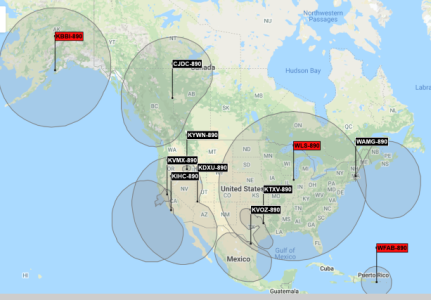
Last edited:

Not really a valid comparison. The local Chicago market is covered by groundwave, and night skywave is of absolutely no concern to the station. It's been about a half-century since skywave listening could be monetized by WLS, and even then it was mostly income from artist tours and movie openings in rural areas. That all went away as music listening went to FM in the 70's.It's not just "DXers" to which better distant reception would matter. If WLS were getting out to Nebraska, it might be a sign that it's getting out better in its target territory also, i.e. Chicagoland, which I'm sure is replete with switching power devices and other RFI, and probably every extra db is needed to overcome all that.
For that kind of AM, there are two coverage areas... the groundwave coverage zone, which is where you can hear it reliably 24 hours a day. the other is the skywave area, which is beyond the local groundwave coverage area.How far are you from their coverage area?
I think as David has been telling me, you need at least 15 mV/m to overcome the most strenuous RFI devices (in my town, the worst offender has to be the all electric car-wash), so any extra strength can be helpful. I suspect that in order to cut through interference, the AM station has to be strong enough to penetrate a telephone or cause the fence to arc, as opposed to just being clear.
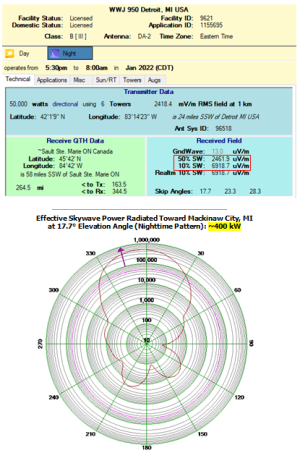
The graphic below shows the nighttime, 1-hop, skywave fields arriving at Mackinaw City, MI from WWJ in Detroit, which radiates 400 kW toward the ionosphere at the skip angle reaching that location.
The fields received there are outlined by the red rectangle in the graphic, and are significantly less than 15 mV/m.
(Observation) If it takes 15 mV/m to overcome modern-day, local r-f noise issues then there would be very few stations that ever could produce a useful, nighttime skywave. Yet it isn't too hard to listen to nighttime skywaves from a lot of the "Clear Channel" and other frequencies radiating a lot less skywave power than in this WWJ example.

Along with electrical interference, incoming skywave is the most common impairment to local reception of AM stations.
The advantage of a Class A (commonly referred to as a clear channel) AM station is local nighttime groundwave coverage that is generally free of incoming skywave interference. Thus, Class A AM stations have clearer nighttime coverage over the Metro market, compared to nearly all other AM stations.
The advantage of a Class A (commonly referred to as a clear channel) AM station is local nighttime groundwave coverage that is generally free of incoming skywave interference. Thus, Class A AM stations have clearer nighttime coverage over the Metro market, compared to nearly all other AM stations.
Last edited:
I can tell you for a fact that WWJ has a listenable Night skywave near Mackinaw City. Though many Nights there is noticeable interference from WNTD 950 5 kW Night from a six tower inline end fire array in the South Chicago area. WWJ is better with a ferrite rod or loop where you can reduce or eliminate interference from WNTD. WLS 890 50 kW Nondirectional is quite a bit weaker than WWJ, but is interference free for the most part. WLS has a 190 degree tower which makes it a little weaker at relatively close distances with higher propagation angles. WWJ has 168 and 138 degree towers (different heights to protect WNTD at higher propagation angles while allowing slightly more 0 degree elevation ground wave).
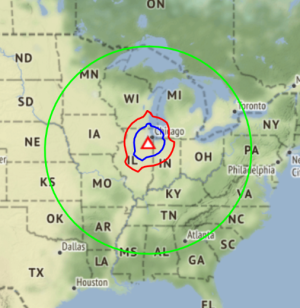
The FCC changed their skywave model circa 1992, and clear channel skywave don't get out that often quoted 750 miles, and the famous but inexplicable 38 state claim. Here is what the FCC 50% newer skywave model is for WLS. Zoom out for the skywave contour.
The FCC changed their skywave model circa 1992, and clear channel skywave don't get out that often quoted 750 miles, and the famous but inexplicable 38 state claim. Here is what the FCC 50% newer skywave model is for WLS. Zoom out for the skywave contour.
Last edited:
The biggest issue with WLS' signal is that it isn't very strong in Lake or McHenry Counties or Kenosha Co., WI (also in the Chicago radio market). In parts of Lake County, WISN (Milwaukee) actually has a stronger daytime signal. And, at night, WLS's signal can be subject to groundwave/skywave cancellation sometimes. None of the other big Chicago AMs suffer these maladies within their own market. Even WIND has a more stable signal at 5,000 watts from somewhere near NW Indiana.
The others are strong locally, though WBBM isn't quite as good as it was before they moved the transmitter (but that's a subject for a different thread).
The others are strong locally, though WBBM isn't quite as good as it was before they moved the transmitter (but that's a subject for a different thread).
Jean Shepherd got a very good signal from WIND 560 on Cleveland St., the real Cleveland St., from the WIND towers in Griffith, IN.
Not really a valid comparison. The local Chicago market is covered by groundwave, and night skywave is of absolutely no concern to the station. It's been about a half-century since skywave listening could be monetized by WLS, and even then it was mostly income from artist tours and movie openings in rural areas. That all went away as music listening went to FM in the 70's.
WLS night commercials during the 60s-mid 70s, included the famous ad: "Sunday, Sunday, Sunday" drag races at "Smokin" U.S. 30 Dragstrip. Another big one, the spots for Mr. Norm's Grand Spaulding Dodge and Karoll's Red Hanger Shops. Those were huge.
Since WLS was a ABC Network station, they played many cool network spots, including Coca Cola ads sung by The Supremes, Beechnut Fruit Strip Gum, Double Mint Gum, Heaven Scent Fragrance. These were heavy on the jingles and youthfulness, which made a difference...
DJ Kris Eric Stevens went to some of his appearances, traveling on a private plane, due to the distances.
I guess Kris could have been the inspiration for both Chris Stevens and Maurice Minnefield on Northern Exposure then. Chris Stevens was the DJ, Maurice was the owner of KBHR. Kris owned stations in Ishpeming Marquette, where he started his career. Come to think of it, the Upper Peninsula is the Contiguous United States' closest thing to Alaska!DJ Kris Eric Stevens went to some of his appearances, traveling on a private plane, due to the distances.
Last edited:
I don't think most of those national accounts came from the network. They were market-by-market spot buys as we heard the same ads on local CHR stations like WOKY, KOIL, KIOA, WIFE, WILS, WJBK, WHK, WIXY and many, many others that were not ABC owned.Since WLS was a ABC Network station, they played many cool network spots, including Coca Cola ads sung by The Supremes, Beechnut Fruit Strip Gum, Double Mint Gum, Heaven Scent Fragrance. These were heavy on the jingles and youthfulness, which made a difference...
Hey DavidEduardo! I was thinking many were ABC network spots, because I was a DJ then, and we played those same spots on the ABC Radio Contemporary network in my hometown. WLS was great wasn't it?

WLS also ran ads for Pug Vickers Honda (motorcycles) in Huntingdon, TN, which would have been close to 500 miles away, but they had a huge audience in West TN at night after WHBQ in Memphis turned down their power. He claimed to be the world's largest Honda dealer, but it was because of his weight.WLS night commercials during the 60s-mid 70s, included the famous ad: "Sunday, Sunday, Sunday" drag races at "Smokin" U.S. 30 Dragstrip. Another big one, the spots for Mr. Norm's Grand Spaulding Dodge and Karoll's Red Hanger Shops. Those were huge.
Kris Erik Stevens was known as Billy Mack overnights on CKLWI guess Kris could have been the inspiration for both Chris Stevens and Maurice Minnefield on Northern Exposure then. Chris Stevens was the DJ, Maurice was the owner of KBHR. Kris owned stations in Ishpeming Marquette, where he started his career. Come to think of it, the Upper Peninsula is the Contiguous United States' closest thing to Alaska!
You are right that some of the spots could be network buys or "combo" network and O&O buys, now that I think about it.Hey DavidEduardo! I was thinking many were ABC network spots, because I was a DJ then, and we played those same spots on the ABC Radio Contemporary network in my hometown. WLS was great wasn't it?
But in that era, there were lots of national brands doing wide radio campaigns. So I suspect a lot of the WLS business was direct non-network stuff.
The problem is that anyone in sales or station management from WLS in the 60's would be in their late 80's or beyond now, so it may be hard to really know which was what.
- Status
- This thread has been closed due to inactivity. You can create a new thread to discuss this topic.