
• Get involved.
    We want your input!
    Apply for Membership and join the conversations about everything related to broadcasting.

    After we receive your registration, a moderator will review it. After your registration is approved, you will be permitted to post.
    If you use a disposable or false email address, your registration will be rejected.

    After your membership is approved, please take a minute to tell us a little bit about yourself.
    https://www.radiodiscussions.com/forums/introduce-yourself.1088/

    Thanks in advance and have fun!
    RadioDiscussions Administrators

KSKO 89.5 McGrath, Alaska Pictures

I realized I've worked at KSKO over a year and never shared pictures on this site, just over on Facebook so I've gathered up the best. I figured some of you esteemed engineers would like to see radio happening just east of the edge of gods creation nowhere alaska. I'm damn proud of the 40 year long legacy of service the station provides, what my predecessors have been able to get done and the stuff I get to do here.

Is our set up perfect? Nope. But when you're 250 miles off the road system, have no engineer local/full/part time, you do what you gotta do. I'll gladly answer any questions about the station or rural Alaska living anyone might have.

My morning and midday host is our village mayor, I'm the program director doing mon to Wed afternoon and Friday evenings. I have a volunteer who does Thu & Fri afternoons. (Shes also a licensed ham, pilot, airplane mechanic, EMT and substitute teacher)


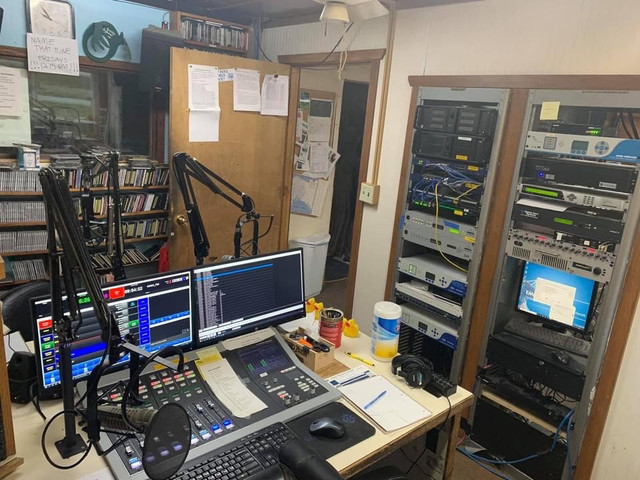
KSKO Studio ImediaTouch automation, Wheatstone E1 console.
Left Rack, from top to bottom:
IMT computers
Netgear switches
Wheatstone blade stuff
old NPR PRSS gray satellite recievers, no longer in use but they power the LNB on the massive mother trucker dish
NPR XDS with one on cold standby. WE only need one, but NPR shipped two.. one is left racked but unplugged with no internet so if one goes bad, we can in 5 minutes power it up, switch over programming and be back to normal. Shipping here takes a minimum of a week.
Barix box bringing in a feed from a Fairbanks station

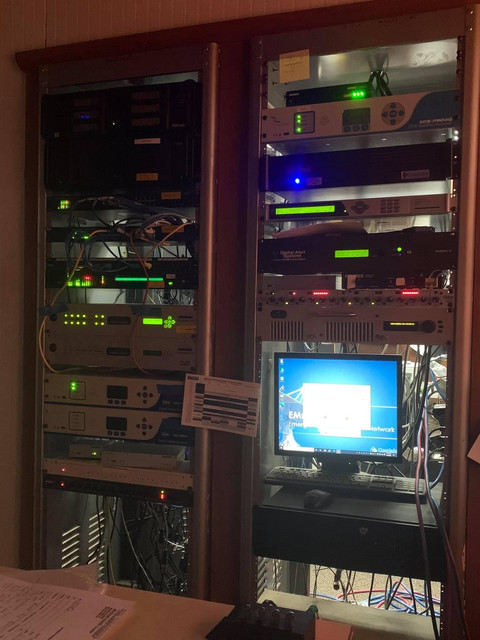
Right rack from top to bottom
Comrex briclink which feeds our webstream which in turn feeds the 6 or so repeaters we have (thats what we call them, they arent translators, but Class D FM non Comms)
Not in use, but should be XDS for AK Pub. Radio feeds.
EAS Emnet box (monitors via satellite)
AK Pub Radio scientific atlanta reciever for news and program feeds.
EAS
BW TX V2 set at 180 Watts TPO for 90 watts ERP

Our ISP is Exede satellite. Works better than you think. Oneweb and Starlink arent available here yet.


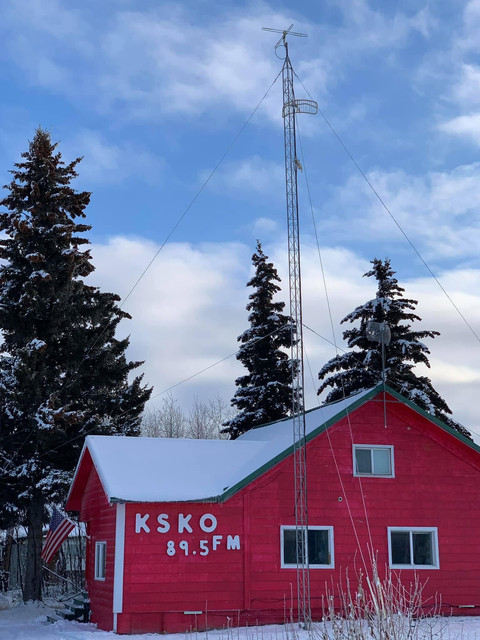
KSKO Broadcast Tower Scala FMO turnstile at the top producing 90 watts ERP. The dish just below it is the old STL for now deleted and completely dismantled KSKO 870. The yagi below that is the old KSKO 870 transmitter to studio telemetry link. KSKO 870 was all generate powered, costing upwards of $60,000+ a year just for gas not taking into account generator maintenance costs.


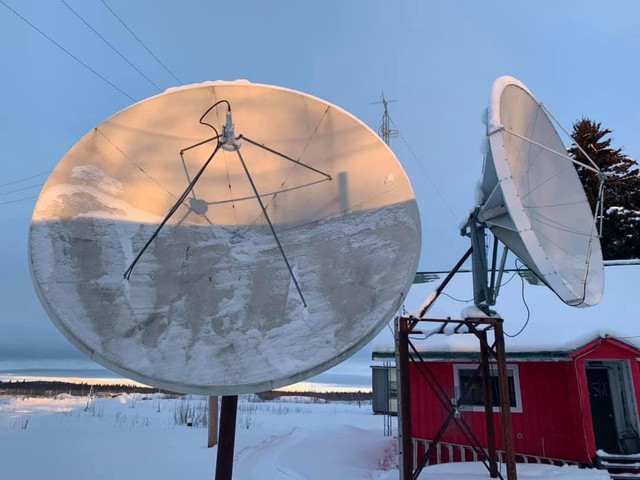
KSKO Satellite dishes THe one facing the camera is for AK Public Radio live feeds, the much bigger and higher up one is a direct NPR feed. You'd think they wouldnt accumulate snow because of the look angle, but they do.. I found out the hard way when I had NO audio at 5pm one day last winter from the statewide 30 minute public radio newscast. Go outside, the dish is caked top to bottom in snow. I brush it off wityh a snow rake, reboot the Scientific atlanta and were good to go.
 
This is wonderful stuff - thank you for posting. I love seeing and hearing about radio stations, especially community stations, in exotic parts of the world. You should send these with a little write up to Radio Survivor, I'm sure they'd love to feature them.
 
This is wonderful stuff - thank you for posting. I love seeing and hearing about radio stations, especially community stations, in exotic parts of the world. You should send these with a little write up to Radio Survivor, I'm sure they'd love to feature them.


We stream www.kskopublicradio.com

Local shows are on 8-9am and 12noon to 4pm weekdays, 7 to 9pm friday. We're one hour behind pacific.
 
This is wonderful stuff - thank you for posting. I love seeing and hearing about radio stations, especially community stations, in exotic parts of the world. You should send these with a little write up to Radio Survivor, I'm sure they'd love to feature them.


FYI, I contacted Radio Survivor.. never heard from them but thats ok.. just plugging away in my little corner of the world, @Miss Tuned
 
I applaud your grassroots efforts. But given the station's limited reach, considering how little population density in Alaska, combined with escalating programming costs from NPR, PRX, etc., how does a little station like that get enough donations to stay afloat. CPB grants have become fewer and further between since the Trump administration too.
 
I applaud your grassroots efforts. But given the station's limited reach, considering how little population density in Alaska, combined with escalating programming costs from NPR, PRX, etc., how does a little station like that get enough donations to stay afloat. CPB grants have become fewer and further between since the Trump administration too.

Grants and funding from outside sources other than our listeners and business members
 
Interesting. Must be a lot of time looking-for and writing grant proposals!

We get CPB grants every year... we get some state funding every year (Alaska state government gives some money to public radio) and we get some businesses signing up to be members. (businesses memberships are more hefty than personal/family memberships)
 
We get CPB grants every year... we get some state funding every year (Alaska state government gives some money to public radio) and we get some businesses signing up to be members. (businesses memberships are more hefty than personal/family memberships)
Are those considered true Underwriting Credits? Or just individual program sponsorships?
 
Are those considered true Underwriting Credits? Or just individual program sponsorships?

The business members get to pick, we have different options, they can sponsor a particular program.. but they all elect for general recognition on the air.. with one exception for a sponsor for weather
 
Our licenses were renewed, as expected.. but yay

We have two new repeaters on the air.

They arent translators... but Class D non comms and could actually but dont.. originate their own programming

If you combine KRFF 89.1 Fairbanks which carries us 2 hours a day and unrelated KZPA 900 which simulcasts us for 12 to 16 hours a day, we have a service area of about 600 miles.
 
Our licenses were renewed, as expected.. but yay

We have two new repeaters on the air.

They arent translators... but Class D non comms and could actually but dont.. originate their own programming

If you combine KRFF 89.1 Fairbanks which carries us 2 hours a day and unrelated KZPA 900 which simulcasts us for 12 to 16 hours a day, we have a service area of about 600 miles.
What's the calculated population count within that 600 (square) miles? And what contour(s) are you using to determine that service area?
 
What's the calculated population count within that 600 (square) miles? And what contour(s) are you using to determine that service area?

If you dont take into account the FM in Fairbanks that carries us for 2 hours a day and KZPA fort Yukon, our population covered is about 1200 people in our immediate local service area of KSKO owned and operated repeaters

If you take into account the FM in Fairbanks and KZPA, that jumps up to 40-50,000 depending on the numbers in the fairbanks metro.

and how do i determine 600 miles? the approximate end to end service area of KSKO's owned/operated repeaters plus what i estimate the KZPA skywave to be based upon what they and other alaska ams can do that ive personally witnessed and how far away i know some legitimate KZPA's listeners are

It's all an approximation/guess on my part for discussion purposes
 

@Kelly A .. KSKO and its owned repeaters cover about 200 or so miles. KRFF covers a good 100 or so miles between their main and repeaters and KZPA covers about 300 miles or so, especially at night
 
KSKO and its owned repeaters cover about 200 or so miles. KRFF covers a good 100 or so miles between their main and repeaters and KZPA covers about 300 miles or so, especially at night
Understood. I'm somewhat familiar with the state, and was just trying to visualize the practical coverage area in population, excluding what could be considered rounding numbers like shared airtime. Given the long distances between villages; translators and satellite stations are pretty common. The population of McGrath is about 400 people. Terrain and distance obviously blocks your station to 'nearby' villages like Nikolai at 94 and Takona at 52 people. Both are a long way from McGrath, and isn't there a long stretch of hundreds of crow-flies miles of tundra between McGrath and Fairbanks? Besides that, KUAC is the NPR affiliate in Fairbanks, so how does a much smaller station hundreds of miles away compete?
 
Understood. I'm somewhat familiar with the state, and was just trying to visualize the practical coverage area in population, excluding what could be considered rounding numbers like shared airtime. Given the long distances between villages; translators and satellite stations are pretty common. The population of McGrath is about 400 people. Terrain and distance obviously blocks your station to 'nearby' villages like Nikolai at 94 and Takona at 52 people. Both are a long way from McGrath, and isn't there a long stretch of hundreds of crow-flies miles of tundra between McGrath and Fairbanks? Besides that, KUAC is the NPR affiliate in Fairbanks, so how does a much smaller station hundreds of miles away compete?
KSKO with 90 watts at 60 feet off the ground can actually kinda be heard in Takotna 15 miles away.. line of sight.


We have a repeater in nikolai so theres no issue there. We have...like 7 repeaters

WE dont compete with KUAC.. the station that runs us 2 hours a day is a native owned station and carries us during 2 of the 5 hours a day of local programming we do.
 
KSKO with 90 watts at 60 feet off the ground can actually kinda be heard in Takotna 15 miles away.. line of sight.


We have a repeater in nikolai so theres no issue there. We have...like 7 repeaters

WE dont compete with KUAC.. the station that runs us 2 hours a day is a native owned station and carries us during 2 of the 5 hours a day of local programming we do.
Either way, that's a tough road to hoe. I owned a commercial Class A FM in a documented population of 18,000. Even then, that pop count was considered tiny. With a pop count, downhill with a tail wind of less than 10,000? Good thing you rely on grants to survive!
I never had that option.
 
Either way, that's a tough road to hoe. I owned a commercial Class A FM in a documented population of 18,000. Even then, that pop count was considered tiny. With a pop count, downhill with a tail wind of less than 10,000? Good thing you rely on grants to survive!
I never had that option.

Weve been on the air since 1981.. originally in the 80s and 90s we had 5 or 6 full time staff./ in the 2000s it was down to 3.. and now its 1 1/2

We were originally 10kw full time on 870, but generator fuel at $60,000 plus a year alogn with maintenance costs got to be too much and we went fm
 
Status
This thread has been closed due to inactivity. You can create a new thread to discuss this topic.


Back
Top Bottom