• Get involved.
    We want your input!
    Apply for Membership and join the conversations about everything related to broadcasting.

    After we receive your registration, a moderator will review it. After your registration is approved, you will be permitted to post.
    If you use a disposable or false email address, your registration will be rejected.

    After your membership is approved, please take a minute to tell us a little bit about yourself.
    https://www.radiodiscussions.com/forums/introduce-yourself.1088/

    Thanks in advance and have fun!
    RadioDiscussions Administrators

Those with a "pirate past" directing existing LPFM stations

Michi

Moderator
Staff member

Let’s be up front on one issue before we continue, many years ago, REC issued a position statement about unlicensed operation of a broadcast station, commonly referred to as “pirate radio”. In that statement, we recognize that the pirate radio movement was one of the issues the FCC was dealing with that helped motivate the creation of the LPFM service and that many who “pirate” do so because they represent a voice that may have been not been able to be represented by licensed radio due to federal regulations. We also specifically stated that we do not condone radio piracy as transmission systems may not use equipment that is of sound engineering practice and due to the lack of coordination in spectrum use (which a license conveys), it could create harmful interference.

With that said, we are aware of the article in Inside Radio, which discusses KXPB-LP, Pacific Beach, Washington. This article discusses how one of the principals had discussed on a Seattle television show who admitted starting an unlicensed broadcast station. The article raised the question on how this person was able to be a party to an LPFM station despite their claimed pirate past.

First, some regulatory and legislative history. In the late 1990s after the passage of the Telecom Act, which deregulated national broadcast ownership, there was a considerable opposition to the legislation because it would allow corporations to come in and purchase radio stations in excess of the previous national ownership caps, thus taking away diversity and local control of broadcast stations in the commercial sector. Unlimited national ownership has always been permitted in the noncommercial sector. As a part of this protest, there was an upsurge in the number of pirate radio operators and some very vocal activists who had sworn to help establish thousands of pirate radio stations in an effort to help retain some kind of locally-controlled radio.

When the FCC was considering the LPFM service, one of the issues that the National Association of Broadcasters stated in their strong opposition to the service was that LPFM would legitimize pirate radio. To address these concerns, the FCC decided in the original Report and Order that in order for someone with a pirate past to be a party to an LPFM application, they must have either voluntarily ceased broadcasting no later than February 26, 1999 without any direction from the FCC or within 24 hours of direction from the FCC. (15 FCC Rcd 2205, 2225-2228 (2000)). This resulted in the original language of §73.854. On Reconsideration, the FCC modified the language so that if anyone was involved in unlicensed radio after February 26, 1999, they would be ineligible, regardless of whether or not they were informed by the FCC (15 FCC Rcd 19208, 19245 (2000)).

This was not good enough for the NAB, who lobbied Congress to pass Section 632 of the DC Appropriations Act, also known as the Radio Broadcast Preservation Act. In addition to the mandate of third-adjacent channel protection, the act also codified language to “prohibit any applicant from obtaining a low-power FM license if the applicant has engaged in any manner in the unlicensed operation of any station in violation of Section 301 of the Communications Act”. The RPBA was implemented by the FCC in the Second Report and Order (16 FCC Rcd. 8026, 8029 (2001)). In the case of Ruggiero v. FCC (317 F 3d. 239 (DC Cir. 2003)), the DC Circuit Court found no basis for sanctioning an automatic, lifetime ban on future lawful speech that applies indefensibly, to only a limited class of unlicensed microbroadcasters and to just the portion of the spectrum created for new voices. This decision would later be vacated by the DC Circuit Court. The RPBA pirate radio language would get carried over to the Local Community Radio Act.

In the 2019 LPFM Administrative Order, §73.854 would be amended to prohibit an LPFM original construction permit application that was dismissed for past piracy from being reinstated with the removal of the person who was engaged in unlicensed broadcasting (34 FCC Rcd. 12519, 12532-12534 (2019)).

The specific station in question filed their original construction permit application in June, 2001, after the Second Report and Order went into effect. At that time, the party of concern was not disclosed as a board member of the applicant, however another female with the same last name was. On LPFM original construction permit applications, a certification question that asks about unlicensed operation appears and the applicant certified back in 2001 that no party to the application had engaged in unlicensed operation. In 2013, the LPFM licensed was assigned to a different organization and in 2021, the license was reassigned back to the original licensee organization. In the 2021 assignment, the party in question was one of the four parties to the application. Unlike applications for original LPFM construction permits, assignment applications do not require the inclusion of a certification that no party to the application had ever engaged in unlicensed operations. We note that on assignment applications handled through REC, we normally do include this certification, even though the Commission has handled hundreds of assignment applications without it.

While we are not aware of any specific ruling from the FCC on this issue, our plain reading of the rule (§73.854) states that it applies only to “an application for an LPFM station”. The RBPA language reads that the law prevents “any applicant from obtaining a low-power FM license” if they have a pirate past. This raises the question of whether an assignment application is considered “an application for an LPFM station” or is considered as “obtaining a low-power FM license”. REC’s position on this is that it should. Likewise, should we also be considering this question every 8 years when a license comes up for renewal as a renewal application is “an application for an LPFM station” and getting a renewal is “obtaining (another) low-power FM license”, especially as board members with a pirate past may join the licensee’s organization.

Even during the original construction permit process, in order to demonstrate that a party had a pirate past, the burden on the Government and any objector is to depend on solid evidence of such operation. In 2013, there were two cases where the FCC denied an objection about an applicant’s pirate past. In Gospel Light Prayer Church, the FCC determined that a newspaper article about a pirate operation was not sufficient to show unlicensed operation. In East Coast Christian Center, a complaint that a Part 15 transmitter was heard past the church property was merely herarsay and there was no support for the objection.

However, in WKMJ Radio Live The People Station, Inc., the FCC had found a §73.854 violation because the party to the application was arrested under Florida’s pirate radio law. An FCC-issued Notice of Unlicensed Operation was also included in the record. In 2020, citing §73.854, the parties of Foundation for a Beautiful Life were advised that they must disclose their unlicensed operation of a broadcast station for any applications filed in the next 10 years. In this case, the applicant had their license application dismissed when evidence surfaced that the station had been operating from an unauthorized location. After the dismissal, the organization advised the FCC they are resuming broadcasting (without a license) in order to serve the Chinese American community due to the COVID19 pandemic, for which the FCC ordered the operation cease immediately. [complete document history]

Those who engage in pirate radio usually fall under one of three categories:

  • Those who want to “tinker” with transmitting equipment in order to watch it work (while many like this will play with Part 15 equipment within the tolerances, some cross the line through increased power and/or adding external antennas to Part 15 equipment or using non-certified (Chinese made Amazon/eBay) equipment),
  • Those who are doing it in order to fill a presumed programming void on the current radio dial (both in music and political views), and
  • Those who are doing it in order to make a profit.
(continued in part 2)
 
The recent PIRATE Act that can fine unauthorized operators up to $2 million, which was lobbied for by the New York and New Jersey state broadcaster’s associations seems to be targeted towards the high-profile pirate stations intending to make a profit, such as those in Brooklyn. It appears that since its enactment in 2020, there have only been a limited number of actions taken against unlicensed broadcasters and in no case, was the forfeiture amount anywhere near the $100,000 per day (in all fairness, the law uses the words “up to”, which does give the FCC authority to allow for lower fines and for threats of “triggering” larger fines if the party reengages in unauthorized broadcasting). The PIRATE Act also requires the FCC to submit an annual report to the House and Senate committees that cover commerce. As we can see, the FCC had not published an annual report that should have been submitted by January 24, 2022.

The FCC’s enforcement of pirate broadcasters seems to be a very low priority, unless an interference complaint comes in from the FAA or a law enforcement agency. This is currently even a lower priority as the Enforcement Bureau was not allowing field agents to travel for broadcast complaints because of the pandemic. The Enforcement Bureau (EB) has swept the issue of pirate radio under the rug by discontinuing the publication of Notices of Unlicensed Operation to the general public. If EB is doing anything about pirate radio, we don’t know about it. The FCC has recently announced $5 million in funding to fill 15 new positions to help fight pirate radio.

What did we learn from this exercise?

  • The pirate radio movement was an instrumental part of the original creation of the LPFM service.
  • The federal statute, which is still in effect to this day states that the law prohibits anyone with a pirate past from “obtaining a low-power FM license”.
  • §73.854, the LPFM pirate radio rule, is only enforced by the FCC on original construction permit applications filed during a designated filing window and is not enforced on assignments of license, transfers of control or renewal applications.
  • In order to demonstrate a violation of §73.854, there must be solid evidence of piracy through an FCC Enforcement Bureau action or in the case of Florida, New York or New Jersey, an action by the state. Complaints depending solely on media coverage, websites and social media reports of pirate radio activity are merely hearsay and unenforceable.
  • The FCC apparently has the authority to only enforce the §73.854 pirate radio ban for ten years as opposed to a lifetime ban.
  • The PIRATE Act was passed in 2020 and so far, no person has been issued a forfeiture on the higher end of the $100,000 per day cap. Instead, they are being issued menial “hand slap” fines and promises to not do it again.
  • The FCC has not published a mandated annual report to the House and Senate Commerce Committees regarding pirate enforcement to cover the year 2021.
  • The FCC has dedicated $5 million in funding to hire more employees to address radio piracy.
Going back to the case of KXPB-LP, assuming that the allegations are true, there is nothing the FCC can do in this case because the RBPA and LCRA seem to have been interpreted to only impact original construction permit applications and not cases where a past pirate can enter LPFM, such as through an assignment of license, a minor (less than 50%) board change or transfer of control. As we have learned from the MB Docket 19-193 exercise regarding LP-250 and using contour protection towards FM translators, the FCC’s interpretation of statute (in this case, the LCRA) is not always to the extent of the letter of the law.

Should the FCC revisit §73.854 and apply it to any entry into LPFM, including for stations that already exist (i.e. assignments and transfers)? Yes, they should. Should the ban be for a lifetime? We don’t think it should. The ten-year ban given to Foundation for A Beautiful Life may be a reasonable length of time. We do feel though that the statute, as written, does not allow for a shortened sentence and that the FCC’s handling of FBL violated the LCRA. It is not the first time that the FCC has considered violating the LCRA. MB Docket 20-401 for “”geo-targeted” FM boosters is very fresh on our mind as the FCC trying to gnaw away at the LCRA.

There’s a lot of things we need to change in the LCRA. This exercise has shown that we need to look at those with pirate pasts who may have rehabilitated and for those who have not, the FCC needs to do a better job of taking pirate cases more seriously, especially in cases where there is interference to licensed stations, even interference towards LPFM stations.

For now, despite what may have been said in the news, the current members of KXPB-LP did not have to make any statement to certify that no party was ever engaged in unlicensed operation and therefore, it would not be appropriate to take action against the licensee on that. It does support a need for a rule change; one which better not delay the LPFM window (it shouldn’t if it only applies to assignments, transfers and renewals).
 
Thanks for addressing this. I cringed when I saw them bragging about their pirate past on TV. Then gasped when I later saw it on Inside Radio. Good to hear your interpretation that it may not land them into trouble.
 
https://recnet.com/node/3548
Let’s be up front on one issue before we continue, many years ago, REC issued a position statement about unlicensed operation of a broadcast station, commonly referred to as “pirate radio”. <snip>
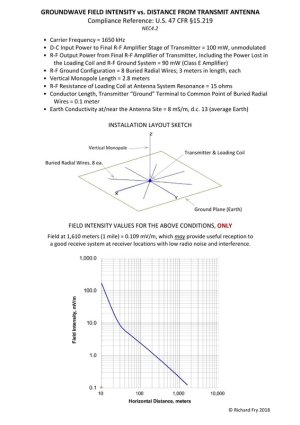
However, a statement such as the quote above implying that the operators of all unlicensed radio stations using the AM or FM broadcast band are engaging in pirate radio does not and cannot include those who are fully compliant with U.S. 47 CFR §15.219 and/or §15.239 — by which the FCC specifically authorizes such unlicensed operations for private citizens compliant to those Rules.

The graphic below illustrates this, based on a detailed example of a non-pirate, unlicensed equipment setup operating in the AM broadcast band.

Richard Fry, CPBE

GW-F-I-vs-H-Distance-from-Part-15-AM-Xmt-System.jpg
 
However, a statement such as the quote above implying that the operators of all unlicensed radio stations using the AM or FM broadcast band are engaging in pirate radio does not and cannot include those who are fully compliant with U.S. 47 CFR §15.219 and/or §15.239
The intention was not to include those that are operating within the Part 15 tolerances as pirates. They are technically "licensed by rule". The case involving East Coast Christian Center that we discussed was a case of a Part 15 that ruffled someone's bloomers. I am concerned about these state level pirate radio laws because they put engineering enforcement into the hands of the state and local law enforcement, who are not electrical engineers. Although in all fairness, I have not personally heard of any cases where the Florida, NY and NJ laws had ever been misapplied to a Part 15 operation.

REC was involved in assuring that there was language put in the PIRATE Act that specifically excluded Part 15 operations from enforcement, thus acknowledging that there is a legal avenue for unlicensed broadcast band use.
 
The intention was not to include those that are operating within the Part 15 tolerances as pirates.
And from a practical perspective; an operator of a radio transmission system assumed to be compliant under Part 15, may be actually deemed to be not in compliance when investigated. Had the opportunity several years ago to witness an inspection of a carrier current operation, who was sure they were technically compliant. The Commission inspector measured the field strength at something like 2mV/m 21 feet away from a particular utility line, which the inspector rightfully determined was a violation. The station was subsequently shut down, and an NAL issued to the individual responsible for the transmission system. https://www.ecfr.gov/current/title-47/chapter-I/subchapter-A/part-15/subpart-C/section-15.209

They are technically "licensed by rule". The case involving East Coast Christian Center that we discussed was a case of a Part 15 that ruffled someone's bloomers. I am concerned about these state level pirate radio laws because they put engineering enforcement into the hands of the state and local law enforcement, who are not electrical engineers. Although in all fairness, I have not personally heard of any cases where the Florida, NY and NJ laws had ever been misapplied to a Part 15 operation.

REC was involved in assuring that there was language put in the PIRATE Act that specifically excluded Part 15 operations from enforcement, thus acknowledging that there is a legal avenue for unlicensed broadcast band use.
And that was just one of the driving factors behind LPFM; reduction of illegal operators. I believe reading after the first round of LPFM CP's were issued, the number of reported illegal operations actually went up, not down.
 
I remember Butler University had a low power AM that could be heard all over Indianapolis on 1610 KC. They thought it was legal because they were a school. But, was it legal?
 
I remember Butler University had a low power AM that could be heard all over Indianapolis on 1610 KC. They thought it was legal because they were a school. But, was it legal?
Probably not. Back in the late '60s, students at a College in Central Florida put an AM station on the air at 800kHz. It covered nearly the entire city. I think they shut it down before the FCC did it for them.
 
Probably not. Back in the late '60s, students at a College in Central Florida put an AM station on the air at 800kHz. It covered nearly the entire city. I think they shut it down before the FCC did it for them.
Arizona State University used to have a station on 1260 which could be heard well away from the campus. College campuses are allowed to have intentional radiators that go beyond the Part 15 AM norms as long as the certain field strengths do not leave the campus grounds.
 
The subject of this thread could have changed this station from an LPFM to a 100 Watt, Class A, NCE, in the last filing window. That would have been an easy filing that would have saved them a lot of worry and potential trouble.
 
KXPB-LP is operating in the educational band already. They could have applied for the same frequency with the same facilities in the last NCE filing window. Then, send the LPFM license back to the FCC upon grant of a CP. Since the station is already built, file for a new NCE license. After that, the ex-pirates could go on the board of the NCE station. Problem could have been solved within FCC rules.

I would have helped these guys for free.
 
Last edited by a moderator:
I think I know about who the pirate is regarding KXPB. Kelly runs the station in tiny Pacific Beach, population about 125. I think there are about 600 people in KXPB's listening area. KXPB is a 24/7 station with liners every 20 minutes. The music is generally album oriented by heavily dayparted from more acoustic in the morning to more rock at night and more pop/classic hits by afternoon drive.

There are a few weekly shows of oldies or specialty shows that actually match the format nicely. FSN News is added at strategic hours each weekday. You hear weather forecasts and community announcements. There have been open forums with government officials aired live. The station is serious about tsunamis and other threats from the ocean.

In a nutshell, this is a very top quality community station that the masses actually listen to.

One of the shows is done by the owner of the Wacky Warehouse, a local business. This guy ran a station for the community prior to KXPB. This is the pirate. He might not be the typical pirate. He is a member of a few non-profits and has been active in working on projects that add to the local quality of life. He's the sort of guy you actually want in your town. He is an underwriter of KXPB.

No matter how you sliced it, this guy was likely found somewhere along the chain of people involved in every improvement in the town. And no, he wasn't like the other pirates you hear about. Pacific Beach is in a radio desert of sorts. Not isolated geographically, just too small for any other station to pay any attention. The Wacky Warehouse folks gave them radio that was about Pacific Beach without a license. I'm sure they did everything they could to help Kelly get KXPB up and going.

The station hasn't the financial resources to fight this. Back after they'd been on about a year, Kelly told me he had 10 local businesses getting a spot (underwriter message) a day for $300 a year. That was most every business.

KXPB was from the first filing window. They have been around many years. In my book this should not be an issue now.
 
Keep in mind that the pirate ban was in a bill passed by Congress and signed into law by the President. The FCC cannot remove this ban. The law can only be changed by Congress or the Federal Court.

So, ex-pirates are banned from being an officer, board member, or manager of an LPFM station. Ex-pirates are not banned from applying for full power stations.

Ex-pirates can play a role at an LPFM, just not the roles listed above.

The Washington station should have got out of the LPFM service by converting to a full power NCE in the last filing window. And, that would have taken less than an hour's work to file the NCE application.
 
KXPB-LP does appear on REC Advisory Letter 13 as potentially being displaced due to the window by the City of Ocean Shores application. They are also an LPFM, KOSW-LP. Ocean Shores was able to break out of the very messy MX Group #221.
 
KXPB-LP does appear on REC Advisory Letter 13 as potentially being displaced due to the window by the City of Ocean Shores application. They are also an LPFM, KOSW-LP. Ocean Shores was able to break out of the very messy MX Group #221.
Another way they missed the bus by not applying for their frequency in the NCE window. I doubt Ocean Shores would have gone from one MX group to another. They were able to get out of MX by displacing a secondary service, an LPFM. Ocean City modified their requested frequency from 89.5 to 88.9.
 
Arizona State University used to have a station on 1260 which could be heard well away from the campus. College campuses are allowed to have intentional radiators that go beyond the Part 15 AM norms as long as the certain field strengths do not leave the campus grounds.
WJPZ at Syracuse University, now on 89.1 FM, started as carrier current, then Part 15 at 1200 AM in the mid-'70s. It also reached well off campus.
 
KXPB-LP does appear on REC Advisory Letter 13 as potentially being displaced due to the window by the City of Ocean Shores application. They are also an LPFM, KOSW-LP. Ocean Shores was able to break out of the very messy MX Group #221.
I was told by the FCC that the statute of limitations for reporting pirate radio conduct on an application is ten years. They told me this 40 years ago, long before there was an LPFM service. So, I hope these guys in Pacific Beach are in good shape. They will need a new channel though.
 
Last edited by a moderator:
Jolly Roger Radio logo.JPG


Jolly Roger Radio was just about the only US pirate in it's day. The station was on AM, FM, and Short Wave frequencies. Jolly Roger made National News many times and the FCC said they would send the pirates to jail.

But that's not what the FCC did at all. They turned out to be the good guys. I know because I was there.
 
Last edited by a moderator:
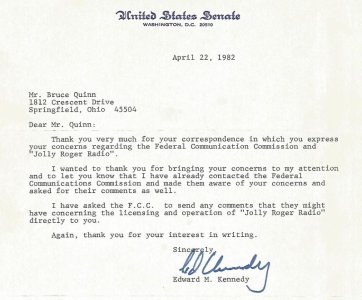
Kennedy Letter.JPG
This is one of the good guys who helped me get a broadcast license from the FCC.
 
Status
This thread has been closed due to inactivity. You can create a new thread to discuss this topic.


Back
Top Bottom