• Get involved.
    We want your input!
    Apply for Membership and join the conversations about everything related to broadcasting.

    After we receive your registration, a moderator will review it. After your registration is approved, you will be permitted to post.
    If you use a disposable or false email address, your registration will be rejected.

    After your membership is approved, please take a minute to tell us a little bit about yourself.
    https://www.radiodiscussions.com/forums/introduce-yourself.1088/

    Thanks in advance and have fun!
    RadioDiscussions Administrators

Post your latest DX

My "canary in the coal mine" to check for auroral conditions are the Manitoba signals that are usually present, T
A separate subject here is "canary" stations that DXers use to determine opportunities.

Back in the day when DXing from Cleveland, OH, if 650 brought me KORL I would spend the Monday morning silent period of WSM looking for other Hawaiians as well as NZ and Australia.

Early evening dominance of WKWF from Key West on 1600 was an invitation to explore other crowded frequencies for deep south and Caribbean stations.

Monday morning good reception of 1370 from MT would indicate an opening to the NW. 1440 KPRO in Riverside, CA, indicated the chance to get stations from CA and AZ and NW Mexico.

And, if at 4 AM EST 1090 had a good signal from Uruguay, looking for Argentina and Paraguy and Brazil was indicated.
 
Auroral conditions? Hmm....maybe. Mixed signals (no pun intended) this morning before sunrise.

My "canary in the coal mine" to check for auroral conditions are the Manitoba signals that are usually present, This morning most of them were either weak or missing entirely. WCCO was also weaker than usual. So I thought I might be in for some interesting DX from the south. But then came the "Manitoba Surprise". CFAM was in on for the first time in at least 8 or 9 months. No positive ID, but the classical music (around 4:15am CDT) was unmistakable. Frequent fades, but for the most part holding its own with WWJ and the other "usual suspects". 658 miles. The last 2 or 3 of which are just north of the Manitoba-North Dakota border.

Also north of the border to the east this morning, CFZM was weak, CJBC was barely audible, but CFMB (Montreal) was roaring in on 1280.

Go figure!
 
Strange conditions indeed last night. I was listening to one of the Southern Florida SDRs. The signals from the north were very weak. No WGN or WBBM to be heard. Lots of stuff from the Caribbean. On the Maui Hawaii SDR the west coast powerhouses were barely making it in. This was around 0100-0200 CDT.
 
A separate subject here is "canary" stations that DXers use to determine opportunities.
Good stuff, thanks! Wasn't WKWF directional east-west? Or maybe I'm thinking of WKIZ. As for KORL, after I returned from my junior year of high school in Honolulu in 1965, I kept trying for it....with no success whatsoever.The fact that WSM was leaving their carrier on and broadcasting a continuous tone after Monday morning signoff didn't help matters. Drove me nuts because I knew KORL was being heard in the Midwest by other DXers, but not me.

I never made a serious effort for K-POI, but you covered that base. :)
 
Congratulations on your Canadian catch!
Auoural conditions would explain Steve's unusual catch, as it would be to the south.
Thanks. I was looking make a haul of new catches from the south, but conditions in that direction seemed pretty normal. to me. Although another oddity was that WWL was at least slightly weaker than normal. Not exactly the way to celebrate their 100th birthday week!

CFAM was a stunner. I first heard classical music on 950 a few years ago, and couldn't figure out where it was coming from. Crainbebo came to the rescue by informing me that if I was hearing classical music on 950, it had to be CFAM. I've heard it a handful of times since then,...with positive IDs...but it's definitely not a regular.

CFAM is mostly a brokered and religious station. It's co-owned with CFRY (920) and CHSM (1250). All three put a good signal into Winnipeg 24/7 despite being more than 40 miles away. Fabulous ground conductivity will do that to ya! CFRY has pretty much become a regular here,with a conventional country music format. CHSM has a format similar to CFAM, but with more ethnic stuff.
 
Thanks. I was looking make a haul of new catches from the south, but conditions in that direction seemed pretty normal. to me. Although another oddity was that WWL was at least slightly weaker than normal. Not exactly the way to celebrate their 100th birthday week!

CFAM was a stunner. I first heard classical music on 950 a few years ago, and couldn't figure out where it was coming from. Crainbebo came to the rescue by informing me that if I was hearing classical music on 950, it had to be CFAM. I've heard it a handful of times since then,...with positive IDs...but it's definitely not a regular.

CFAM is mostly a brokered and religious station. It's co-owned with CFRY (920) and CHSM (1250). All three put a good signal into Winnipeg 24/7 despite being more than 40 miles away. Fabulous ground conductivity will do that to ya! CFRY has pretty much become a regular here,with a conventional country music format. CHSM has a format similar to CFAM, but with more ethnic stuff.
It is quite fascinating to see how the latest solar conditions are affecting even bands such as MW. Perhaps with this activity we are seeing "extended winter conditions". I have yet to understand MW propagation as much as I do with VHF prop.
 
Believe it or not, WWKB 1520 is one of the first stations heard in Michigan when recovery from an Auroral event begins. It's because it's reflecting off an ion layer to the North, rather than across Canada. The engineers at WKBW used to claim that the signal would have to go all the way around the world to reach Michigan and Ohio. It could be heard quite often in Western Europe and Northwest Africa.
 
It is quite fascinating to see how the latest solar conditions are affecting even bands such as MW. Perhaps with this activity we are seeing "extended winter conditions". I have yet to understand MW propagation as much as I do with VHF prop.
I didn't notice any "extended winter conditions" on MW last night, but I'll check again.
 
I didn't notice any "extended winter conditions" on MW last night, but I'll check again.
No I meant as a general statement. I wasn't even MW DX'ing last night.
 
Now tonight is interesting. As if midnight PST, I'm getting WHO 1040 decently here, which normally is a null sig with KURS as the dominant frequency.

[Edit 12:24]
Shoot, now KOMO just jumped up to S9+. Not too far from normal behavior for this regionally 50 KW birthday candle, but still intriguing.
 
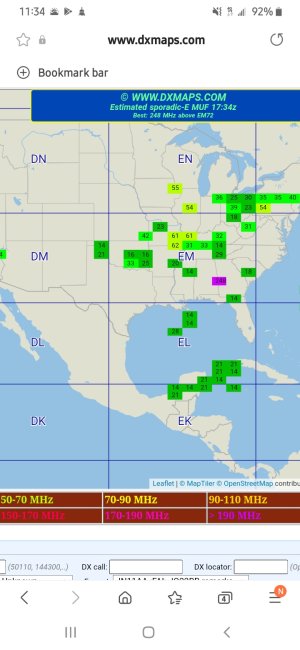
Well that can't be right: E-skip MUF of 248 over the Southeast right now! 🤯Screenshot_20220403-113452_Samsung Internet.jpg
Edit: Now it's down to 223, but seriously, I hope someone is taking advantage of this!
 
Well that can't be right: E-skip MUF of 248 over the Southeast right now! 🤯

Next time you see something like that, go up to the "Modes/Props" tabs and unclick "digital" on the dropdown menu. Then see if the outlier MUF goes away. Often when you unclick digital modes, what would otherwise look like a very busy e-skip map clears out nearly completely.

Hams using digital modes are the source of much of the information displayed on this map, and the map's representations can sometimes be misleading. Not to say that it isn't a valuable tool for gauging whether a real e-skip event is getting underway.
 
Well that can't be right: E-skip MUF of 248 over the Southeast right now! 🤯View attachment 2814
Edit: Now it's down to 223, but seriously, I hope someone is taking advantage of this!
Its a glitch. The day we see a 224 MHz MUF is the day when all of the world power grids go kaboom.
 
Next time you see something like that, go up to the "Modes/Props" tabs and unclick "digital" on the dropdown menu. Then see if the outlier MUF goes away. Often when you unclick digital modes, what would otherwise look like a very busy e-skip map clears out nearly completely.

Hams using digital modes are the source of much of the information displayed on this map, and the map's representations can sometimes be misleading. Not to say that it isn't a valuable tool for gauging whether a real e-skip event is getting underway.
Its a glitch. The day we see a 224 MHz MUF is the day when all of the world power grids go kaboom.
Thank you for letting me know. I was too quick to accept the map, without checking my instincts.
 
Next time you see something like that, go up to the "Modes/Props" tabs and unclick "digital" on the dropdown menu. Then see if the outlier MUF goes away. Often when you unclick digital modes, what would otherwise look like a very busy e-skip map clears out nearly completely.

Hams using digital modes are the source of much of the information displayed on this map, and the map's representations can sometimes be misleading. Not to say that it isn't a valuable tool for gauging whether a real e-skip event is getting underway.
Typically yes, I would agree. Digital modes are meant to be weak signal propagation work anyways, so it isn't the most exact way to tell if something is going on. The rule of thumb is that if SSB, or even other modes like AM and FM contacts are being reported, that's when an opening of some sort (10 meters and above in this case) is typically strong.

Granted, it isn't to say either that we should dismiss 10 or 6 meter openings with FT8 only. They are still good indicating that the ionosphere is active enough in some parts to sustain ES or F2 openings. But if nothing else than digital modes are being reported, the event (ES cloud in some cases) may not be strong enough to go further. In my personal experiences I still say they are worth to keep an eye on still. As the name implies, these layers can act randomly at any time.
 
On 630 AM, I'm hearing KVMA Magnolia, AR with its classic hits format which runs 1kw day/30 w night. I also heard 980 KOKA Shreveport, LA "980 AM and 93.3 KOKA" 5 kw day/79 w night. 720 WRZN Hernando, FL is also coming in with WGN nulled (10kw day/250 w night). This is around 12:00-12:30 AM.
 
The other night I was hanging out on one of the South Florida SDRs and heard WRZN and no sign of WGN. WGN usually comes in late at night, but not this time.
Anyone know what happened to the Key West SDR? It hasn't been around for awhile.
 
On 630 AM, I'm hearing KVMA Magnolia, AR with its classic hits format which runs 1kw day/30 w night. I also heard 980 KOKA Shreveport, LA "980 AM and 93.3 KOKA" 5 kw day/79 w night. 720 WRZN Hernando, FL is also coming in with WGN nulled (10kw day/250 w night). This is around 12:00-12:30 AM.
When my local on 980, KQUE is off or running dead air at night, KOKA often dominates the frequency. I suspect they're accidentally on day power.


Back
Top Bottom