
• Get involved.
    We want your input!
    Apply for Membership and join the conversations about everything related to broadcasting.

    After we receive your registration, a moderator will review it. After your registration is approved, you will be permitted to post.
    If you use a disposable or false email address, your registration will be rejected.

    After your membership is approved, please take a minute to tell us a little bit about yourself.
    https://www.radiodiscussions.com/forums/introduce-yourself.1088/

    Thanks in advance and have fun!
    RadioDiscussions Administrators

Happy 100 to WGR-AM

WGR-AM is celebrating its centennial this year. This week in 1922, the station that had started very limited broadcast service on April 1st was advertising "Radio Week in Buffalo" that would introduce a new, high-powered transmitter and the "formal opening of one of the largest and most powerful broadcasting stations in the east which may make Buffalo the ethereal center of this part of the country", because "The arrangements and furnishing of the station will be equal to that of any of the present stations of national fame."

The new transmitter would go into service on May 21st. WGR-AM actual was granted permission to broadcast on two frequencies. A slate of programs was scheduled for 7 days a week. Weather reports provided by the Department of Navigation were broadcast on 485 meters each weekday at 12:30 and 6:00 p.m. along with market reports and other government reports. You could listen to it all on a crystal receiver manufactured by the station owner, Federal Telephone and Telegraph at their Elmwood Avenue factory.
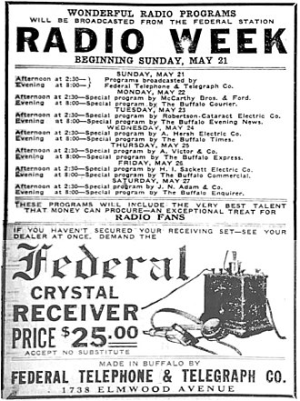
1652714867172.png
 
Thanks for posting that Rox. WBT and WSB are also 100 this year. KDKA hit 100 last year. I was kind of excited about it in fact Pittsburgh area Amateur Radio operators did what is called "Special Event Stations" where you could make contacts and get a nice commemorative 100th Anniversary QSL card. When I told other Amateurs about this their response was a collective yawn. I for one have an interest in radio history. I find it fascinating!
 
Back in 1972 I got a WGR keychain, probably at the Erie County Fair, that said 55 is 50. Didn't realize what that meant until years later. If I still had it I'd post a picture.

Happy 100th birthday, 'GR55.
That is a clever slogan!
 
Back in 1972 I got a WGR keychain, probably at the Erie County Fair, that said 55 is 50. Didn't realize what that meant until years later. If I still had it I'd post a picture.

Happy 100th birthday, 'GR55.
I always liked to see the WGR guys out at the as we natives call "The Hamburg Fair". In the '60's I remember Tom Shannon's short stint there before going to CKLW. He was at the Fair and interviewed me. That was also the first time I saw the engineer cue a record! So that's how they do it!! In the '70's it was fun to hear Shane broadcast from out there and have fun with the people who came around to see him.
 
According to Wikipedia George Eastman of Kodak helped the University of Rochester and suggested they name their new station WHAM. George liked powerful names, Kodak was named that for just that reason.

In 1927 Electronics manufacturer Stromberg-Carlson took over the station and with that the power increases came. There was a giant "Rochester Radio Center" built next to the Stromberg-Carlson factory for WHAM, WHFM and WHAM-TV in the early '50's at 201 Homboldt Street that eventually became home to WROC-AM-FM-TV (WHAM and WHFM moved downtown). For the TV studio they just used one of the old radio performance studios taking out a few rows of auditorium seats. I saw the place in 1976 long past it's prime and had a feeling it never quite reached the potential the original builders planned. A separate wing for TV studios was planned but never constructed. Today it's home to WROC-TV alone.
 
According to Wikipedia George Eastman of Kodak helped the University of Rochester and suggested they name their new station WHAM. George liked powerful names, Kodak was named that for just that reason.

[citation needed]

Actually, that story is one of those urban myths that won't die. If you look at the Radio Service Bulletins of the era, it becomes very clear that WHAM was a sequentially-issued callsign (as all were in 1922), right there in order between WHAL and WHAN.

I discussed this in detail with Joe Lomonaco on the first installment of his WHAM centennial podcast over the winter.
 
Another urban myth was "WGR" stood for George Rand, but was originally the call letters of a ship "The Governor" which sank in 1921, they were randomly reassigned when 'GR was licensed in 1922. WGR initially broadcast on two frequencies in the 900's kHz range until moving to its present 550. The 550 spot on the dial was first occupied by WMAK in Lockport. A look at the FCC history cards for 550 reveals WMAK was first licensed in September 1922.
 
At one time GR was using the tag line "Buffalo's First Radio Station" - this is going back to the late 1980's. I'm not sure that was 100% true but any that had come before didn't last so they claimed it. I see they have a nice writeup on their web site so glad they are acknowledging it. Grew up listening to Stan Roberts, Frank Benny, Shane and to John Otto, quietly, after I had gone to bed and was supposed to be sleeping. I believe they were station of the year a couple times during their A/C days and looks like they were sports station of the year as well. A long, proud history.
 
At one time GR was using the tag line "Buffalo's First Radio Station" - this is going back to the late 1980's. I'm not sure that was 100% true but any that had come before didn't last so they claimed it. I see they have a nice writeup on their web site so glad they are acknowledging it. Grew up listening to Stan Roberts, Frank Benny, Shane and to John Otto, quietly, after I had gone to bed and was supposed to be sleeping. I believe they were station of the year a couple times during their A/C days and looks like they were sports station of the year as well. A long, proud history.
They were the first licensed commercial station for sure. Next up was WMAK, which eventually became WBEN.
 
Here's Audacy's take on it: WGR turns 100-years-old!
Well, at least they finally acknowledged it. December 1, 1921, the Department of Commerce, which regulated U.S. radio at this time, had adopted regulations formally defining "broadcasting stations". The wavelength of 360 meters (833 kHz) was designated for entertainment broadcasts, while 485 meters (619 kHz) was reserved for broadcasting official weather and other government reports. On March 14 Federal Telephone & Telegraph was issued a license for Buffalo's first radio broadcasting station, with the randomly assigned call letters WGR. They started regularly scheduled broadcasts on April 1st with weather reports provided by the Department of Navigation on 485 meters each weekday at 12:30 and 6:00 p.m. In mid-April, WGR's regular broadcast schedule was reported to be musical programs sent on 360 meters on Tuesday and Thursday evenings and Sunday afternoons along with the daily weather and market reports on 485 meters.

WWT, owned by McCarthy Brothers and Ford, also obtained a license from the FRT and broadcast on 360 meters. They may have been first with entertainment programming by a day or two, but they shared the frequency with WGR with the two stations broadcasting on alternate days. WWT broadcast on Wednesday and Friday nights, and Sunday afternoons. Note the conflict on Sundays, although it's likely that they broadcast at different times during the afternoon. WGR did suspend broadcasting in early May to install their new transmitter while WWT carried on.

By May 21st, McCarthy Bros. & Ford programs were broadcasting on WGR on their newer, more powerful transmitter. WWT suspended operations for WGR's "Radio Week," then ceased broadcasting altogether during the Summer of 1922.
 
In mid-April, WGR's regular broadcast schedule was reported to be musical programs sent on 360 meters on Tuesday and Thursday evenings and Sunday afternoons along with the daily weather and market reports on 485 meters.

I wonder how they handled the music. While there were phonographs at the time, there were no "mixers" as we know them. I've seen pictures of microphones placed in front of phonograph speakers in some cases. The easiest way to do music is a live performance. Although then you run into potential grievances from the musicians union. Although ASCAP existed, I don't think they had a procedure in place to collect royalties until a few years later.
 
I wonder how they handled the music. While there were phonographs at the time, there were no "mixers" as we know them. I've seen pictures of microphones placed in front of phonograph speakers in some cases. The easiest way to do music is a live performance. Although then you run into potential grievances from the musicians union. Although ASCAP existed, I don't think they had a procedure in place to collect royalties until a few years later.
In the '20s it was live local performers. A few amateurs played recorded music from phonographs, but commercial stations were live.
 
Status
This thread has been closed due to inactivity. You can create a new thread to discuss this topic.


Back
Top Bottom