
-
Get involved.
We want your input!
Apply for Membership and join the conversations about everything related to broadcasting.
After we receive your registration, a moderator will review it. After your registration is approved, you will be permitted to post.
If you use a disposable or false email address, your registration will be rejected.
After your membership is approved, please take a minute to tell us a little bit about yourself.
https://www.radiodiscussions.com/forums/introduce-yourself.1088/
Thanks in advance and have fun!
RadioDiscussions Administrators
You are using an out of date browser. It may not display this or other websites correctly.
You should upgrade or use an alternative browser.
You should upgrade or use an alternative browser.
KNWN audio question
- Thread starter Treehouse SWL
- Start date

Maybe not if you buy old hardware via E-Bay.It is cheaper to process a stream than to buy an Optimod or Omnia processor for over the air... Like probably $20,000 cheaper.
But over-processing already heavily processed recordings? Makes it much worse.Processing or not, not much can be done after the recording itself is flat-topping. Billy Eilish for example.

Hit that Billie Eilish file with a couple of processes in Adobe and it sounds fine.
I hope you jest. Once it's flat-topped, you can't fix. You can fix levels, but you can't restore the integrity of of the data.
Not totally unrelated to the idea that you can recover detail by converting .mP3 back to .wav. Remove 95% of the data, then try to bring back detail that's gone... converting back to .wav doesn't bring back the dead.
Not totally unrelated to the idea that you can recover detail by converting .mP3 back to .wav. Remove 95% of the data, then try to bring back detail that's gone... converting back to .wav doesn't bring back the dead.
You're totally correct Bill. An Mp3 file is incredibly lossy to begin with. Transcoding it to a .wav will only have an otherwise crappy file just play as a different type of file. The crappy-ness of the quality remains.Not totally unrelated to the idea that you can recover detail by converting .mP3 back to .wav. Remove 95% of the data, then try to bring back detail that's gone... converting back to .wav doesn't bring back the dead.
Hi Bill,I hope you jest. Once it's flat-topped, you can't fix. You can fix levels, but you can't restore the integrity of of the data.
Not totally unrelated to the idea that you can recover detail by converting .mP3 back to .wav. Remove 95% of the data, then try to bring back detail that's gone... converting back to .wav doesn't bring back the dead.
First thing to remember is there's no integrity in the way the files today are processed. Removing everything below 80-100hz and adding a SMALL amount of reverb to the file at least lets the needles move. It's not perfect but the average listener will never know unless you're playing Classic Rock. Now, if you're playing Classic Rock you'd never need to alter the files in the first place.

It's fun to be able to run an Omnia 9 so it isn't the loudest but nice & open. The "Undo" does work on clipped and compressed sources..
Same with the Omnia Volt although sounds much better when not pushed.
Same with the Omnia Volt although sounds much better when not pushed.

Actually, yes. We have been trained to think the average listening span is around 15 minutes or so. And that is true, but the typical listener will give a station many / multiple bits and pieces in a day.Does your average listener listen to a station long enough today for listener fatigue to actually set in?
The PPM simply showed us that no one really listened from "9 am to 5 pm" at work. They listened in slices, with lots of interruptions: bathroom visits, coffee break, taking the kids to the bus stop, walking the dog, visiting the copier room, lunch break, phone calls, meetings, time in the stock room, a presentation... and so on.
But loyal listeners may have a dozen or more of those tidbits of time in a workday or while calling on clients in their car or doing deliveries or stocking shelves.

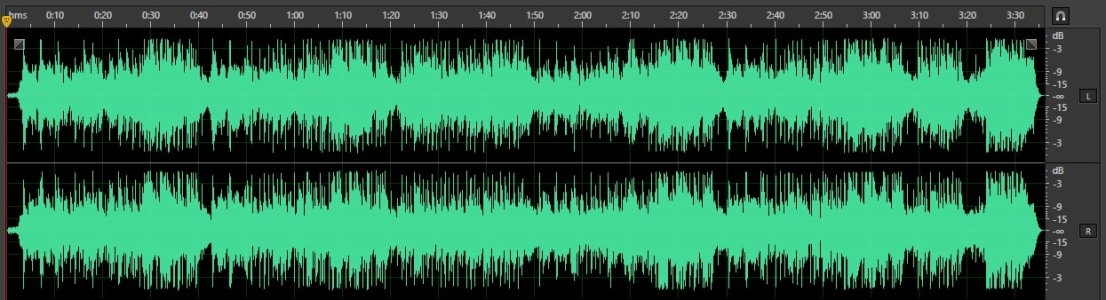
It is possible to improve the dynamic range of a recording. I do it all the time using Adobe Audition. I expand the upper 3 or 4dB with the time constants of the process set to zero.
This is a recording before the process:
This is the same song after I have "uncompressed" it.
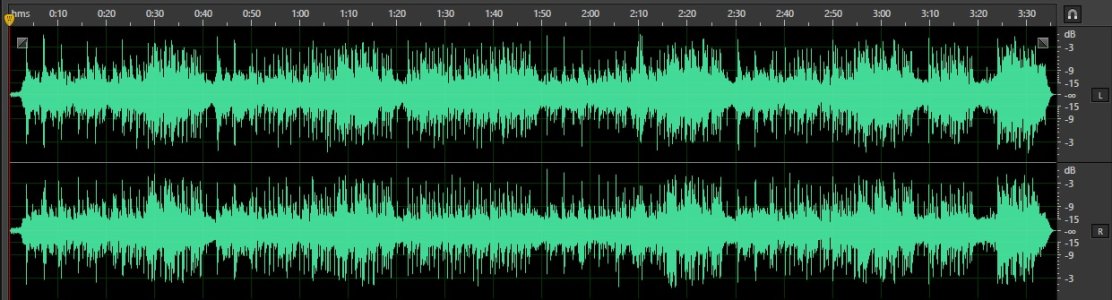
Of course, the process doesn't work on clipped audio. It only works when the recording is heavily compressed and peak limited.
This is a recording before the process:
This is the same song after I have "uncompressed" it.
Of course, the process doesn't work on clipped audio. It only works when the recording is heavily compressed and peak limited.
Downward expansion adds a simulated dynamic range, but not based on frequency. The loud's get quieter, and the quiet's get quieter. A kick drum who's peak frequency at 110Hz isn't afforded an increase in dynamics separate of the electric guitar mixed in front of it. Even with compression and clipping, there will be an overall change in level. Downward expansion only enhances the existing level changes.It is possible to improve the dynamic range of a recording. I do it all the time using Adobe Audition. I expand the upper 3 or 4dB with the time constants of the process set to zero.
This is a recording before the process:

As a listener might say, "This sounds like sh!t. What else could I be listening to?" (clicks and moves on to the next audio source)
Flattopped music was definitely the standard, since the early 2000s, and even before then. When I was in the business in the 90s-00s, right about halfway through the 90s we started getting music from the record companies that was maxed. It was that way on the promo CDs, and when we went towards Mp3 delivery from the recording co's it was just as bad, except grainier sounding. The top of the waveform was a flatline in many, if not most cases. In many alt-rock and pop hits you could even hear the compression working, it was that pumped.
I haven't been in the business for around 15 years, so I don't know if that's changed.
PS, in the examples Frank Berry posted, that would have been moderate. I mean, there's some actual dynamics there, even in the top example. A lot of the tracks we got where I worked, it would have had a few waveforms visible at the very start, and then it would be solid green for three to four minutes, until the fadeout at the end.
I haven't been in the business for around 15 years, so I don't know if that's changed.
PS, in the examples Frank Berry posted, that would have been moderate. I mean, there's some actual dynamics there, even in the top example. A lot of the tracks we got where I worked, it would have had a few waveforms visible at the very start, and then it would be solid green for three to four minutes, until the fadeout at the end.
In the focus groups I've been part of, the listener doesn't necessarily claim that something sounds bad, but more that another sounds better. For example; we ran a FG one time that took a minute audio clip recorded from a heavily processed FM station, followed by the same part of a song un-processed. Immediately, without hesitation, 100% of the participants said they would prefer listening to the un-processed clip.As a listener might say, "This sounds like sh!t. What else could I be listening to?" (clicks and moves on to the next audio source)
- Status
- This thread has been closed due to inactivity. You can create a new thread to discuss this topic.