
Blaming the almost total end of AM broadcasting in Europe, here is a discussion of new cars with no AM radio.

Good piece. Makes the point I’ve been making that the EV interference argument Tesla and other EV makers have used as an excuse for not including AM is nonsense.Blaming the almost total end of AM broadcasting in Europe, here is a discussion of new cars with no AM radio.
Longwave began being eliminated 50 or more years ago.Hasn't Europe been more of a longwave (e.g. ~150 to 280 kHz) than medium wave continent?
Was driving South on the Autostrada after staying at Lake Como in Italy about a year ago. The rental car had MW, but most of anything there were travelers information services. No broadcasts to speak of.Hasn't Europe been more of a longwave (e.g. ~150 to 280 kHz) than medium wave continent?
My experience, too, Kelly. And the frequency switches while you’re tuned to a national format as you drive are very cool.Was driving South on the Autostrada after staying at Lake Como in Italy about a year ago. The rental car had MW, but most of anything there were travelers information services. No broadcasts to speak of.
Pretty much all of radio was on FM, with an excellent RBDS system that automatically changes the stations as you drive.
We used that RBDS system on KRCD / KRCV in the LA market and it works quite well. However, it appeared that many non-European made cars did not do the needed software implementation of the feature for North America.My experience, too, Kelly. And the frequency switches while you’re tuned to a national format as you drive are very cool.
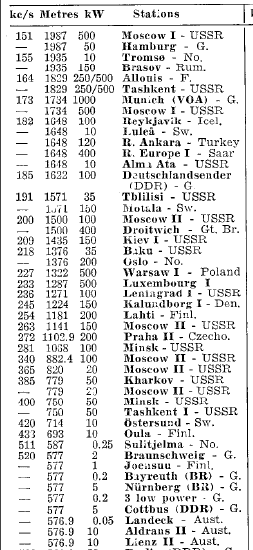
Longwave has awesome groundwave coverage, which made it ideal for covering rural and offshore areas.From my perspective, LW developed for regional or national coverage before higher power MW transmitters were practical. Some European nations never developed LW, and others used it for rural coverage... some nations used it to cover offshore islands and the marine listener.
That they did, and many were still around until 2014, when the Russians shut down all of their longwave and shortwave broadcast infrastructure, along with all but a few medium wave transmitters.The Soviets seem to have liked LW, as it was an easy way to cover wide areas that had no local radio and poor communication with Moscow or regional capitals.
That is a rather incomplete listing. If you check WRTH editions from a few years later there are many more stations.Numerically, there were relatively few of those stations. Here is the WRH listing for all LW stations in 1960:
Ford and Tesla EV's don't have AM.What isn't being discussed here is the possibility, or even probability, that American automakers will also begin omitting AM from their "in-dash entertainment systems."
Too late.I'd think that with the band still having viable stations with significant listenership, manufacturers might be inclined not to go that route yet.
One reason why sports stations are moving to FM, and I'm not talking about lousy limited-coverage translators.(Yes, those listeners are mostly in the shunned 55+ demo but, in many markets, sports stations with no FM translators that are listened to by significant numbers of in-the-money-demo males.
As David posted, that move is already underway.Not that advertiser preferences should play a role in the decision to eliminate AM, of course.) So, how long until Ancient Modulation becomes ancient history in the American car/SUV/truck?
That is a rather incomplete listing. If you check WRTH editions from a few years later there are many more stations.
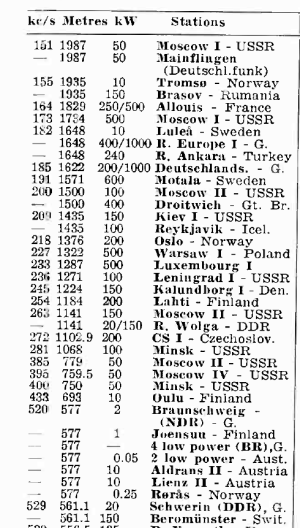
Some of that is the difference in terminology. Outside of the US and Canada, 530 to 1600 (or 1700 where it applies) are called "Long Wave".Note the stations between 330 and 440 kHz. Technically medium wave but not part of the usual broadcast bands. All long gone now.
That's pretty much the last three paragraphs of the original article that started the thread.What isn't being discussed here is the possibility, or even probability, that American automakers will also begin omitting AM from their "in-dash entertainment systems." I'd think that with the band still having viable stations with significant listenership, manufacturers might be inclined not to go that route yet. (Yes, those listeners are mostly in the shunned 55+ demo but, in many markets, sports stations with no FM translators that are listened to by significant numbers of in-the-money-demo males. Not that advertiser preferences should play a role in the decision to eliminate AM, of course.) So, how long until Ancient Modulation becomes ancient history in the American car/SUV/truck?
Tesla does not.Ford and Tesla EV's don't have AM.
My neighbor just took delivery of a brand new F-150 Lightning. No AM.Tesla does not.
Ford's EVs do. That from my career as an automotive journalist and from the article itself:
"Detroit's Three—Ford, General Motors, and Stellantis—have produced or currently make EVs that include AM radio, even on flagship models. That goes for the Ford F-150 Lightning and Mustang Mach-E, GM EVs from the Cadillac Lyriq to the Chevy Bolt EUV and GMC Hummer EV, and even Stellantis's almost-forgotten Fiat 500e."
Tell them to look in the settings menu and see if there is an option to enable it. I know many cars are that way with RDS and HD Radio -- they do have those features, but they ship from the factory with them turned off by default.My neighbor just took delivery of a brand new F-150 Lightning. No AM.
One of my colleagues at work drives a Ford C-Max. No AM there either.
We checked the menu for the new F-150 Lightning. Even the owners manual doesn't list AM as being there. FM-FM HD, Apple Carplay(tm) Google Android? Those are there. AM? Nope!Tell them to look in the settings menu and see if there is an option to enable it. I know many cars are that way with RDS and HD Radio -- they do have those features, but they ship from the factory with them turned off by default.


