
-
Get involved.
We want your input!
Apply for Membership and join the conversations about everything related to broadcasting.
After we receive your registration, a moderator will review it. After your registration is approved, you will be permitted to post.
If you use a disposable or false email address, your registration will be rejected.
After your membership is approved, please take a minute to tell us a little bit about yourself.
https://www.radiodiscussions.com/forums/introduce-yourself.1088/
Thanks in advance and have fun!
RadioDiscussions Administrators
You are using an out of date browser. It may not display this or other websites correctly.
You should upgrade or use an alternative browser.
You should upgrade or use an alternative browser.
Ethnic Listening to LA Radio Stations
- Thread starter davideduardo
- Start date
As shown by the lively discussions here of Nielsen's 6+ numbers, sometimes useless information is the most interesting!Useless information to me but thanks for posting anyway
But isn't it true that the granularity of the data isn't that great when the total cume is so small? I wonder if that 70% is just 3 people with meters who happen to listen continuously.I'm fascinated by the high minority listenership to KPFK. Almost 70%!
Dave B.
But isn't it true that the granularity of the data isn't that great when the total cume is so small? I wonder if that 70% is just 3 people with meters who happen to listen continuously.
That's 3 more people that don't listen to KBLA, for example.
I know Nielsen doesn’t have data for Asian Americans, but in several markets that are predominantly Asians like San Francisco, Los Angeles, SAN Diego, Seattle, Sacramento, New York and Honolulu affects the music taste. I know CHR/Rhythmic, CHR Pop,Classic Hip Hop, Rhythmic AC, HOT AC, Adult Contemporary, especially Soft AC, Classic Hits and Classical does very well with Asian American demographics. The Asian language formats (Chinese both Cantonese and Mandarin, Korean, Vietnamese, Hindi/Urdu, Punjab, Farsi) tends to target 1st generation Asians who are recently immigrants into United States or been here for few years, we call them “FOBs/Fresh of the boat” (It maybe a derogatory term). The 2nd/3rd generation and further generation don’t listen to the ethnic Asian language format.
Ethnic programming in radio or at concerts can serve as an imporant educational component for American society at large. In Washington D.C. each summer, the Smithsonian Folk Life Festival takes place on the Capitol Mall. Each year, different states and countries are represented. For example, one year the traditional music of central/ eastern Europe as relates to immigrants to Wisconsin was celebrated. Until I attended, I did not realize that there were dozens of versions of traditional polka songs and dances. German polka is different from Czech polka, which is different from Slovenian polka, which is different from Polish polka, etc. The state of Wisconsin sent polka bands who each specialize in regional forms of polka music and who can explain how polka differs from nation to nation in Europe.
When I lived in Mexico for awhile, I soon learned that there is a large variety of music based on the geographical region. For example "music nortena", ( my keyboard cannot make the tilda over the "n" key) or music of the states at the northern border can sound very different from music of southern mexico. Mariachi music, for example, is different than "musica tropical", which is centered in cities like Veracruz, which border the Caribbean.
North American radio listeners ( me, for example ) sometimes don't think about the literally tens of thousands of different ethnic music styles.)
In Puerto Rico, which is sometimes assumed to play only jilbo music ( ltraditional music for old-timers) or reggaeton ( trap-style or house-style music for younger listeners), there's also a form of jazz-swing-tropical music called "bomba", which is really fun. If one listens to stations with programming for listeners from other countries - or attends festivals in which a variety of music is played and explained, it can be very mind-expanding. As I was saying, bomba music is quirky and most interesting.
When I lived in Mexico for awhile, I soon learned that there is a large variety of music based on the geographical region. For example "music nortena", ( my keyboard cannot make the tilda over the "n" key) or music of the states at the northern border can sound very different from music of southern mexico. Mariachi music, for example, is different than "musica tropical", which is centered in cities like Veracruz, which border the Caribbean.
North American radio listeners ( me, for example )
sometimes don't think about the literally tens of thousands of different ethnic music styles.)In Puerto Rico, which is sometimes assumed to play only jilbo music ( ltraditional music for old-timers) or reggaeton ( trap-style or house-style music for younger listeners), there's also a form of jazz-swing-tropical music called "bomba", which is really fun. If one listens to stations with programming for listeners from other countries - or attends festivals in which a variety of music is played and explained, it can be very mind-expanding. As I was saying, bomba music is quirky and most interesting.
Last edited:

In cume, it is not as minuscule as that... the station does get a cume of over 150,000 at times, and that means that there were probably 35 or so meters that detected some listening. Still, you point is well founded in that it's a tiny sample of a specific station's listeners and subject to all kinds of wobbles.But isn't it true that the granularity of the data isn't that great when the total cume is so small? I wonder if that 70% is just 3 people with meters who happen to listen continuously.
Dave B.
The Hispanic listening to KPFK is likely due to their Spanish language shows, some of which deal with Central American sociopolitical issues so that unique content may actually have appeal.
"Música jíbara" which figuratively translates as "country music" or "music of the people of the country" is named after the "jíbaro" who is the rural farmer who raised chickens and bananas and the like on the hilly terrain of the central parts of Puerto Rico.In Puerto Rico, which is sometimes assumed to play only jilbo music ( ltraditional music for old-timers) or reggaeton ( trap-style or house-style music for younger listeners), there's also a form of jazz-swing-tropical music called "bomba", which is really fun. If one listens to stations with programming for listeners from other countries - or attends festivals in which a variety of music is played and explained, it can be very mind-expanding. As I was saying, bomba music is quirky and most interesting.
For years, most small town stations on the Island would have a "jíbaro" show from 5 AM to 6 AM or something similar before going into a rebroadcast of one of the island-wide news blocks from 6 AM to 9 AM. Practically none is played any longer at any time except around Christmas.
Bomba and Plena are two African origin types of Puerto Rican music, generally limited to being played on holidays and the like.
In the weeks ahead of Christmas, lots of música jíbara and bomba and plena are played... it is the local equivalent of Christmas music but songs sing about the gathering of family and friends and parties and Christmas traditions like the roast pig and coquito, the drink made of rum and coconut milk. Some, in fact, can be a bit off color, too.
Salsa, the Afro-Antillean style, is a pure Puerto Rican creation, refined on the streets of New York with the influence of the jazz styles of the 60's when salsa was born in the later part of that decade. Today, salsa is mostly listened to by those over 45.
Of course, Puerto Rico has many FMs that play US hits and there are AC stations in Spanish as well. I managed, programmed or consulted stations on the Island between 1970 up to just a few years ago, and still am in communication with dozens and dozens of friends there... even get invited to be part of call-in shows every once in a while.
Thank you ! You have a vast background in station management and programming, as well as an excellent knowledge of music. I have mostly traveled to Puerto Rico during the Christmas or winter holidays, so I thought that jibaro and bomba were traditional music played all the time. Much appreciated."Música jíbara" which figuratively translates as "country music" or "music of the people of the country" is named after the "jíbaro" who is the rural farmer who raised chickens and bananas and the like on the hilly terrain of the central parts of Puerto Rico.
For years, most small town stations on the Island would have a "jíbaro" show from 5 AM to 6 AM or something similar before going into a rebroadcast of one of the island-wide news blocks from 6 AM to 9 AM. Practically none is played any longer at any time except around Christmas.
Bomba and Plena are two African origin types of Puerto Rican music, generally limited to being played on holidays and the like.
In the weeks ahead of Christmas, lots of música jíbara and bomba and plena are played... it is the local equivalent of Christmas music but songs sing about the gathering of family and friends and parties and Christmas traditions like the roast pig and coquito, the drink made of rum and coconut milk. Some, in fact, can be a bit off color, too.
Salsa, the Afro-Antillean style, is a pure Puerto Rican creation, refined on the streets of New York with the influence of the jazz styles of the 60's when salsa was born in the later part of that decade. Today, salsa is mostly listened to by those over 45.
Of course, Puerto Rico has many FMs that play US hits and there are AC stations in Spanish as well. I managed, programmed or consulted stations on the Island between 1970 up to just a few years ago, and still am in communication with dozens and dozens of friends there... even get invited to be part of call-in shows every once in a while.

Maybe not being racist and having racist artists may help country be popular. Country radio refuse to play many artists who aren't straight white men.Wait! I thought getting Kane Brown and Jimmie Allen on the radio was going to change all those old biases!
Have you considered that, perhaps, the songs by those unnamed artists are just not as good as other ones released at the same time?Maybe not being racist and having racist artists may help country be popular. Country radio refuse to play many artists who aren't straight white men.
Most programmers in most formats find more acceptable songs "on their desk"* than the number of open slots on the playlist at any give time. The color or sexual preferences of the artist are about the last thing considered... if they are even noted in the programming process.
The fact is that many kinds of music have their strongest appeal within a specific racial or cultural group... the one from which that music originated.
I'll give you an example that is outside the terrifying obsession with race prevalent today in the U.S.... and that is salsa, a tropical and rhythmic music which grew out of more traditional rhythms in Puerto Rico and among the Puerto Rican community in New York City in the later 1960's. The artists were predominantly Afro-Antillean (a term used to define African heritage Blacks from the Greater and Lesser Antilles in the Caribbean) and they drew on American Black Jazz and heritage African heritage music forms of Cuba, Puerto Rico and the Dominican Republic.
Salsa quickly was accepted, both at the club and dance hall level and, a bit more slowly, on the radio. As the music developed and matured, it began to appeal in a sort of parallel to Motown in the US, to broader and broader audiences irrespective of color. Artists who were not of pure African heritage arose and were accepted, too. But the fact remains that the core of the music is Afro-Antillean.
So, just because there are not so many European pure white salsa artists does not mean that there are prejudices against them... it just means that the majority of the new aspiring artists as well as the established ones are just not of that ethnic origin.
So, before you accuse country radio of being totally influenced by racism, perhaps you should consider the origins and culture behind country.
* That is a term, like "spins", that goes back to the days of vinyl and in-person servicing of new music.
I am sure that those artists songs are amazing which is unfortunate because they deserve airplayHave you considered that, perhaps, the songs by those unnamed artists are just not as good as other ones released at the same time?
Most programmers in most formats find more acceptable songs "on their desk"* than the number of open slots on the playlist at any give time. The color or sexual preferences of the artist are about the last thing considered... if they are even noted in the programming process.
The fact is that many kinds of music have their strongest appeal within a specific racial or cultural group... the one from which that music originated.
I'll give you an example that is outside the terrifying obsession with race prevalent today in the U.S.... and that is salsa, a tropical and rhythmic music which grew out of more traditional rhythms in Puerto Rico and among the Puerto Rican community in New York City in the later 1960's. The artists were predominantly Afro-Antillean (a term used to define African heritage Blacks from the Greater and Lesser Antilles in the Caribbean) and they drew on American Black Jazz and heritage African heritage music forms of Cuba, Puerto Rico and the Dominican Republic.
Salsa quickly was accepted, both at the club and dance hall level and, a bit more slowly, on the radio. As the music developed and matured, it began to appeal in a sort of parallel to Motown in the US, to broader and broader audiences irrespective of color. Artists who were not of pure African heritage arose and were accepted, too. But the fact remains that the core of the music is Afro-Antillean.
So, just because there are not so many European pure white salsa artists does not mean that there are prejudices against them... it just means that the majority of the new aspiring artists as well as the established ones are just not of that ethnic origin.
So, before you accuse country radio of being totally influenced by racism, perhaps you should consider the origins and culture behind country.
* That is a term, like "spins", that goes back to the days of vinyl and in-person servicing of new music.
There is nothing like Puerto Rico at Christmas. The weather is cooler, with many nights in the low 70's in San Juan and the big cities, and in the 60's in the hills and mountains. And evenings in December can bring the traditional "asalto" or "invasion" where groups of friends drop in on a family unannounced in the evening and scream "ASALTO" and begin singing some of the traditional Christmas island songsThank you ! You have a vast background in station management and programming, as well as an excellent knowledge of music. I have mostly traveled to Puerto Rico during the Christmas or winter holidays, so I thought that jibaro and bomba were traditional music played all the time. Much appreciated.
And often the first song is:
The host invites the "asaltantes" into the home where food and drink is always waiting "just in case" during the month.
Radio stations, whatever the format, will include at least a few seasonal songs in the playlist during December.
Due to increased criminality and stricter drunk driving rules, this is a fading tradition.

Is Asalto Navideño a Dying Tradition? - Latino Music Cafe
The Puerto Rican tradition of "parrandas", also known as an "asalto navideño" seems to be in steady decline in Puerto Rico.
 latinomusiccafe.com
You know, not everything today is racially influenced or motivated.I am sure that those artists songs are amazing which is unfortunate because they deserve airplay

Here is the same information ranked by number, rather than by call letters.....Here is a taste of data on the ethnic (Black and Hispanic) listening to some interesting stations in LA:
Station Black percent AQH Hispanic Percent AQH KBIG 2 39 KCBS 4 47 KDAY 16 67 KFI 8 23 KFSH 12 56 KIIS 5 58 KJLH 81 5 KKGO 0 8 KLAC 9 34 KLOS 1 35 KNX 26 37 KOST 3 43 KPFK 27 39 KPWR 28 57 KROQ 1 40 KRRL 21 71 KRTH 2 40 KTWV 54 22 KYSR 1 66
This is the percentage of the AQH audience that comes from each of the two measured and weighted ethnic groups. Nielsen does not quantify "Asian" as an ethnic group, so you will find all ethnic and cultural groups not included in Black and Hispanic to be in "Other" which means non-Hispanic whites, Asians, Arab/Middle Eastern, etc.
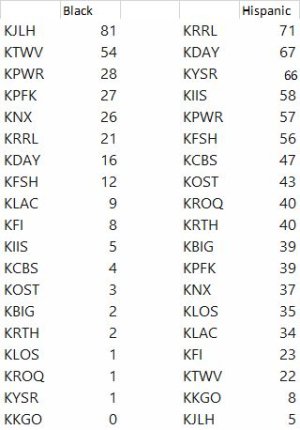
Remember, I left out lots of stations, including just those that had interesting data to see. For example, all the Spanish language stations get 95% Hispanic listening or more (the small non-Hispanic portion is due to either "mixed" ethnic households or PPM detected hearing of a Spanish language station at work or in a store).Here is the same information ranked by number, rather than by call letters.....
What I find the most interesting is the low percentage of Black listenership to KPWR and KRRL. Of course, this is mostly due to the market being over 50% Hispanic in the 18 to 39 demos and only about 8% Black.
What I find the most interesting is the low percentage of Black listenership to KPWR and KRRL. Of course, this is mostly due to the market being over 50% Hispanic in the 18 to 39 demos and only about 8% Black.
How do you explain the large percentage of alternative listeners (KROQ and KYSR) who are Hispanic?
How is KYSR so high with the so-called antiquated term Hispanics?
KIIS higher than Power, and real just crushing them in the listening base that made that station legendary.
KRTH and KBIG lower than Jack? Another rock based station, mostly rock, outperforming the stations with more rhythmic product.
I ask for answers from those who are more knowledgeable on this than me, but my best guess is that programming or politics maybe the divided up groups of Americans are not as Monolithic as our bankster masters want us to be.
KIIS higher than Power, and real just crushing them in the listening base that made that station legendary.
KRTH and KBIG lower than Jack? Another rock based station, mostly rock, outperforming the stations with more rhythmic product.
I ask for answers from those who are more knowledgeable on this than me, but my best guess is that programming or politics maybe the divided up groups of Americans are not as Monolithic as our bankster masters want us to be.
Of all races, ethnicities and faiths, of course. (I hope. The notion that a sinister cabal of bankers is seeking to control America -- or even the world -- is often employed as an anti-Semitic dog whistle.)How is KYSR so high with the so-called antiquated term Hispanics?
KIIS higher than Power, and real just crushing them in the listening base that made that station legendary.
KRTH and KBIG lower than Jack? Another rock based station, mostly rock, outperforming the stations with more rhythmic product.
I ask for answers from those who are more knowledgeable on this than me, but my best guess is that programming or politics maybe the divided up groups of Americans are not as Monolithic as our bankster masters want us to be.
The three stations with the lowest non-zero percentages among blacks are the three rock stations. No surprise there.Here is the same information ranked by number, rather than by call letters.....
View attachment 3801
- Status
- This thread has been closed due to inactivity. You can create a new thread to discuss this topic.