• Get involved.
    We want your input!
    Apply for Membership and join the conversations about everything related to broadcasting.

    After we receive your registration, a moderator will review it. After your registration is approved, you will be permitted to post.
    If you use a disposable or false email address, your registration will be rejected.

    After your membership is approved, please take a minute to tell us a little bit about yourself.
    https://www.radiodiscussions.com/forums/introduce-yourself.1088/

    Thanks in advance and have fun!
    RadioDiscussions Administrators

Early Rating Report & A Mystery!

davideduardo

Moderator/Administrator
Staff member
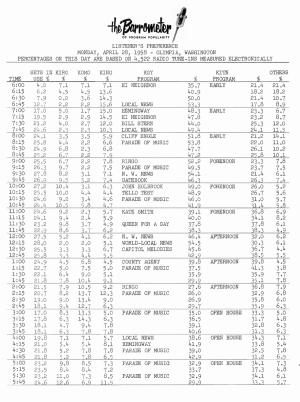
Here is a late 50's rating in what is today the Seattle metro. The interesting thing is that it shows "sets in use" (similar to today's PUR) and it says "measured electronically". Does anyone have any knowledge of this research company?

1671095632043.png
 
Elden Barr created the "Barrometer". These were the days of AM Radio, and relatively few AM stations in a market. Mr. Barr set up a special receiver in his vehicle and could determine how many radio receivers were on each frequency. He would move from location to location, count the blips, and publish the results. My understanding is that it worked fairly well. Someone else may remember exactly how Mr. Barr's equipment worked.
 
Elden Barr created the "Barrometer". These were the days of AM Radio, and relatively few AM stations in a market. Mr. Barr set up a special receiver in his vehicle and could determine how many radio receivers were on each frequency. He would move from location to location, count the blips, and publish the results. My understanding is that it worked fairly well. Someone else may remember exactly how Mr. Barr's equipment worked.
The IF frequency is standardized in a super-het receiver (455 kHz). Before the days of shielding, you could pick up the IF frequency of the local oscillator and figure out what frequency the radio was tuned to.
 
Wow! KING was the king in ratings, but most of us at SS age know this. KIRO had a hot spell in the 80’s with crime coverage, but today the hierarchy is generally pretty close.
 
Additionally I remember my parents watching KING NEWS in 1965. Though I was only six years old I remember this. I may have shared this before, but after the ‘65 Olympia earthquake that was definitely felt in Seattle I distinctly remember KING’s weather man, Bob Cram, (RIP 2017) coming on the air shaking his weather board just for comedy attempt. Not sure all viewers thought it was funny, but Seattle was even quirky enough back then that some probably enjoyed the humor.
 
Last edited:
How did we go from IF frequencies on AM radios to KING TV?
 
Shows the popularity and the power of the local stations, really. KGY and KITN were the only local stations in Olympia at the time. Obviously the Seattle stations had a pretty big reach. I would hazard a guess that after 1963, KJR would have had significant ratings, as rock 'n' roll, surf music, girl groups, and rock 'n' roll began to predominate. I don't know what year KJR had 50-level ratings in Seattle, but I'm fairly sure it reached into Olympia during the day.
 
No, not obsessed, but realize how good this station was compared to the competition. Of course you and I were both employed there. Around the same time, no less.

Love/hate? Ok maybe, but nothing I really care about 40 plus years later. Posting on a post after 40 years is not an obsession, just trying to add good content.
 
Last edited:
. I would hazard a guess that after 1963, KJR would have had significant ratings, as rock 'n' roll, surf music, girl groups, and rock 'n' roll began to predominate. I don't know what year KJR had 50-level ratings in Seattle, but I'm fairly sure it reached into Olympia during the day.
I only have access to 1966 and beyond. In '66, KJR had an 11.4. The highest was a 16.5 in April/May of 1967 By 1970 it was down to an 11.9 in Fall.
 
...back to the original topic...sorta...

The IF frequency is standardized in a super-het receiver (455 kHz). Before the days of shielding, you could pick up the IF frequency of the local oscillator and figure out what frequency the radio was tuned to.
I tried to dig up some additional info on who held the copyright (ELDON CARROL BARR), but it's as if he didn't patent the device or the process as far as I could gather described by @bossbill earlier in the thread.

The device I'm picturing in my head is similar to a spectrum analyzer. Now, how one might discriminate one receiver from the next while cruising down a residential street without assistance would be the trick.

Intriguing...
 
I only have access to 1966 and beyond. In '66, KJR had an 11.4. The highest was a 16.5 in April/May of 1967 By 1970 it was down to an 11.9 in Fall.
The local press mentioned something like 50% of radios tuned to KJR, I think it was during one of the several articles that came out on Pat O' Day during the 80s and 90s. Maybe they were using a different system, or it was exaggerated, or one show only.
 
The local press mentioned something like 50% of radios tuned to KJR, I think it was during one of the several articles that came out on Pat O' Day during the 80s and 90s. Maybe they were using a different system, or it was exaggerated, or one show only.
There were no "single show" ratings back then. Arbitron did a two-month survey with different respondents each week, so for one show the sample was only 12% of the total, and definitely not enough to measure specific weeks or days.

Half the teen audience, maybe. But definitely not half of all listening.
 
KJR was truly dominant in Seattle in the 60’s. Of course that brought on competitors. KOL and KING AM challenged in the early 70’s. But this brutal battle was not for long as Seattle finally was introducing top40 on FM in roughly the early to mid 80’s. A bit late as the topography limited reception. KYYX (Pat O’Day station) was one of the first, but I found it quite uneven. K-plus 101.5 followed and became simply KPLZ. When KUBE arrived in the early 80’s they took over. KPLZ finally beat KUBE in the late 80’s. Both stations eventually modified their formats with KPLZ heading more hot AC with their Star format and KUBE going rhythmic.
 
Oh and by the way threads going off topic is not unusual. I guess if there were thread police I could be be sent to jail. Happily that won’t ever happen. Come on, this is a discussion forum. All opinions are welcome and detours are not penalized, thank God. Those who get riled up by this need to take a big breath and relax.
 
Status
This thread has been closed due to inactivity. You can create a new thread to discuss this topic.


Back
Top Bottom